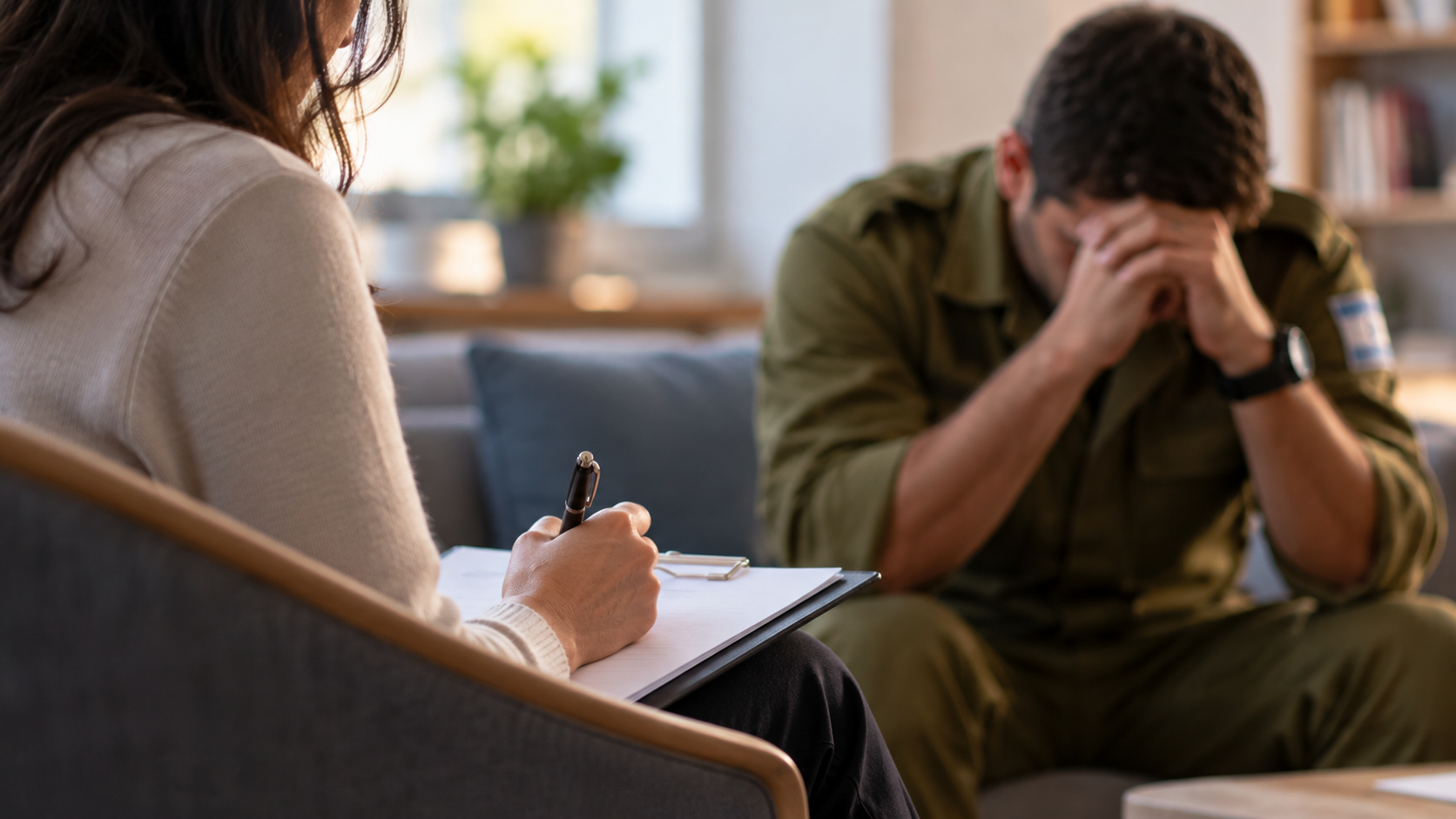
The War Follows Them Home: Israeli Researchers Seek Answers to Lasting Trauma
Three years after October 7, Bar-Ilan University researchers are preparing a long-term study of trauma among former hostages and their families, while colleges seek ways to help students and reservists cope with war’s lasting effects
A Bar-Ilan University research center, described by the university as Israel’s first interdisciplinary initiative devoted to studying the trauma of the October 7 attacks and the ensuing war, is preparing to launch its first major project, focusing on former hostages and their families.
The center is led by Prof. Danny Horesh, Prof. Rivka Tuval-Mashiach, and Dr. Yael Shoval-Zuckerman, all of Bar-Ilan University.
Horesh, who spoke to The Media Line by phone, said the team was awaiting final ethics approval before beginning data collection.
The study will combine psychological and physiological measurements to develop a comprehensive understanding of how captivity has affected former hostages and their families over time, drawing on multiple disciplines and perspectives.
“We know the trauma affects both body and mind,” Horesh said. “It is going to be a unique, long-term study in line with what has been done in previous endeavors in Israel, mostly on former prisoners of war from the Yom Kippur War.”
Horesh added that the center has more than “40 researchers from the entire Bar-Ilan campus who have already shown interest in joining us” and that it will be “a very large project with people from multiple domains.”
Established earlier this year, the center aims to conduct large-scale studies examining the war’s long-term effects on a wide range of populations. These include former hostages and their families, soldiers, evacuees, residents of communities near the Gaza Strip who were present during the October 7 attacks, and people who treated survivors or documented their experiences, including emergency responders and journalists. The research will also examine those who sustained physical injuries during the war.
Beyond these groups, the center will study the general population. Researchers believe that three years of war and upheaval are likely to have lasting mental health consequences for Israelis, including those who were not directly exposed to violence.
Experts from a variety of disciplines are involved, including mental health, biology, neuroscience, medicine, law, data science, and communication. The center will also provide opportunities for students pursuing master’s degrees and doctorates, as well as postdoctoral researchers in trauma-related fields, to conduct research as part of its broader work.
“Bar-Ilan University has always been a major center for trauma researchers,” Horesh said. “There’s a long tradition here of people who have been doing trauma work and trauma research over the years in various faculties and in various domains.”
Horesh explained that researchers across Israel, including at Bar-Ilan, had discussed pooling their resources and developing an interdisciplinary approach to trauma research for years. Those efforts never came to fruition. Now, just after the third anniversary of the October 7 massacre and approximately eight months after the center’s establishment was announced, its first study is finally about to begin.
The idea is to understand the effects of the war and the events of October 7th on all domains possible
“There is a realization that there is a real need to join forces throughout the faculties and the various fields of research and really try to understand the effects of October 7th and the Iron Swords war on various populations,” Horesh said. “The idea is to understand the effects of the war and the events of October 7th on all domains possible: mind, body, society, law, ethics, and any other domain that can be actually studied. … We know that trauma has ripple effects, very, very wide ripple effects, not only psychological, but also biological, physiological, medical, legal, and, of course, sociological.”
The researchers plan to follow participants over an extended period, bringing them back for multiple evaluations. These repeated assessments will allow the team to track how psychological distress develops or changes over time, identify factors associated with vulnerability and resilience, and determine which populations or subgroups are particularly susceptible to long-term difficulties.
Their findings could help medical and mental health professionals understand how trauma affects people at different stages of recovery. Researchers also hope to identify patterns that distinguish those who gradually recover from those who develop persistent symptoms.
The ultimate goal is to use that knowledge to improve treatment, identify trauma-related conditions earlier, and potentially intervene before symptoms become more severe.


Don't Let AI Explain the Middle East
AI noise, algorithmic bias, and misinformation fuel global hate and antisemitism.
Independent journalism is a vital line of defense for democracy.
Without boots on the ground, you can't tell the full story.
The Media Line is on the ground in 12 Middle Eastern countries.

This Holiday Season Invest in Truth.
Make a holiday gift which supports journalism with integrity.
DONATE“Over time we also plan to do intervention studies,” Horesh said.
Jessica Feldan, CEO of American Friends of Bar-Ilan University, said Israeli universities play an important role in the nation’s ongoing recovery.
“Through interdisciplinary research into the long-term psychological and biological effects of trauma, we can develop new and better ways to treat trauma and determine which approaches are most effective for the future,” she told The Media Line. “Healing will take time, sustained commitment, and a community that continues to show up.”
Healing will take time, sustained commitment, and a community that continues to show up
For Horesh, the center’s work must ultimately reach beyond academia and help shape government policy, particularly as Israel struggles to meet the growing mental health needs of its population.
With elections scheduled for October 27, political parties are increasingly discussing proposals to expand and reform Israel’s mental health system. Ideas include establishing a national body to coordinate services and funding, strengthening community-based treatment, and giving local authorities a greater role in supporting residents affected by trauma.
Today, many Israelis seeking mental health assistance, including those who may be entitled to services because of their wartime experiences, encounter gaps between the Health Ministry, National Insurance Institute, and welfare system. Responsibility for treatment, funding, and other forms of assistance can be divided among different agencies, making it difficult for some people to obtain the support they need.
Horesh hopes the center’s research will provide policymakers with the evidence necessary to identify those gaps and develop more effective responses. A clearer understanding of the psychological and physiological consequences of trauma could help authorities determine which services are needed, who should receive them, and how resources should be allocated.
“The more we know about the psychological and physiological distress of these populations, the easier it will become to treat them, to diagnose them, to prevent the stress,” Horesh explained. “When we better know what is needed from the mental health and medical system, then policymakers can change legislation for the better, enhance the rights of these people, and provide compensation. We know today in 2026 we want to change policy. But if you want to change policy, you have to show data.”
For families who have experienced loss during the war, the need for better mental health support is deeply personal.
Tom Wasserstein’s brother, Roi, died by suicide after serving more than 300 days of reserve duty as a combat medic. In a blog published by The Times of Israel, Wasserstein described the “incredibly difficult transition” his brother faced as he moved repeatedly between the battlefield and his studies at Afeka Academic College of Engineering in Tel Aviv.
“Ultimately, my brother was unable to escape the demons of war,” Wasserstein wrote.
Ultimately, my brother was unable to escape the demons of war
After his brother’s death, Wasserstein said he faced a choice: to “sit around in my grief” or find ways to help others like Roi before it was too late.
Working with Afeka, Wasserstein helped establish the Quiet Tent, a dedicated support space for students affected by the war. The initiative offers personal coaching, mind-body workshops, and resilience-building activities for reservists, students, and others struggling with the consequences of the fighting. Other communities have established similar spaces.
The program grew out of conversations between Wasserstein’s family and the college about how to provide meaningful support for students and reservists. It was designed to offer a place where people could seek help, connect with others who had undergone similar experiences, and take time away from the pressures of academic and everyday life.
“We need places that will still be there after the headlines fade and the fighting ends, places where people can come regularly, without stigma, and find the tools, community, and support they need to rebuild their lives,” Wasserstein wrote.
The Quiet Tent opened in June 2026. According to Prof. Yossi Rosenwaks, president of Afeka, the initiative grew out of the recognition that students struggling with the aftermath of war sometimes need more than academic accommodations. They need a safe place to talk, receive emotional support, or simply take a moment for themselves.
The idea, Rosenwaks explained, came from an “understanding that sometimes a student needs a place to pause, to talk, or simply to be. Three years on, creating that space and making sure students know they do not have to navigate these challenges alone remains as important as ever.”
He said that even three years after October 7, healing remains a daily challenge for many students carrying the weight of trauma, loss, and repeated reserve duty. Some have returned to their studies after extended periods of military service, only to find that resuming an academic routine is more difficult than expected.
“As an engineering college, we prepare students to solve complex problems, but the past three years have taught us that we must also understand the complex realities our students bring back with them to campus,” Rosenwaks told The Media Line. “Returning from reserve duty does not necessarily mean returning to routine. Some students need academic flexibility, others need emotional support, or simply someone to listen, and those needs can change over time. Our responsibility is to keep listening and responding, so they can continue their education and move forward. The students returning to our classrooms today are the engineers and technologists who will help rebuild Israel, strengthen its security and resilience, and develop the technologies the country will depend on in the years ahead.”
While initiatives such as the Quiet Tent are already helping Israelis cope with the consequences of war, Horesh hopes the research being conducted at Bar-Ilan will eventually benefit people far beyond Israel’s borders.
Researchers, healthcare professionals, and policymakers around the world are seeking to better understand how societies respond to widespread trauma, he said. With wars continuing elsewhere, soldiers and civilians in other countries face similar psychological challenges, including difficulties returning to ordinary life after prolonged exposure to violence.
We will happily share our findings. There is no reason to believe that things that are working here will not work in other places.
The lessons learned in Israel could help improve how trauma is diagnosed, treated, and managed internationally. By following participants over time and examining both psychological and physiological responses, the center hopes to develop evidence-based approaches that could be applied in different settings, from identifying vulnerable populations to establishing more effective treatment protocols.
“We will happily share our findings,” Horesh said. “There is no reason to believe that things that are working here will not work in other places.”
This report is part of Traumatech, a series developed and created by Maayan Hoffman and debuting on The Media Line. The series explores how Israel is building and exporting breakthrough mental health technologies that can transform life at home and bring hope to communities worldwide.