Author and teacher Thomas Hübl traveled to Rwanda earlier this year to help the country become the first nation to adopt a trauma-informed approach to justice at a national level.
Hübl, who is married to an Israeli and focuses his work on collective trauma, was at ICAR’s (Israel’s Collective Action for Resilience) two-day conference in February. There, he shared part of Rwanda’s effort to move toward reconciliation and societal healing following the 1994 genocide, in which a million people were murdered. He also spoke about how some of those lessons might apply to Israel.
“The Rwandan example is not equal to what happened in Israel, but there are lessons learned that we can apply here,” Hübl said.
The Rwandan example is not equal to what happened in Israel, but there are lessons learned that we can apply here
To understand the weight of that statement, one has to look at what Rwanda endured. During the 100-day genocide, perpetrators carried out widespread sexual violence and torture. The country was left shattered, with victims and aggressors forced to live side by side.
In the years since, Rwanda has sought not only to prosecute crimes but also to rebuild trust and social fabric. Through Hübl’s work with the Global Restoration Institute and in collaboration with African Peace Partners, Rwanda adopted an Alternative Dispute Resolution Policy in 2022. It is the first national policy of any country to call for a trauma-informed approach to justice, centering mediation and restorative justice throughout the legal system.
Earlier this year, Hübl was in Rwanda to help train a group with participants from various ministries, organizations, and NGOs. The goal was to equip them with practical tools to integrate into their areas of work and, in turn, influence society at large. The hope, as Hübl wrote in a related blog post, is that “the incredible pain can be transformed into post-traumatic growth.”
How do we even define trauma and resilience in the first place? The language the world uses to describe trauma has been shifting, the experts said.
“We speak of moral injury, the wound of acting against one’s moral code,” said Dr. Alexandra Klein Rafaeli, director of psychological services at Ben Gurion University in Israel, who moderated the session. “But more recently, the field has moved towards ideas of identity injury, recognizing that trauma not only hurts us, but it can reshape who we understand ourselves to be.”
Trauma not only hurts us, but it can reshape who we understand ourselves to be
She continued, “Similarly, resilience has become the dominant lens through which we interpret trauma recovery. Yet, the word now stretches across vastly different realities, from a child going back to school after a night of sirens to a society living through years of ongoing war … The word ‘resilience’ risks meaning less and perhaps may be evolving.”
Rafaeli questioned whether the term ‘resilience’ had reached a point of “semantic exhaustion” and whether there is a need for a new definition, or even new language, to capture more accurately what societies actually do, or should do, in the wake of multilayered, multigenerational, and collective trauma.
Resilience has become the dominant lens through which we interpret trauma recovery. Yet, the word now stretches across vastly different realities.
She noted that as many as three million out of 10 million Israelis are experiencing some symptoms of trauma. At the same time, she said, Israel can examine how different contexts shape policy and practice in dealing with trauma and can learn from global experience.
Other panelists echoed the tension between language and action.
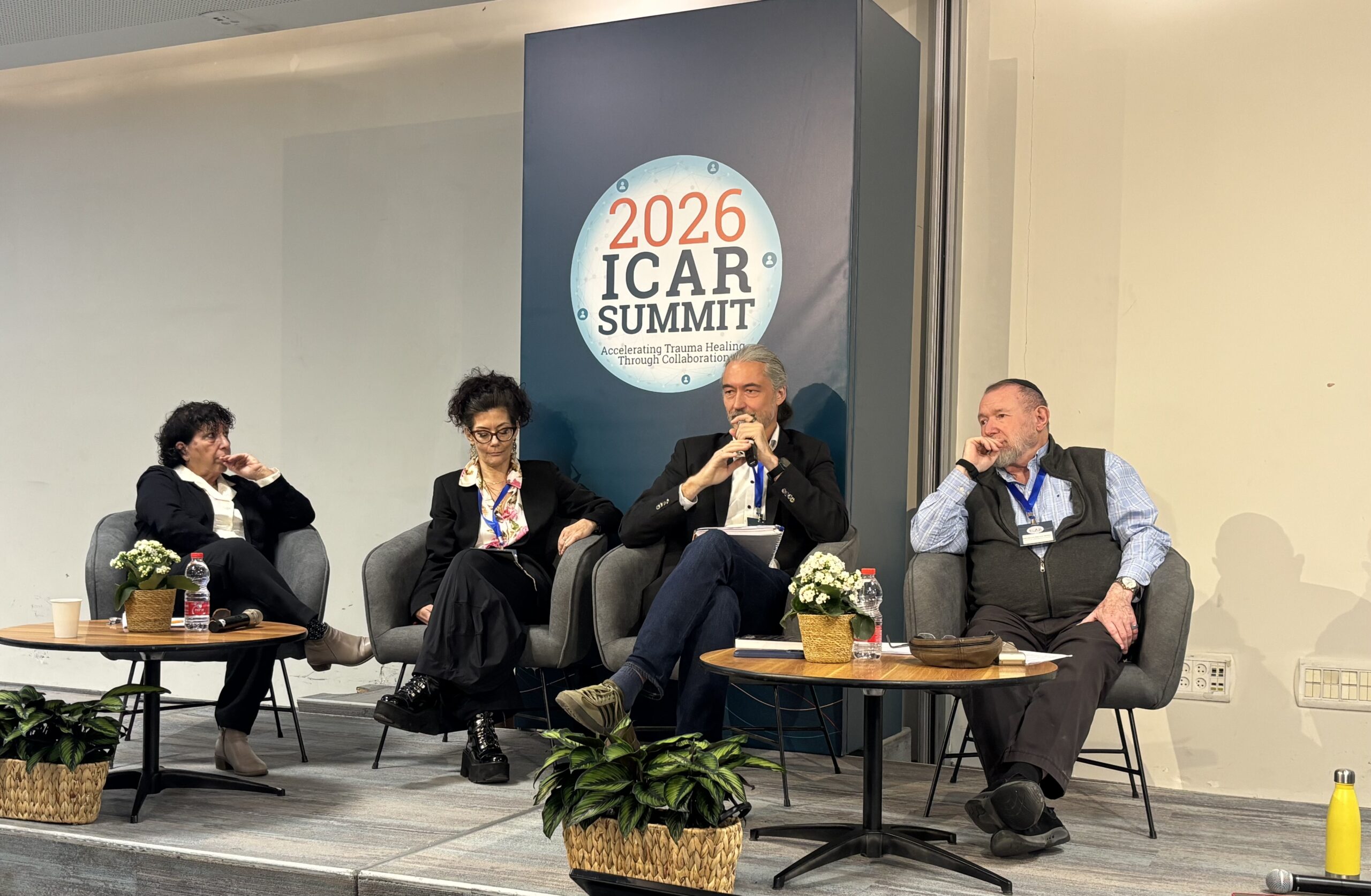 [1]
[1]From left: Tali Levanon, C. Gabrielle Salfati, Thomas Hübl, Dr. Abraham Gerard Meyer at the ICAR Collective Summit. (Maayan Hoffman/The Media Line)
“When speaking about resilience, it has become very clear that it’s become a buzzword, and we’re lumping it together with trauma,” said C. Gabrielle Salfati, a professor of psychology and the director of the Investigative Psychology Research Unit at John Jay College of Criminal Justice. “Whenever we speak about trauma, we speak about resilience.”
But Salfati cautioned that resilience is not meant to treat trauma. Instead, it can help mitigate its impact. She described resilience as a coping skill, something that everybody can learn.
“It’s not something complex,” Salfati said. “You don’t have to be in psychotherapy or in treatment for months and years … Resilience is prevention. It’s about what skills we can give people to make them stronger, so that when they are in a difficult situation, anything from daily life to extreme trauma, they use those skills to mitigate the impact of that trauma.”
Give the gift of hope
We practice what we preach:
accurate, fearless journalism. But we can't do it alone.
- On the ground in Gaza, Syria, Israel, Egypt, Pakistan, and more
- Our program trained more than 100 journalists
- Calling out fake news and reporting real facts
- On the ground in Gaza, Syria, Israel, Egypt, Pakistan, and more
- Our program trained more than 100 journalists
- Calling out fake news and reporting real facts
Join us.
Support The Media Line. Save democracy.
In her view, resilience should be understood primarily as a prevention strategy rather than a treatment strategy. From there, the question becomes how to equip society with resilience skills. She also stressed the importance of identifying who truly lacks resilience and is therefore in more acute need of treatment after trauma or while living in a traumatic situation.
When you go to a battlefield, you look at who is injured, and you do triage. I think we need to do the same thing with psychology.
“When you go to a battlefield, you look at who is injured, and you do triage. I think we need to do the same thing with psychology,” Salfati said. “You approach people, and you do a psychological triage of who actually is in that moment of extreme trauma, and they need that psychologist.”
Not everyone needs to go into treatment, she added. That distinction is critical given the vast deficit of trauma-informed clinicians available in Israel and around the world. Salfati said that giving people the power back, helping them believe in themselves and their ability to heal, can in many cases be more healing than anything else.
If Salfati focused on prevention and triage, Hübl returned the conversation to systems.
Hübl said that over the last 20 years, he and his team have been working on the concept of collective trauma. Sometimes, collective trauma is defined as a historical layer of impact on a society. Hübl believes it is far more expansive. In his view, collective trauma is not limited to a specific moment in time. It is a long-standing systemic process, ingrained in how people experience their lives and relate to one another.
He acknowledged that individuals are impacted differently by trauma, from their DNA to their subjective experience of a situation. Still, he believes that for many people, the most effective treatment models are “healing collectives” that operate as a systemic, interdependent process rather than a purely individual one. Rwanda, he said, offers an example of that approach in action.
“I think resilience is a combination of the individual capacity to stay related to one’s agency, the individual capacity to stay related to the challenge, and the intersubjective, or interdependent capacity of a system to face a challenge together, like to stay related to the collective challenge,” Hübl explained.
That systemic lens, he suggested, is particularly relevant in Israel. He noted that the events of October 7 were not the first trauma the country has faced. Processes that unfolded before and after that day also influenced how the country responded to the massacre.
“Resilience is a fluidity and maturation, and as a systemic capacity to stay related to challenges,” Hübl said. “Treatment models need to include more collective power. I see in our healing collectives that we work with around the world that these collective spaces, together with individual highly trained therapists, have a lot of power, and you can train individual competence building and collective competence building together.”
Treatment models need to include more collective power
Given the scale of trauma in Israel and the difficulty of directing the right treatment to the right person at the right time, Hübl argued that integrating stronger collective responses could make care more efficient and more accessible.
Others on the panel framed resilience not only as a system, but as a mindset.
Another speaker, Tali Levanon of the Israel Trauma Coalition, said that resilience means not only being strong, but “holding your vulnerability and the understanding that you will be able to cope together.”
She challenged the common idea that resilience is about “bouncing back.” Instead, she described it as “bouncing forward with the experience” and understanding what a traumatic event did to the individual, the family, and the community.
“I am part of a bigger thing in life,” Levanon said, explaining that those who suffer from trauma should consider how the experience can help not only them move forward, but also society as a whole.
In her view, that requires shared structure and shared learning.
“I think we should invest a lot in creating a framework within which we all work, learning from each other,” Levanon said.
As an example, she pointed to the Israel Resilience Center model, a community-based, proactive psychosocial support system designed in 2005 to treat trauma and build resilience among civilians living under ongoing security threats. Today, these centers operate throughout the country, and the model has been exported to places such as Ukraine and France, which have faced their own forms of collective trauma.
Levanon also emphasized that trauma care should not be confused with mental health care. While some clients may need both, she said, the approaches and treatments are not the same.
Dr. Abraham Gerard Meyer, CEO and co-founder of the Mental Wellness Society, extended that argument, pushing back against the idea that resilience is about returning to a previous state.
“Resilience is not to make you back to what you were, because what you were was already deficient, because you were made in a way where you were susceptible to trauma,” Meyer said. “So we need to rebuild you better than before.”
In practice, he said, that means looking beyond the traumatic event itself. When treating someone who has undergone trauma, a provider should consider how the person has functioned throughout their life and then take a forward-looking, solution-oriented approach rather than focusing solely on the traumatic experience.
Meyer also argued that trauma must be understood within a broader global context. He described the current era as one of “VUCA,” an acronym for vulnerability, uncertainty, complexity, and ambiguity. In such an environment, he said, it is too simplistic to view individuals as sick or inherently mentally ill. Often, he suggested, the system itself is broken and needs repair so people can live healthier lives.
All of this comes at a moment when Israel is speaking more openly than ever about trauma.
In Israel, the words “resilience” and “trauma” have become part of the mainstream conversation after more than 75 years of statehood. October 7 accelerated that shift.
Salfati noted that in the United States, the mental health crisis reached a peak over the last decade, with suicide levels rising and a widely recognized “burnout crisis.” People began speaking more openly about stress and trauma, and many left their jobs in large numbers.
She said similar patterns are now emerging in other Western countries. In some cases, the trend began with COVID or was at least brought to the surface more clearly by the pandemic.
Israel, she suggested, can learn from the American experience, especially in integrating programs locally and ensuring that treatment is delivered with cultural context in mind.
At the same time, she emphasized that programs must be full circle to have a real impact. It is not enough to deliver treatment or training to individuals and societies and then move on.
We need to deliver training in a way that makes the ground underneath people’s feet move
“We need to deliver training in a way that makes the ground underneath people’s feet move,” Salfati said.
She stressed that teaching skills alone is insufficient. Those skills must be reinforced for months afterward, with guidance on integrating them into daily life.
“We can train people on things, but if they don’t use it, then it doesn’t really matter,” she said.
Salfati’s message centered on continuity. Build resilience by delivering training, testing it before implementation, following up for months afterward, and then measuring its impact once people begin using those tools.
Only when “all of the pieces of the bridge” are in place, she said, will individuals and societies drowning in trauma “get to the shore.”
This report is part of Traumatech, a series developed and created by Maayan Hoffman and debuting on The Media Line. The series explores how Israel is building and exporting breakthrough mental health technologies that can transform life at home and bring hope to communities worldwide.