Felice Friedson and Gabriel Colodro take readers and viewers inside one of the least glamorous and most vital fronts of Israel’s war effort: the men and women of Magen David Adom [1] who move toward the blast site when everyone else is running for cover.
Their report shows how Israel’s national emergency medical service has built itself for exactly this kind of moment. When Iranian missiles and drones struck cities during the June 2025 war, Magen David Adom, or MDA, had to do more than dispatch ambulances. It had to function under fire, coordinate nationwide in real time, train responders for chaos, and keep the country’s blood supply alive even if missiles landed nearby.
Give the gift of hope
We practice what we preach:
accurate, fearless journalism. But we can't do it alone.
- On the ground in Gaza, Syria, Israel, Egypt, Pakistan, and more
- Our program trained more than 100 journalists
- Calling out fake news and reporting real facts
- On the ground in Gaza, Syria, Israel, Egypt, Pakistan, and more
- Our program trained more than 100 journalists
- Calling out fake news and reporting real facts
Join us.
Support The Media Line. Save democracy.
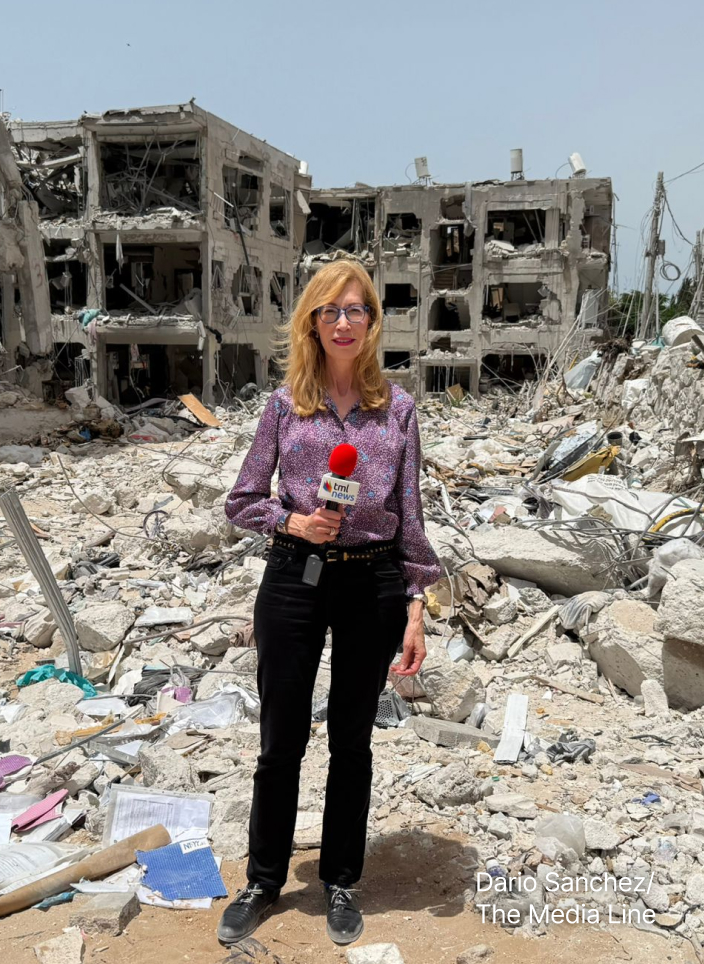

The story’s most gripping scenes come from Bat Yam, where a ballistic missile tore into a residential neighborhood. Paramedics arrived before they even knew the precise address, working through shattered buildings, wounded residents, and the constant fear of a second strike. The damage spread far beyond the impact point, with casualties coming from across the surrounding blocks. This was not just emergency medicine. It was triage in a war zone, carried out in apartment courtyards and broken streets.
Friedson and Colodro also pull back the curtain on the system behind the sirens. At MDA headquarters in Ramla, dispatchers track incoming alerts and direct crews across the country. Trainees work in a hydraulic ambulance simulator and mixed-reality scenarios designed to mimic the noise, confusion, and stress of real disasters. Down below sits one of Israel’s most strategic assets: an underground, fortified national blood bank built to keep operating even during missile attacks. Once the war began, MDA raced to expand blood reserves, collecting and processing donations in protected locations.
Just as striking is the scale of the human network behind it all. With 39,000 personnel, about 90% of them volunteers, MDA reaches into cities, towns, and villages across the country. The result is a civilian-based emergency force that does not wait for perfect conditions. It responds in real time, often with local people helping their own communities first.
Felice Friedson and Gabriel Colodro tell a story that is about technology, training, and logistics, but also something older: duty under pressure. Read the full article [1] and watch the video report [5]. Together, they show what wartime medicine looks like when the siren sounds and the medics run toward the danger.