Maayan Hoffman’s report [1] tells a very Israeli story: the sirens sound, the missiles fall, and somebody figures out how to build something life-saving at absurd speed. In this case, that something is Lion’s Shield, a fully fortified rehabilitation and geriatric hospital in Rishon LeZion that Clalit Health Services opened just one week after the war began on February 28.
The urgency was obvious. For many patients recovering from strokes, surgeries, or other severe injuries, Israel’s standard 90-second dash to shelter is not a dash at all. It is a logistical nightmare. Wheelchairs, rolling beds, immobility, frailty, panic—none of that fits neatly into a stopwatch. Sara Nisri, whose husband Meir is recovering from a stroke, described the relief in plain terms: in the new facility, patients no longer need to be rushed out with every siren. That alone changes everything.
Give the gift of hope
We practice what we preach:
accurate, fearless journalism. But we can't do it alone.
- On the ground in Gaza, Syria, Israel, Egypt, Pakistan, and more
- Our program trained more than 100 journalists
- Calling out fake news and reporting real facts
- On the ground in Gaza, Syria, Israel, Egypt, Pakistan, and more
- Our program trained more than 100 journalists
- Calling out fake news and reporting real facts
Join us.
Support The Media Line. Save democracy.
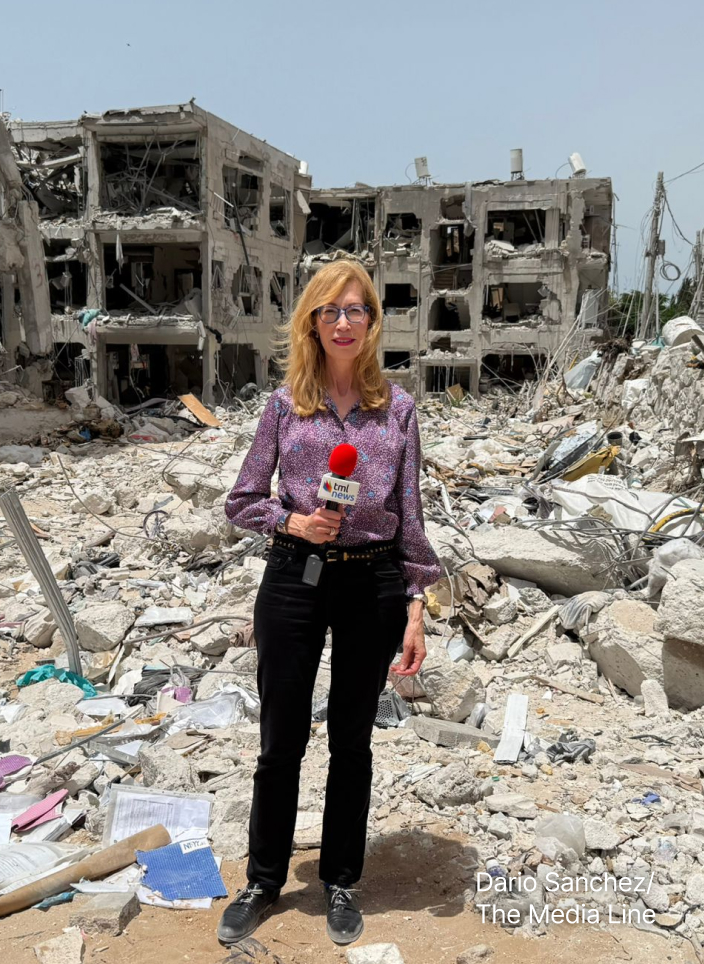
Hoffman shows how the project came together through a blend of improvisation, discipline, and sheer nerve. Dr. Mira Maram, deputy director general at Clalit Health Services and head of its hospitals division, led the push. Staff and equipment were pulled from three separate hospitals. Patients were transferred. Engineering, logistics, IT, and operations teams were mobilized. About 250 staff members now run the site, which can hold more than 200 patients. The building itself had originally been intended as an assisted-living facility, but half of it was swiftly repurposed under an agreement signed the night the war began.
The result is more than a clever wartime workaround. It is a rare medical space where vulnerable patients can remain in protected rooms rather than being dragged into stairwells or makeshift shelters when alarms go off. Doctors who doubted the plan now speak with pride. Patients speak with gratitude. And one patient, 36-year-old Liora Matatov, put it in larger national terms: this is what Israel does—reinvents itself under pressure because survival leaves little room for dithering.
Hoffman captures both the practical feat and the human stakes. Read the full article [1] for the details, because this one is about more than a hospital. It is about a country improvising under fire and refusing to leave its weakest patients exposed.