
Women ‘Disappear’ as They Move Up the Academic Ladder in the Sciences
On the International Day of Women and Girls in Science, senior Israeli researchers describe how structural barriers, institutional responses, and moments of national crisis shape who advances and who quietly disappears from scientific caree
In Israel’s leading research institutions, women enter science in significant numbers, particularly in fields such as biology and chemistry. Yet as academic careers advance—from master’s degrees to doctoral studies, from postdoctoral research to faculty appointments—the presence of women declines. At some institutions, women make up about 50% of doctoral students, even as representation at the faculty level can fall to around 15%, according to senior academics in interviews with The Media Line. What remains in question is not whether the problem exists, but where responsibility lies and which interventions actually change outcomes.
Observed each year on February 11, the International Day of Women and Girls in Science brings renewed focus to a familiar reality inside Israeli academia. Across interviews with senior scientists, the same bottlenecks recur—mobility, uncertainty, and constant output colliding with personal responsibilities and gradually narrowing the path forward. Researchers pointed to a data-backed pattern: Women are well represented at early stages but far less visible as academic careers progress.
At the Weizmann Institute of Science, Prof. Idit Shachar, a researcher and head of the Office for the Advancement of Women in Science, has spent years addressing those dynamics from within the system. Speaking with The Media Line, Shachar said the challenge for women in science rarely lies at the point of entry. “We have around 50% women Ph.D. students,” she said, emphasizing that the institute draws highly qualified candidates across scientific fields. “They are very good. Many of them could be academic scholars.”
We have around 50% women Ph.D. students
Shachar said many reconsider later, when the path toward an academic position requires an extended postdoctoral stay abroad. In Israel, as in many research systems, overseas postdoctoral experience remains a near prerequisite for faculty recruitment, often treated as proof of independence, network-building, and access to top labs and mentorship. “In order to become an academic staff member, you need to go abroad,” Shachar said. “For women, it is sometimes very difficult to decide to take the family and go.”
For women, it is sometimes very difficult to decide to take the family and go
She framed the dilemma not as an abstract cultural issue but as a recurring, practical calculation. “For men, on average, it is much easier to say to the spouse, ‘I need this for my career,’ so we go. For women, she starts to think that the career of my spouse is on me, the children are on me, and that she is going to ruin their lives because of her decision.” As a result, she said, many highly capable researchers choose not to take the risk—not because they lack ambition, but because the personal cost appears too high.
Those pressures became sharply visible in recent months when Shachar’s laboratory was destroyed during an Iranian missile attack on June 15, 2025. The physical loss, she recalled, was overwhelming but not the most difficult aspect of the event. “Everything was ruined. All the machines, all the things that we built for years,” she said. Yet the deeper concern was how the destruction would affect her students—an all-female research group in the middle of their doctoral work. “They were in the middle of their Ph.D. careers. The question was how to calm them down and make them feel there is a future.”
Give the gift of hope
We practice what we preach:
accurate, fearless journalism. But we can't do it alone.
- On the ground in Gaza, Syria, Israel, Egypt, Pakistan, and more
- Our program trained more than 100 journalists
- Calling out fake news and reporting real facts
- On the ground in Gaza, Syria, Israel, Egypt, Pakistan, and more
- Our program trained more than 100 journalists
- Calling out fake news and reporting real facts
Join us.
Support The Media Line. Save democracy.
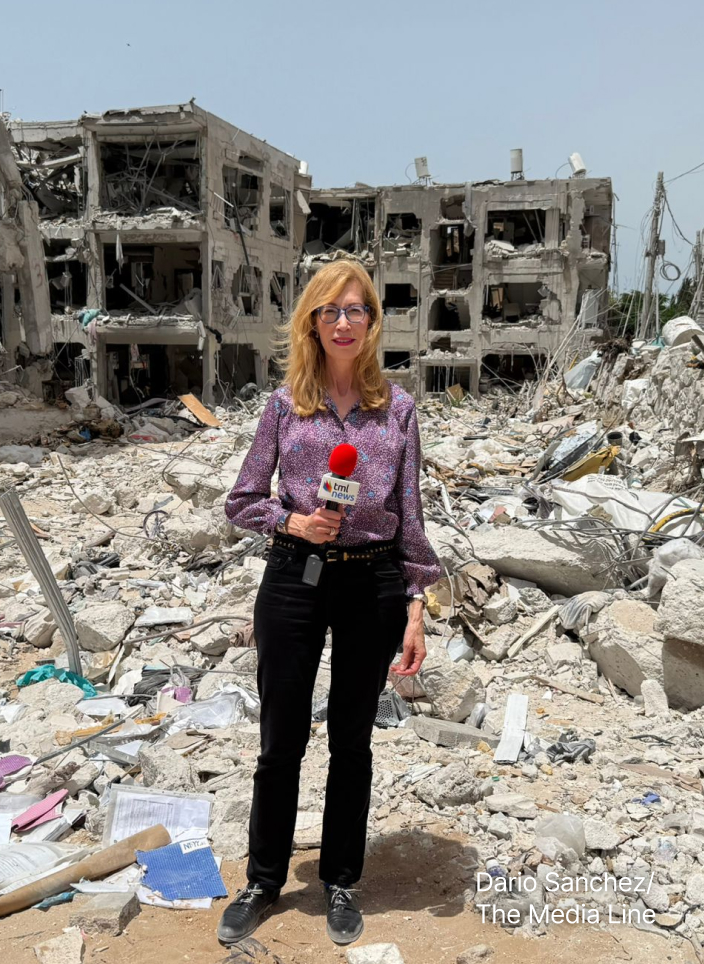
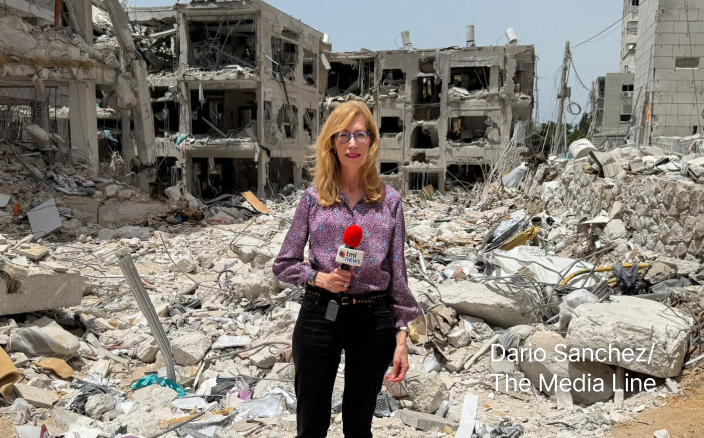

Prof. Idit Shachar is interviewed in front of a destroyed building on the campus of the Weizmann Institute in Rehovot, Israel. (Courtesy Idit Shachar)
Relocated to a temporary space, the lab has resumed work, but the episode exposed a broader vulnerability. Scientific careers that already depend on fragile timelines can fracture entirely when crisis strikes, especially in fields where experiments cannot easily be paused and restarted. Shachar said that in the weeks that followed, simply returning to scientific thinking was a challenge. Writing grant proposals, planning experiments, and rebuilding infrastructure required a level of mental focus that had been abruptly disrupted. “At the beginning, I couldn’t think about science at all,” she said. “It took time to feel that we could go back to something stable.”
At Tel Aviv University, Prof. Tova Milo, a computer scientist and dean of the Faculty of Exact Sciences, approaches the same issue from a data-driven perspective. Speaking with The Media Line, Milo said women’s representation steadily declines as academic careers advance, explaining that “they disappear when you go up to a master’s degree and Ph.D. degree,” with numbers falling to 20% and reaching “only 15%” at the faculty level.
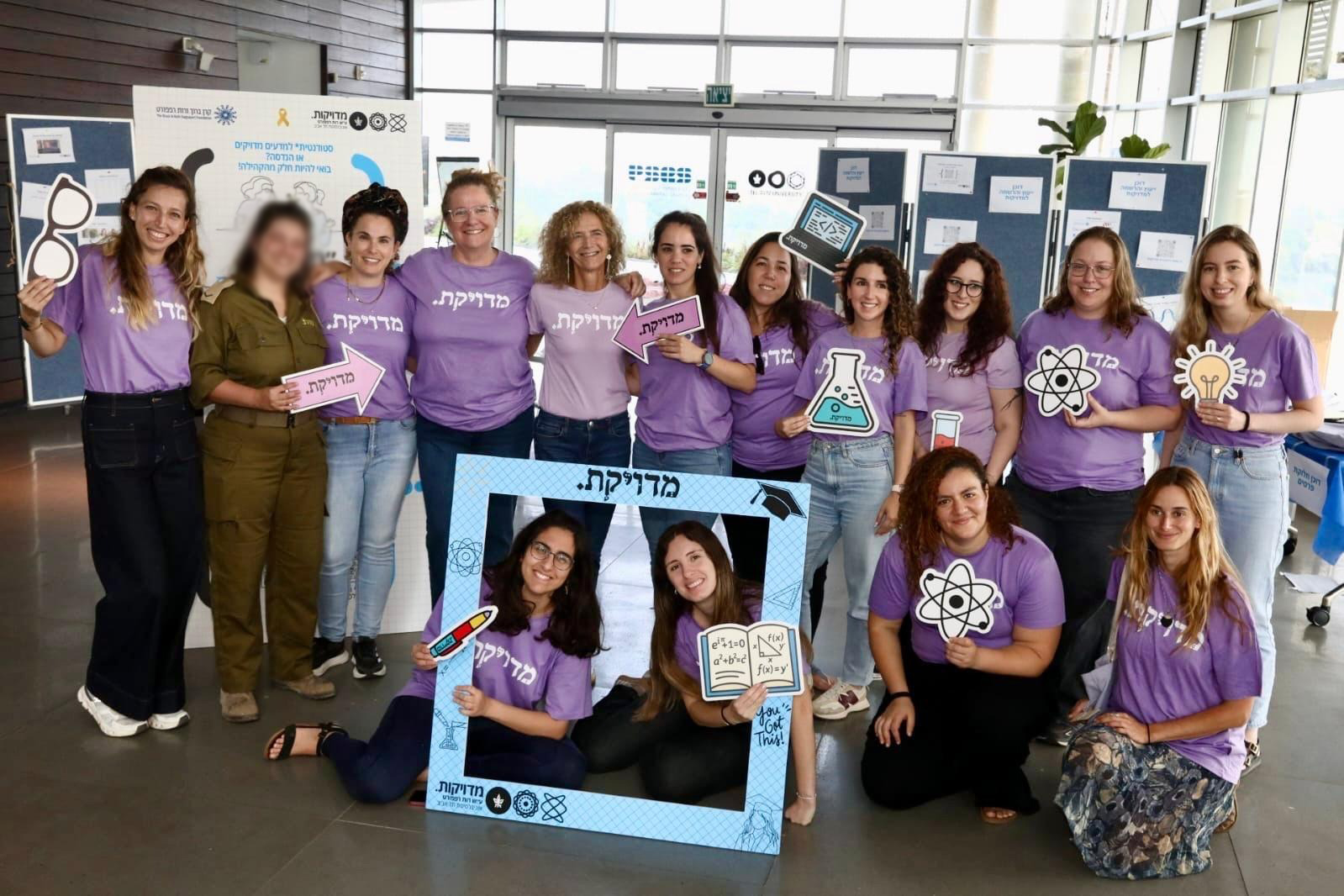
Prof. Tova Milo (C) with ExactShe program. (Courtesy Tel Aviv University)
After assuming her position, Milo consulted colleagues whose research focuses on career trajectories and organizational behavior. Drawing on research in career trajectories and organizational behavior, Milo said women leave not because they fail academically, but because they struggle to see themselves as belonging in the field and because they struggle to picture what the next step looks like. “They don’t feel that this is their area, even though they study, they have degrees, and they have great grades,” Milo explained. “They don’t see another female like them doing the path.”
With the support of the Baruch and Ruth Rappaport Foundation, that insight shaped the creation of ExactShe, a faculty-wide mentoring program designed to intervene at multiple stages of the academic pipeline. Rather than relying on distant role models, the program is structured around proximity and continuity. Faculty members mentor Ph.D. students, who mentor master’s students, who in turn mentor undergraduates. “Every student sees someone who was in her shoes just a little time ago and managed to move one step forward,” Milo said. “She can imitate her and learn from her.”
Since the program started, the percentage of recruitment of female faculty increased from 15% to 25%
Since starting in the Faculty of Exact Sciences, the program has expanded to engineering and is now being piloted in the Faculty of Management. Participation has grown from 200 students in its first year to more than 500 today. Milo pointed to hiring figures, which she said changed after the program’s launch. “Since the program started, the percentage of recruitment of female faculty increased from 15% to 25%,” she said.
One lesson stands out for Milo: Structural change requires sustained institutional commitment. “If you want to fix something, you have to be willing to pay for it,” she said, explaining that mentorship, coordination, and continuity demand time and resources. That can mean dedicated program staff, formal time allocation for mentors, steady funding for coordination, and practical support that keeps early-career researchers from slipping out during predictable life-stage crunches. “These things do not happen by magic.”
A longer view of the same system emerges from Silvia Schuster, M.Sc., a senior scientist at Tel Aviv University with decades of work in plant sciences and food security. Speaking with The Media Line, Schuster said the gap between women at the student level and women in senior academic positions has persisted throughout her career. “There are many women at the master’s and Ph.D. levels, but when you reach faculty positions, the numbers drop sharply,” she said. “It is not close to 50% anymore.”
Schuster rejected the idea that the gap reflects a lack of progress. “Officially, things have improved today,” she acknowledged. “But unofficially, the burden of childcare still falls much more heavily on women.” She pointed to the nature of experimental science as a structural obstacle. “A Ph.D. in biology is not something you can do from home,” she said. “Experiments require constant physical presence in the lab, and interruptions are not easily absorbed by the system.”
Like Shachar, Schuster emphasized the central role of postdoctoral mobility in shaping academic outcomes. In Israel, she explained, spending four or five years abroad at a leading institution is often a prerequisite for obtaining a faculty position, even as that expectation collides with the years when many researchers are building families and setting financial footing. “For many women, this requirement coincides with the stage of life when they are building a family,” she said. “That makes mobility extremely difficult.”
Schuster said the system recognizes the problem without fully accommodating it. “Formally, there is much more awareness today,” she said. “But the system itself has not changed enough to truly accommodate women who are raising families while pursuing demanding scientific careers.” Cultural factors compound the challenge, she added, pointing to the way military service and the broader rhythms of Israeli life shape networks, timing, and expectations across professions. “Israeli society is still deeply masculine and militarized,” she added. “These dynamics inevitably shape academic life.”
Across institutions and disciplines, the three scientists converge on the same conclusion: The loss of women from science is rarely abrupt or dramatic. It builds at specific moments, when decisions about mobility, stability, and time begin to outweigh academic promise. What several Israeli institutions have learned—often through trial and error—is that intervention matters most when it is timed to those moments and sustained long after the initial commitment is announced.
No simple takeaway emerges from the Israeli case. The problem has been mapped, and partial solutions are already in motion. The challenge, as several of the scientists describe it, is not starting new initiatives but sustaining them—especially through the postdoctoral bottleneck, where career rules collide with real life. Staying involved long enough, they suggest, may matter more than announcing the next solution.
