Foreign Workers Replace Palestinian Labor in Israel, Face Hurdles
Restructuring of work permits and recruitment policies is reshaping construction, agriculture, and services while raising concerns about long-term economic and social effects
After more than two years of war, Israel’s labor market is feeling the consequences, undergoing a striking transformation as longstanding employment patterns are reshaped by new policies, security developments, and shifting economic needs.
One result of the war has been a sharp reduction in the number of Palestinian laborers permitted to enter Israel. Previously, hundreds of thousands of Palestinians were allowed to work in Israel. That figure has fallen as Israel cites major security concerns and a push to wean itself from reliance on Palestinian workers.
In response, authorities have expanded the entry of foreign workers, altering the composition of the workforce.
For decades, Palestinian workers—mainly from areas in the West Bank controlled by the Palestinian Authority (PA), but also from Gaza—filled a large share of low-paid jobs in agriculture and construction. They worked through permits allocated and issued by Israel’s Population and Immigration Authority (PIBA) and by the Coordinator of Government Activities in the Territories, the military unit responsible for implementing the government’s civilian and humanitarian efforts in the territories.
According to Kav LaOved, a nongovernmental organization focused on protecting workers’ rights in Israel, roughly 100,000 Palestinians were employed in Israel. Since October 2023, the entry of Palestinian workers has been cut to about 8,000, driven by heightened security restrictions and political tensions that have disrupted the labor market and major sectors such as construction.
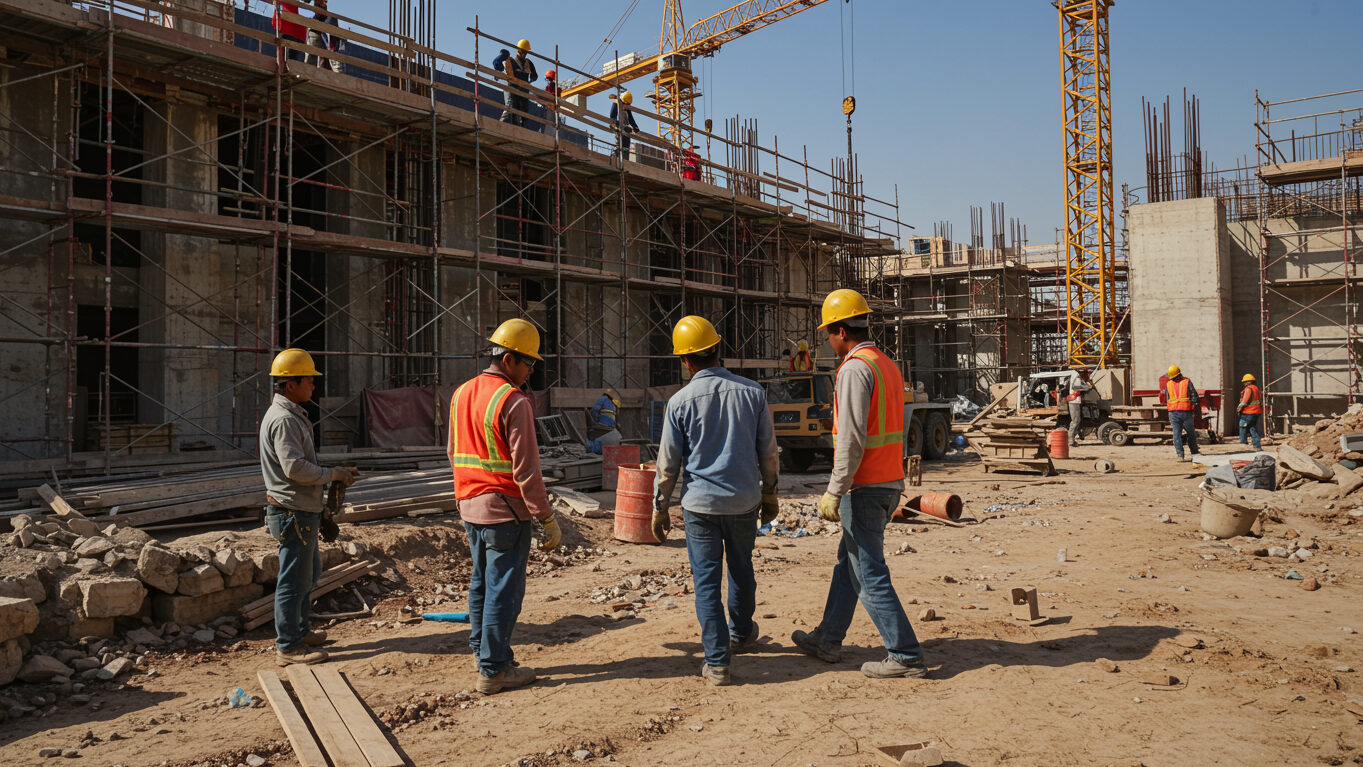
Data published by PIBA last week showed that almost 61,000 new work permits were issued to foreign workers in 2025 in an attempt to fill the widening labor gap, bringing the total number of foreign workers to 227,044. This new migrant workforce is employed not only in construction and agriculture—the traditional sectors of non-Israeli labor—but also increasingly in caregiving, trade, services, and renovation, roles previously held by Palestinian workers.
Israelis have long been reluctant to fill many of these positions. Part of that reluctance stems from the high cost of living and the preference among many Israelis for higher-paying jobs over lower-paid occupations in sectors now staffed by foreign workers.
A government decision in May 2024 sought to increase the number of foreign workers, raising the quota to 3.3% of the country’s population. For now, a shortfall of 100,000 workers remains.
According to Moshe Nakash, director of the Foreign Workers Administration at PIBA, that quota could still rise.
There are large numbers of workers coming into Israel in an effort to fill the different quotas of each sector
“There are large numbers of workers coming into Israel in an effort to fill the different quotas of each sector,” Nakash told The Media Line. “This is part of a great effort on our part to close the gap.”
The recalibration of the workforce has been most acute in sectors heavily reliant on manual labor. Construction firms, already grappling with staffing shortages, are taking advantage of the influx of foreign workers. At the same time, restaurants and manufacturing have begun tapping into foreign labor quotas.
Give the gift of hope
We practice what we preach:
accurate, fearless journalism. But we can't do it alone.
- On the ground in Gaza, Syria, Israel, Egypt, Pakistan, and more
- Our program trained more than 100 journalists
- Calling out fake news and reporting real facts
- On the ground in Gaza, Syria, Israel, Egypt, Pakistan, and more
- Our program trained more than 100 journalists
- Calling out fake news and reporting real facts
Join us.
Support The Media Line. Save democracy.
But while foreign labor alleviates immediate staffing shortages, it also adds complexity to wage dynamics and labor-rights enforcement in a market still reeling from conflict-related disruptions.
What we are seeing is no less than a structural change of the labor market, and decision makers must understand the meaning of this
“What we are seeing is no less than a structural change of the labor market, and decision makers must understand the meaning of this,” Dror Litvak, CEO of ManpowerGroup Israel, told The Media Line. “This is not some temporary event and could eventually lead to a rise in unemployment amongst Israelis.”
Unemployment in Israel currently stands at 2.9%, according to figures published by the Bank of Israel.
Litvak noted: “If someone thinks that unemployment will remain low, they are mistaken. Foreigners are already occupying positions previously occupied by Israelis.”
Hamas’ surprise attack and the subsequent war shook Israel to its core. In the labor market, that upheaval left decision makers and employers scrambling for solutions. One key response has been not only to increase the number of foreign workers admitted into the country, but also to expand the sectors in which they are permitted to work.
“Decision makers are not looking at the long term, and they are trying to put the fires out,” said Litvak. “This will create a completely different reality.”
Litvak does not see Palestinian laborers being allowed back into Israel in the coming decade.
For Palestinian workers, their families, and the Palestinian economy, this is a major blow.
“This is creating a major financial and social crisis that is politically motivated and not based on clear-cut security reasons,” Shai Grunberg, a spokesperson for Gisha, an Israeli NGO that focuses on freedom of movement for Palestinians, told The Media Line.
Even before the war, the far-right Israeli government pushed to adopt policies that would sever ties with the PA. The outbreak of the war only intensified those calls.
Some Israeli security officials have called for Palestinian work permits to be reinstated to prevent a major crisis in the PA. The government has not acted on those calls.
For now, workers from Thailand and Sri Lanka are stocking supermarket shelves and cleaning the streets. Employers say they are satisfied with the new labor supply.
Litvak also raised concerns about the employment conditions of the new workers.
Israel is at risk of creating a slave market rather than a job market
“Israel is at risk of creating a slave market rather than a job market,” he said. “The conditions that some of the workers live in are worse than Israeli prisoners, and in the end, this will create even greater problems.”
In a separate move that has alarmed international aid agencies and the United Nations, Israel has begun a sweeping regulatory overhaul that would drastically affect the work of foreign humanitarian NGOs in Gaza and the West Bank. Under new rules enforced from the beginning of 2026, more than 30 organizations face license suspension unless they comply with stringent transparency and registration requirements, including detailed disclosure of Palestinian staff and funding sources.
Israel will no longer allow NGOs to bring supplies into Gaza or send international staffers into the war-torn territory.
“The most acute consequence will be to the ability of the civilian population in Gaza to survive,” said Grunberg. “Since the beginning of the war, Israel has hindered the work of the NGOs, and this new mechanism, with its disproportionate and draconian measures, will deal a severe blow to essential health services in Gaza.”
Proponents within the Israeli government maintain that the measures are needed to prevent exploitation of aid by Palestinian terrorist groups.
Citing security concerns, the government is determined to implement the policy despite international condemnation. Coupled with tighter control of Palestinian movement and the drastic reduction in Palestinian laborers, Israel appears to be seeking to sever as many connections as possible to Palestinians and the PA.
“These are different expressions of the same political rationale by which further control over Palestinians and their movements has a greater impact on the civilian population in the West Bank and Gaza,” said Grunberg. “This is a policy that is intended to bring about the falling apart of the fabric of Palestinian life.”
The reality emerging is not merely a wartime adjustment, but what appears to be a fundamental shift in Israel’s labor market. The rapid replacement of Palestinian workers with foreign labor, alongside tighter restrictions on humanitarian actors, reflects a policy of breaking away from dependence on Palestinian labor, with far-reaching consequences. While these measures may ease immediate economic pressures, they risk creating new vulnerabilities—straining labor standards, deepening the crisis in an already struggling Palestinian economy, and potentially fueling greater instability over time.
