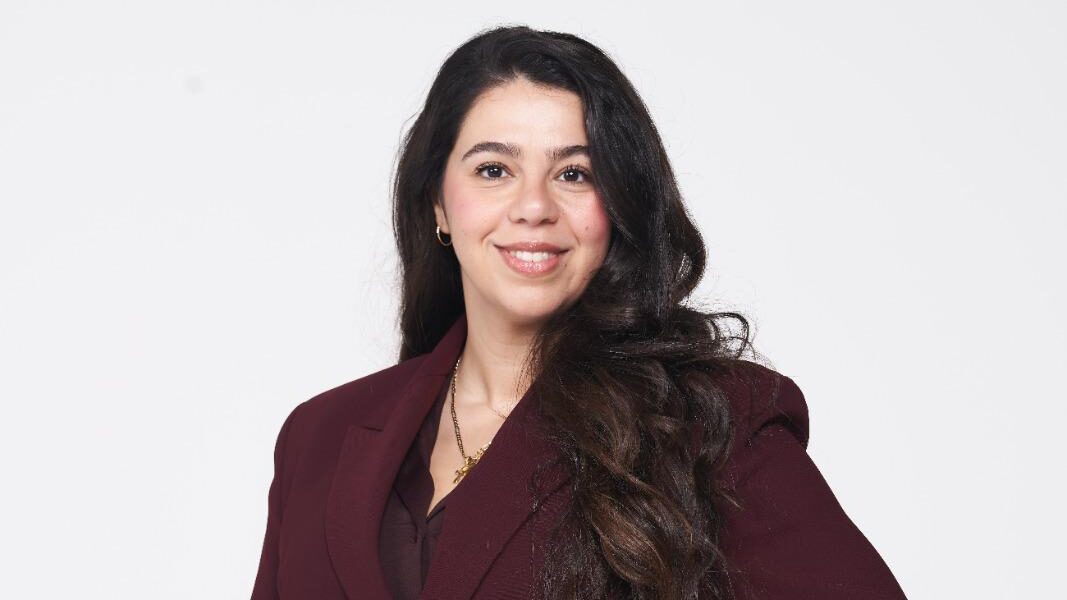
Lebanese Christian in Israel Dreams of Becoming First Ambassador to Lebanon
Maryam Younnes told TML: “I believe that we are toward the elimination of Hezbollah in Lebanon.”
While drone sirens sound nearly every hour across Israel and the country continues striking Hezbollah targets in southern Lebanon, Maryam Younnes is imagining a very different future.
Her dream is to one day serve as the first Israeli ambassador to Lebanon.
“I believe that we are toward elimination of Hezbollah in Lebanon,” Younnes, a Lebanese Christian whose father was a former South Lebanon Army commander, told a group gathered on the Aish World Center rooftop in the Old City of Jerusalem just days before the latest round of fighting began. Her family fled to Israel in 2000 following Israel’s withdrawal from southern Lebanon.
My biggest dream is to be the first ambassador to Israel in Lebanon. But until then, I am like an Arabic spokesperson for Israel.
“I believe that in a couple of years, we will have a peace agreement with Lebanon,” she continued. “My biggest dream is to be the first ambassador to Israel in Lebanon. But until then, I am like an Arabic spokesperson for Israel.”
Younnes has built a large following on social media, including more than 35,000 followers on Instagram. She is also active in the podcasting space, where she speaks Arabic and advocates for peace in the Middle East. Through her content, she shares cultural, religious, and technology updates from Israel with the Arab world, highlighting what she calls “all the amazing stuff happening here.”
Her message is being shared at a time when tensions between Israel and Hezbollah continue to flare.
Just as Hezbollah joined the war against Hamas on October 8, launching thousands of rockets into Israel and displacing hundreds of thousands of Israelis, the group began attacking Israel again days after Israel, the United States, and Iran became involved in the most recent conflict. The renewed fighting came despite a ceasefire agreement that was supposed to take effect at the end of November 2025.
Since that ceasefire, and despite attempts by the Lebanese government to disarm Hezbollah and prevent it from fighting Israel, the terror organization has continued to launch attacks. Israel has responded with its own strikes and has announced plans to eradicate Hezbollah once and for all.
Younnes’s own story is deeply tied to that conflict.
The South Lebanon Army (SLA) fought alongside Israel against the Palestinian Liberation Organization and Hezbollah during the Lebanese War. After Israel withdrew its forces from southern Lebanon, many SLA members and their families were forced to flee the country. A small number came to Israel, where they were granted citizenship. Today, around 2,500 former SLA members and their families live in Israel, according to a committee of relatives of exiled SLA members, as quoted by Ynet.
I feel very much Israeli, as well as very much Lebanese
“I grew up in Lebanon. I was born in the southern part of Lebanon, and my family was exiled in 2000 with the other southern Lebanese army community. I was five years old,” Younnes, now 29, told a select group of journalists during the closed event. “I grew up in Ma’alot. My community managed not only to integrate into Israeli society but also to assimilate and to be a very proud part of Israel. So I feel very much Israeli, as well as very much Lebanese.”
Give the gift of hope
We practice what we preach:
accurate, fearless journalism. But we can't do it alone.
- On the ground in Gaza, Syria, Israel, Egypt, Pakistan, and more
- Our program trained more than 100 journalists
- Calling out fake news and reporting real facts
- On the ground in Gaza, Syria, Israel, Egypt, Pakistan, and more
- Our program trained more than 100 journalists
- Calling out fake news and reporting real facts
Join us.
Support The Media Line. Save democracy.
Younnes grew up speaking Arabic at home and celebrating Christian holidays such as Christmas and Easter. She said she felt part of the Arabic-speaking community in Israel and, as a Christian, also connected to the Abrahamic faiths.
Christians are often persecuted in the Middle East, she said, but in Israel, she was able to be fully herself, something she recognized and appreciated from an early age. At the same time, she said her community, a minority within a minority in Israel, often kept quiet and simply focused on building their lives.
As she grew older, however, Younnes realized her voice could serve a larger purpose for the country she loves and for the possibility of peace, especially as the war with Hezbollah continues and she believes many in Lebanon want a different future.
People are sick of wars, are sick of conflict, and they really want to hear a different point of view, a real point of view, an authentic point of view
“People are sick of wars, are sick of conflict, and they really want to hear a different point of view, a real point of view, an authentic point of view,” Younnes said of why she chose to become a public figure. All of her posts are in Arabic.
“I don’t try to change anyone’s opinion. I literally say what I feel, and that’s why people follow me, are interested in what I’m doing, and are watching my videos,” she added.
In one recent video, Younnes filmed herself spending time in Tel Aviv with a Bahraini friend who was visiting Israel. The two women were simply enjoying the city together: a veiled Muslim woman and a Christian Arab in the heart of Tel Aviv.
“This is something that no one imagined was possible,” Younnes said, noting that Fatima, her friend, was not afraid to post the video because Bahrain is actually a moderate and modern, open-minded country, despite what it sometimes shows in the news. That is one of the reasons it became a signatory to the Abraham Accords.
“Doing these videos really allows me to talk to moderate Arabs that want peace,” Younnes added. “I believe that there are more moderate people than extremists from all sides, and we need more voices, moderate voices that are amplified and brought to the table and heard. And I think that it takes a lot of courage, because the Arab world is very collective, so it’s very hard for one person to speak up, because they will get attacked even by their family. So, having one courageous voice amplified and normalizing it will help normalize the conversation about Israel.”
I believe that there are more moderate people than extremists from all sides
Younnes said many Lebanese people reach out to tell her they are grateful for what she is doing and that she is giving them hope, something she said she learned from the Jewish community while growing up in Israel.
“No matter what, there is this hope,” Younnes said. “Giving light to others is something I take with me, and I try to bring and give to other people.”
Younnes’s talk was part of a larger discussion about whether a new “Abrahamic Movement” could serve as an alternative to the influence of the extremist Muslim Brotherhood. The idea is a focus of Tom Wegner, author of The Abrahamic Revolution, a work that explores the redefinition of regional cooperation.
Shortly after the October 7 massacre, Wegner began asking a simple question: “Where is the Muslim peace camp?”
He said that one of the most overlooked facts of the Israel-Arab conflict is that the people on all sides of the table are, historically speaking, cousins who share a religious heritage.
“This should count for something,” Wegner said, noting that he is now in discussions about creating a shared Abrahamic identity that could eventually lead to the formation of an Abrahamic confederation or another political framework. While such an idea may seem imaginary today, he believes it could become a reality one day.
“I published The Abrahamic Revolution as a manifesto of political Abrahamism, a new school of thought, a Middle Eastern school of thought that brings together Jews, moderate Muslims, Christian Jews, Alawites, and other Abrahamic minorities in a way that is creating an almost natural alternative to the Muslim Brotherhood,” Wegner said.
The concept has been gaining traction, with branches of the movement now emerging in countries such as Somaliland, Pakistan, Ethiopia, Iraq, Ramallah, Syria, Morocco, and Bangladesh. The Abrahamic Movement Iraq Facebook page gained 3,000 followers in its first three weeks.
“I’m not speaking in terms of interfaith dialogue anymore. We have passed the dialogue phase,” Wegner said. “We are now in the phase of interfaith agreements. We have conversations about the roles of Jews and Muslims. We have conversations about Jerusalem and how we figure it out, religiously speaking. And we can see that on many occasions, the conversations just didn’t happen before, because no one initiated them.”
I’m not speaking in terms of interfaith dialogue anymore. We have passed the dialogue phase. We are now in the phase of interfaith agreements.
Rabbi Daniel Rowe, the educational visionary of Aish whose expertise includes Jewish-Muslim relations, said he believes such a shift is possible even as war continues.
“In the Muslim world, somebody can come and kill you today and then be your friend tomorrow. So it’s just a much more fluid world,” Rowe said.
According to Rowe, one of the biggest mistakes of the Oslo process was keeping religion out of the room.
“Just like religion can bring out the worst in people, because it’s an override of our natural human mechanisms,” Rowe said, “it can also override our natural human defaults when it comes to peace.”
