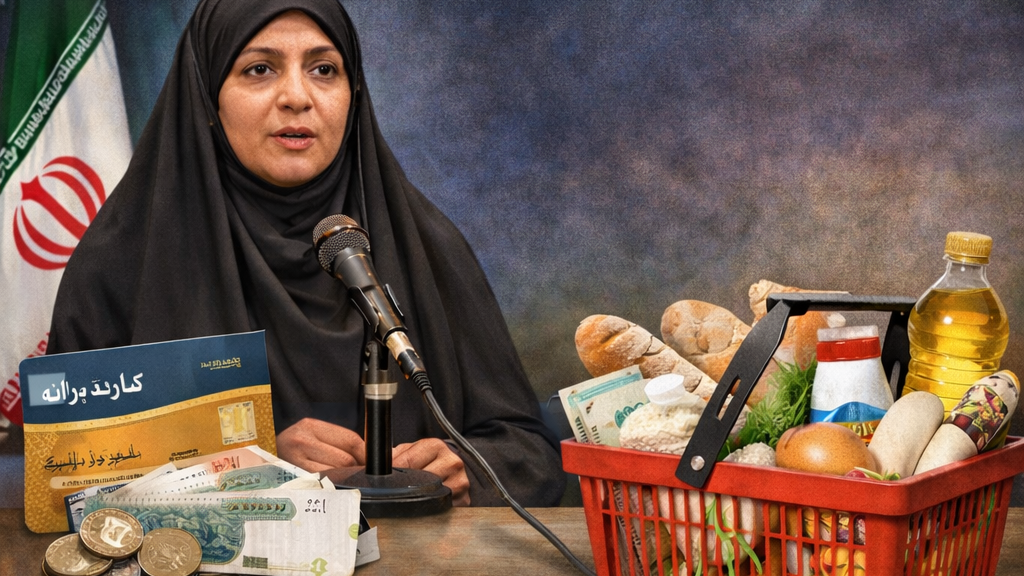
Iranian Government Announces Financial Relief Program as Protests Continue
Following a week of protests in 40 cities with 12 estimated fatalities, the Iranian government announced a financial relief program to ease economic hardship caused by extended sanctions, the devaluation of the national currency, and rising inflation.
Government spokeswoman Fatemeh Mohajerani announced on state television that every citizen will receive, for the next four months, 1 million tomans (approximately $7) per month through direct deposit payments in the form of credit, rather than cash, to help purchase basic necessities.
Mohajerani said the purpose of the payments was to “reduce the economic pressure on the people.”
Give the gift of hope
We practice what we preach:
accurate, fearless journalism. But we can't do it alone.
- On the ground in Gaza, Syria, Israel, Egypt, Pakistan, and more
- Our program trained more than 100 journalists
- Calling out fake news and reporting real facts
- On the ground in Gaza, Syria, Israel, Egypt, Pakistan, and more
- Our program trained more than 100 journalists
- Calling out fake news and reporting real facts
Join us.
Support The Media Line. Save democracy.
The government has not said whether the allowance program could be extended beyond the initial four-month period. For now, officials have presented it as an emergency measure to ease immediate economic distress amid ongoing public demonstrations across the country.
Inflation reached 52 percent year-on-year in December, placing additional strain on households already grappling with stagnant wages. Over the past year, the national currency has lost more than one-third of its value against the US dollar, significantly weakening purchasing power.
With a population of more than 85 million, Iran’s income levels remain low by regional standards. The minimum monthly wage is estimated at roughly $100, while average salaries are around $200. Most daily transactions are conducted electronically, with debit cards and mobile phones widely used, a system authorities say enables rapid distribution of the new credits.
On Saturday, Iran’s Supreme Leader Ali Khamenei told a crowd in a speech broadcast on state-run television that protesters can be negotiated with, but rioters would not be tolerated.
He said, “We talk to protesters, the officials must talk to them,” Khamenei said. “But there is no benefit to talking to rioters. Rioters must be put in their place.”
He also alleged that protests were being directed by foreign influence, including the US and Israel, without providing evidence.
