Ceasefire Changes the Mood, but Memorial Tours Keep Oct. 7 in Focus
A summer visit to Alumim and the Nova site shows how grief tourism took hold before the truce and continues as remains are identified and communities rebuild
A ceasefire between Israel and Hamas, negotiated with the involvement of the United States, Egypt, and Qatar—and backed by a broad coalition of Arab and Muslim countries—has shifted Israel’s wartime rhythm again, but the story of remembrance tourism began months earlier. In the heat of this summer, before the truce and before the release of the remaining living hostages, tour buses were already threading through the Oct. 7, 2023 attack sites, including Kibbutz Alumim and the Nova festival grounds.
Many kibbutzim that were attacked became widely known for tragic reasons, but others remain lesser known, including Kibbutz Alumim.
Tourism in Israel dropped sharply after the attacks, yet some sites began drawing visitors for a somber purpose. In a shift from traditional tours of famous cultural and heritage locations, many operators added excursions to communities affected by the October 7 massacre.
Bein Harim Tour Services is one such company. In August 2025—a few months before the ceasefire—a minibus carrying eight people, including Itamar, the guide, who started with Bein Harim in 2013—set out for the Gaza Envelope.
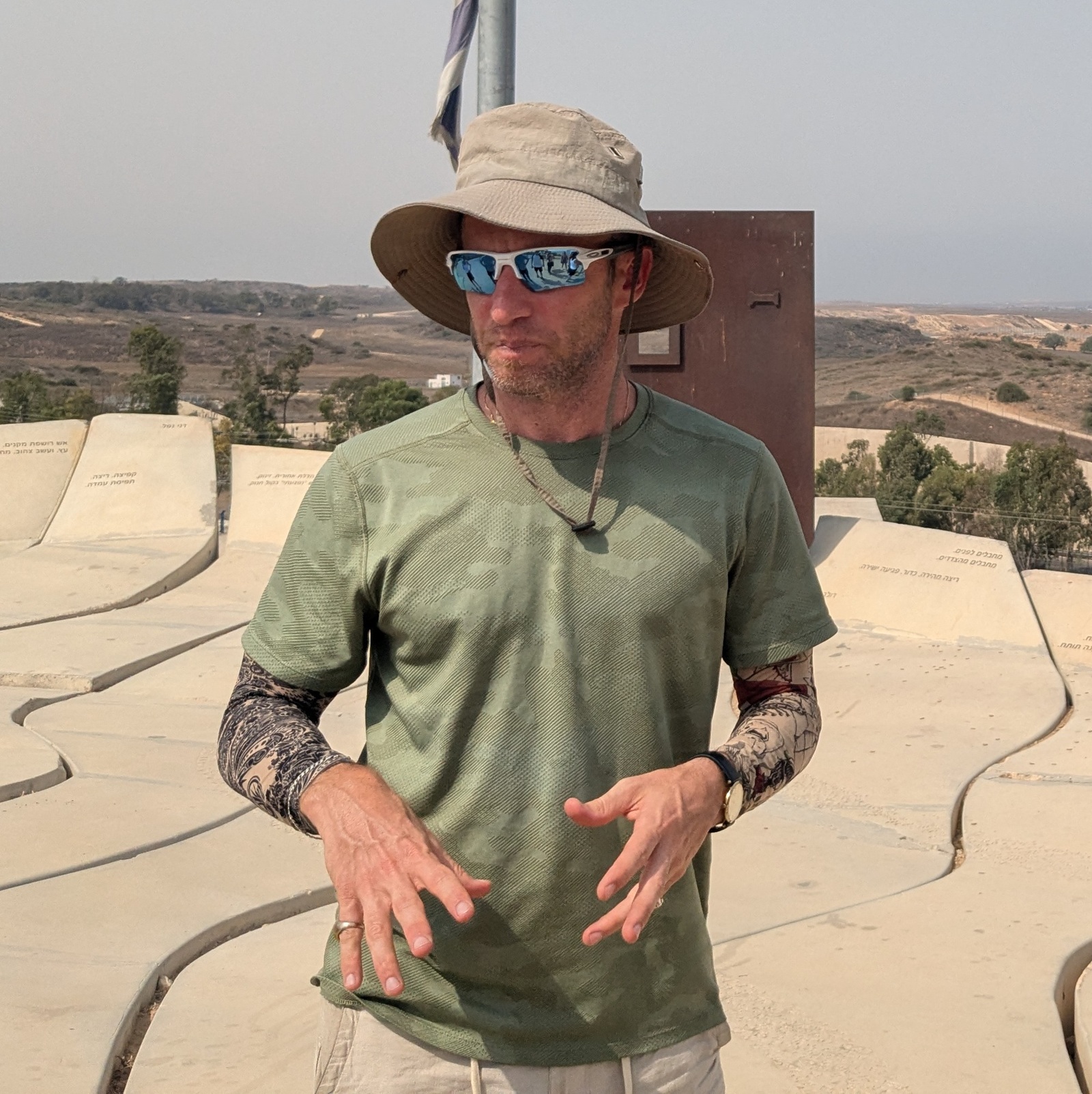
Itamar, a tour guide for Bein Harim Tour Services, speaks to the group, with the Gaza Strip in the background, Aug. 12, 2025. (Addie J. Davis/The Media Line)
From Switzerland to Mexico, the group—nearly all Jewish—came for varied reasons: Two were in the country to attend weddings, and one young woman had just immigrated from the US. Yet all chose to visit memorial sites of the largest terror attack on Israeli soil.
One stop was Alumim, a religious kibbutz about 2 miles from the Gaza border. It saw dozens of Hamas terrorists infiltrate on October 7, during the Simchat Torah holiday. More than 20 people were murdered and others kidnapped, yet the kibbutz’s story remains lesser known.
Eyal Rein, head of the security team at Alumim, told The Media Line in a later interview that only when the terrorists penetrated the community did he realize something far larger was unfolding than the missile alerts to which the border town had grown accustomed.
“Before that, we heard missiles, we heard alarms, but it’s nothing that we didn’t know. … We’ve been here for the last 20 years. It’s a thing that happens once in a while,” he said. “Only when the terrorists came and started shooting—that was something new, something that never happened here.”
Rein recounted the harrowing hours as his small security team, kibbutz members, and others who came to help defended Alumim.
The attack began at 6:30 a.m. with missile sirens, and it took less than half an hour for Rein to grasp the severity of the situation as 10 Hamas fighters broke through the rear gate. From there, they went to the Thai and Nepali workers’ housing, killing two Nepali workers and injuring others. This was only the start of the foreign workers’ ordeal.
A few miles away, linked to Alumim by Route 232, the Nova music festival drew thousands near Kibbutz Re’im. The festivities were cut short, and the site became the deadliest attack location on October 7.
Nearly 400 people were murdered there—a figure Itamar stressed represents hundreds of families who lost loved ones. Beyond the fatalities, he emphasized the toll on survivors and the injured.
There were hundreds who didn’t die but something in them died
“There were hundreds who didn’t die but something in them died,” he said.
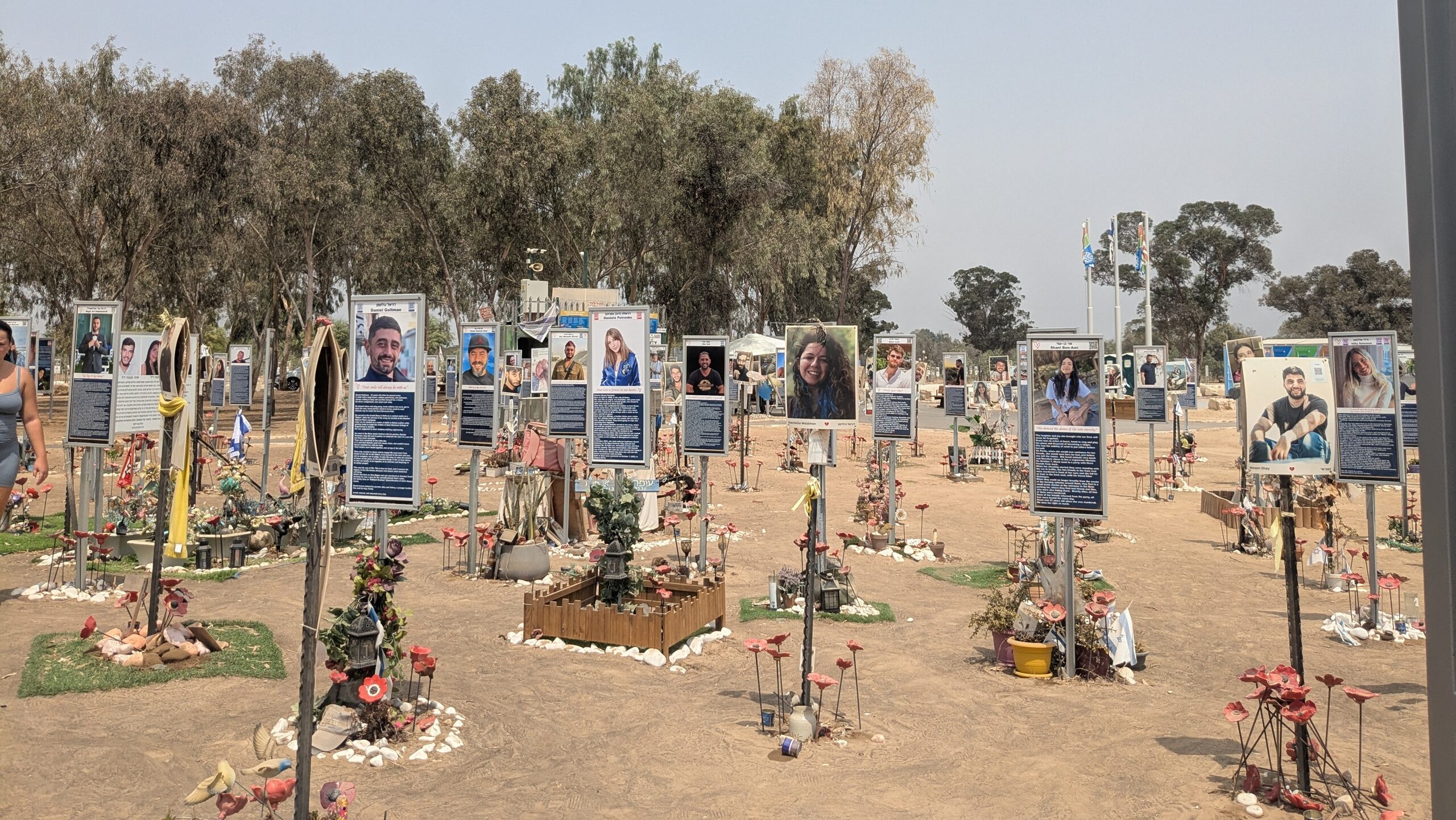
The area, once alive with music and activity, now bears hundreds of wooden posts, each carrying a poster with a victim’s story—their interests, hobbies, character, and heartbreaking fate.
Many posts portray those who were not killed but were kidnapped to Gaza. At the time of the summer tour, some of those captives were still being held; under the October 2025 ceasefire, all 20 remaining living Israeli hostages have since been released, and the return and identification of the deceased continues.
When he first began guiding there, Itamar told a few victims’ stories himself. Realizing each story told meant another went untold, he now lets visitors explore the site and find the narratives they connect with most.
Escaping the festival did not always mean safety, as Hamas gunmen attacked vehicles on the road and threw grenades into shelters. Traveling up Route 232, some met their end outside Alumim.
“From inside the kibbutz, 10 terrorists came outside and started killing there,” Rein said about those who had escaped from the festival.
Give the gift of hope
We practice what we preach:
accurate, fearless journalism. But we can't do it alone.
- On the ground in Gaza, Syria, Israel, Egypt, Pakistan, and more
- Our program trained more than 100 journalists
- Calling out fake news and reporting real facts
- On the ground in Gaza, Syria, Israel, Egypt, Pakistan, and more
- Our program trained more than 100 journalists
- Calling out fake news and reporting real facts
Join us.
Support The Media Line. Save democracy.
From inside the kibbutz, 10 terrorists came outside and started killing there
He said five soldiers arrived and fought the group of fighters that had come from Gaza on motorcycles. With one dead and another wounded, the terrorists grabbed the injured and retreated to Gaza. The battle, though, was far from over.
Over the next several hours, the kibbutz response squad fought off multiple teams of Hamas infiltrators. Three members were injured battling a group that breached the fence. While engaged there, another cluster of terrorists returned to the foreign workers, and Rein said the team could not reach them.
In total, Rein said 22 workers were killed and two were kidnapped—one Thai, who was released almost two months later, and one Nepali, Bipin Joshi. In the days after the ceasefire took effect this month, authorities confirmed Joshi among the deceased; his remains were returned to Israel for identification ahead of repatriation to Nepal.
Asked why Alumim was initially viewed as less affected, Rein said, “I think it’s because all the people who got murdered in the kibbutz are foreign workers and not Israeli citizens.”
He added, “The story that people heard or knew or something is that the first response squad from the kibbutz saved the kibbutz,” he said. “It’s true because we saved our citizens and our civilians, our kids, our families, but our workers we couldn’t save.”
At first, he said, people across the country were focused on the stories of Israelis.
As the violence raged, the game-changer was the arrival of a large army unit—about 200 soldiers against roughly 70 terrorists. Still, some who came to defend the kibbutz were killed or wounded while seeking refuge there.
After the attack, Alumim residents were evacuated to hotels in Netanya, where they remained for nearly 10 months, even opening a kindergarten there, Rein said. With the dairy farm destroyed and two barns burned down, it took four days before they could milk the cows again.
The security team had trained for terrorist infiltrations in the past, but nothing on that scale.
“We trained for six, seven, eight terrorists, not a hundred terrorists,” Rein said, noting it was also a surprise attack.
Looking ahead, Rein said the team has strengthened its defenses.
“We were 16 people, now we are 28, and we have better weapons, better equipment, drones,” he said, also listing them having more cameras, and training more often.
In the heavy heat, mixed with the smell of livestock, tourists can still see the wreckage of a building at the Alumim dairy farms struck by a missile nearly two years ago.
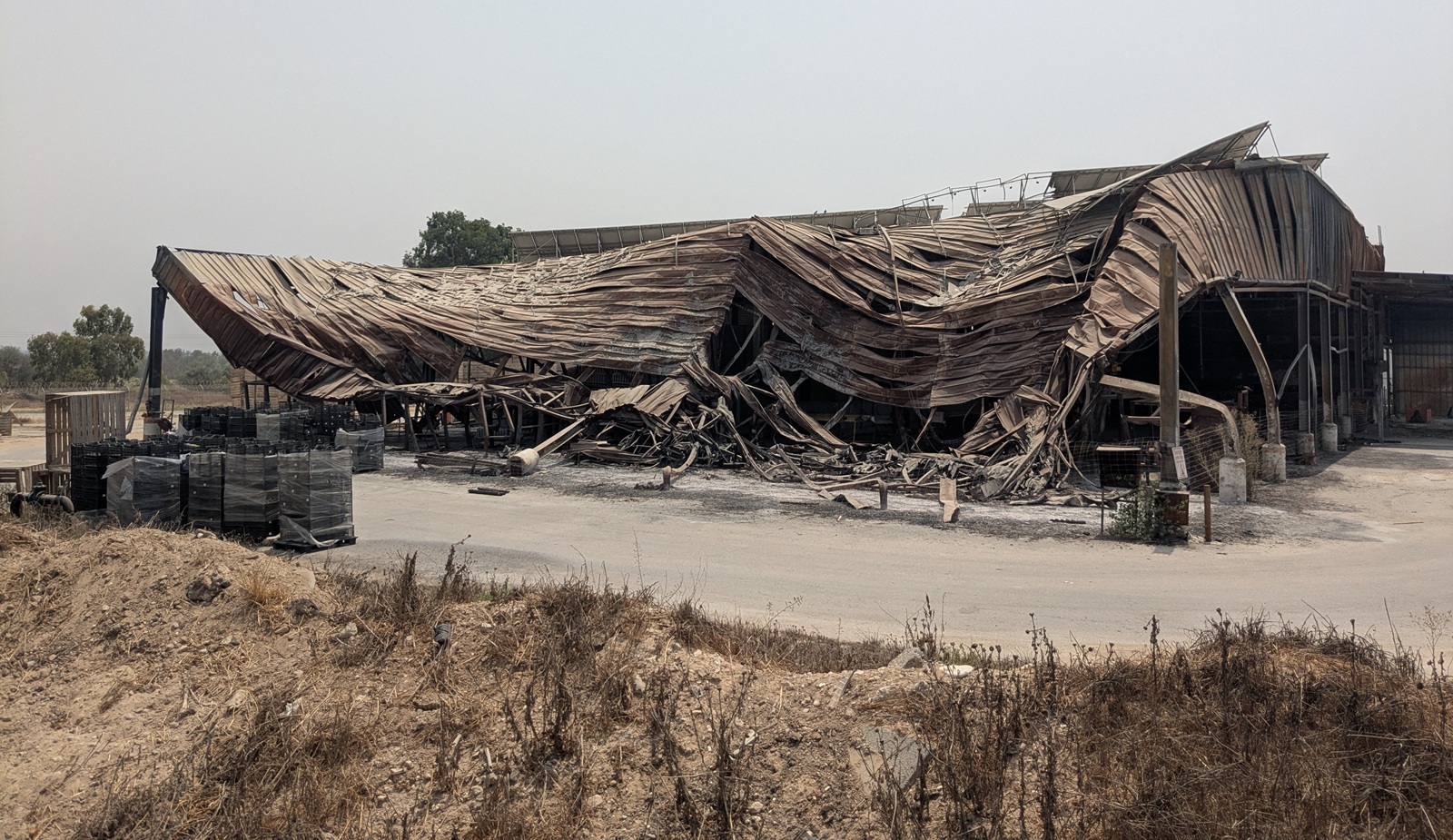
Farm building destroyed by a missile from Gaza on Oct. 7, 2023, at Kibbutz Alumim. (Addie J. Davis/The Media Line)
“In a way, I wanted to avoid this tour,” Itamar told The Media Line. He has conducted more than a dozen tours of this type into the Gaza Envelope, but at first, he was hesitant to do so.
Less than a week after the terror attack—when terrorists’ bodies still lay on the ground—Itamar traveled to the area as a volunteer serving meals to soldiers.
All four of his grandparents were Holocaust survivors, and he avoided much of the information about it to protect his mental well-being, he explained. For the same reason, he initially did not want to witness the horror of October 7.
After a trip to Poland, where he saw the Holocaust’s lasting effects, he realized that if he could do that, he could also conduct these tours. His way of processing the attack is to emphasize heroism; once he understood that would be his approach, he agreed to guide.
With that focus—and the bus stopped at the former police station in Sderot—he described the more-than-a-day battle against Hamas fighters, which ended with the building’s demolition.
According to the Times of Israel, 20 police officers died in the battle, and more than 70 people were murdered throughout the city.
When it became clear no police officers remained alive in the overrun station, officials decided to demolish the building, burying the terrorists inside, Itamar said.
A memorial now fills the site, with stone pillars reaching upward and verses and quotes carved into them in English and Hebrew, conveying messages of hope and strength. Large, colorful murals on nearby buildings tell the story of the fights, reflecting the tragedy while emphasizing Israeli resilience.
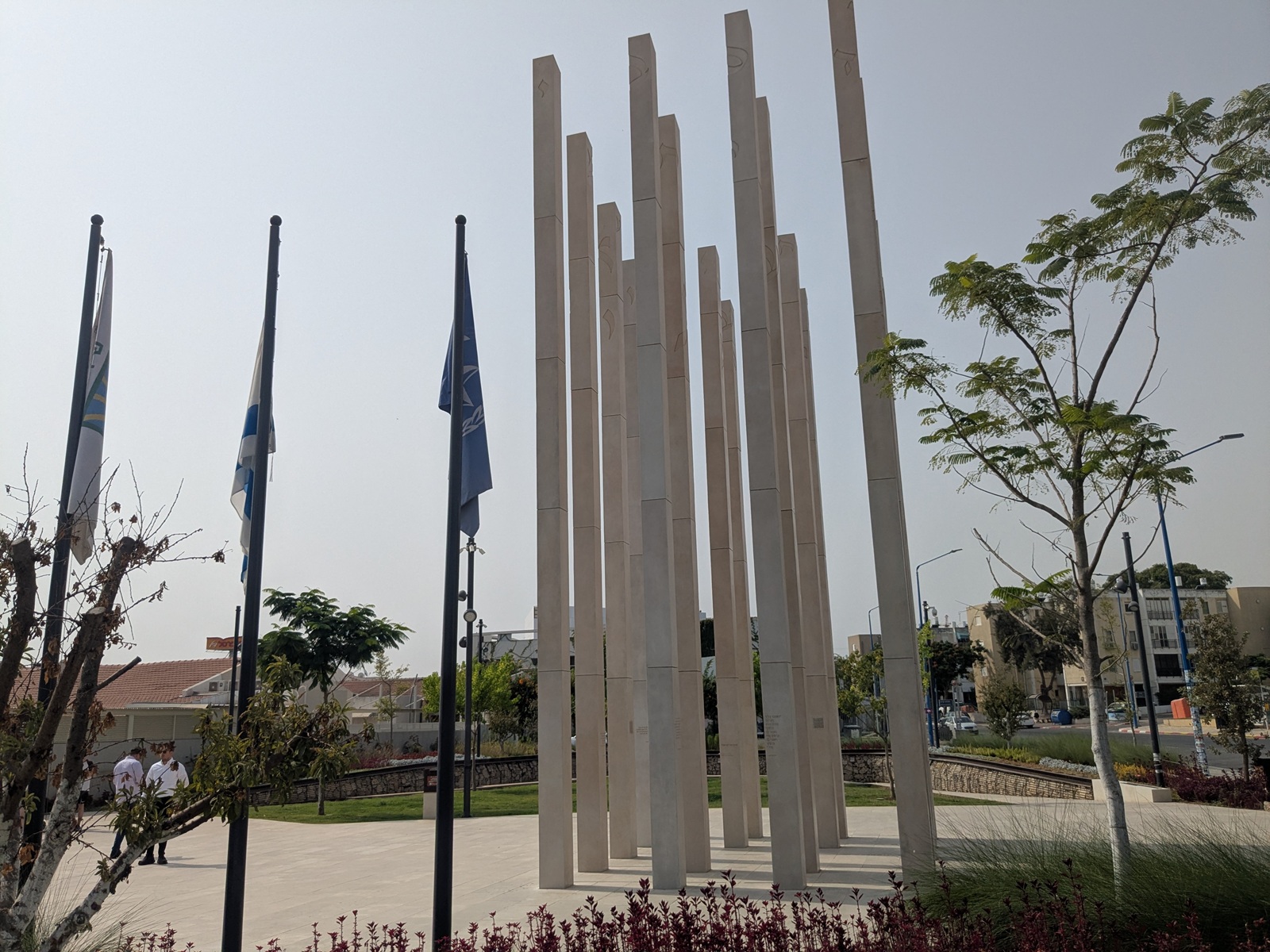
Pillars at the memorial site of the Sderot police station that was destroyed during the Oct. 7, 2023 attack. (Addie J. Davis/The Media Line)

A mural in Sderot, Israel memorializes the Oct. 7, 2023 terrorist attack on the city, Aug. 12, 2025. (Addie J. Davis/The Media Line)
Placards lining a small walkway in the area recount the stories of those who died on October 7, as well as others. Visitors read about people out for a morning run, taking a tour, returning from a fishing trip, and many more.
Following October 7, the Israel Defense Forces launched an offensive into the Gaza Strip, where Hamas governed. That campaign destroyed cities and towns and, according to the Hamas-run Gaza Health Ministry, killed more than 60,000 people.
From Sderot’s Givat Kobi lookout, less than a mile from the Gaza border, tourists can see into the war-torn enclave. Through the viewer, northern cities including Beit Hanoun and Jabalia appear reduced to rubble, multistory buildings destroyed and leaning precariously. Today, with a ceasefire shaped by both US and regional mediation, controlled demolitions and the transfer of remains continue to echo across the border—a reminder that the emergency has eased but not ended.
It’s still a war
“Still we are hearing all the explosions and the gun shooting we hear. It’s still a war,” Rein said. “Sometimes it’s very loud and you get used to it.”
Nearby stands the moshav of Tkuma, where burned and destroyed vehicles from the terrorist attack are kept in a lot, each representing the misfortune of a victim or victims.
Rust-brown, burned cars are stacked into a wall, with a few vehicles set apart; plaques in front link to victims’ stories. Among them is the “ambulance of death,” where 18 people died from an RPG strike. Two of the dead were not identified until much later, one believed kidnapped for more than 200 days.
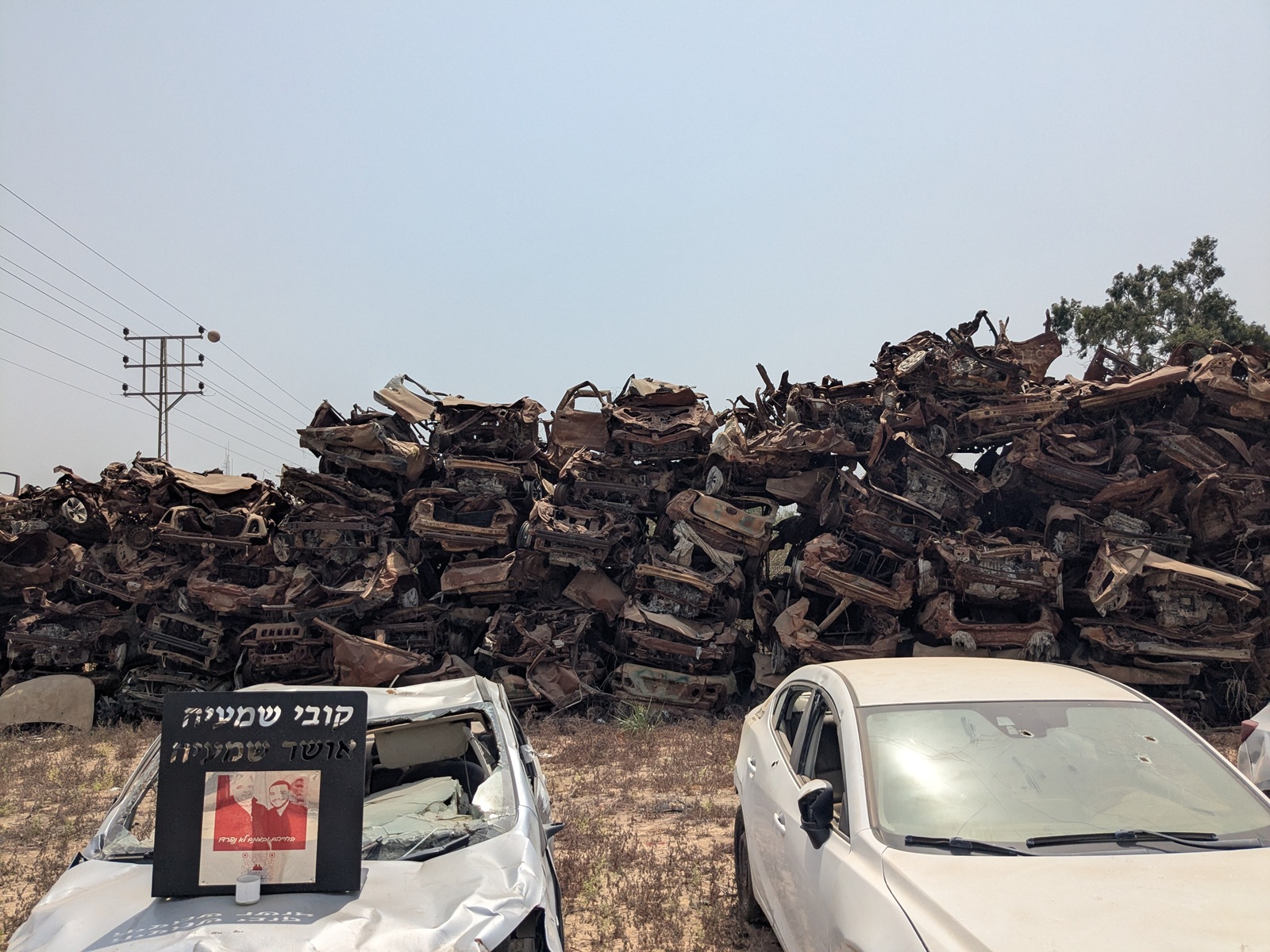
Wall of cars burned and destroyed during the Oct. 7, 2023 terrorist attack. (Addie J. Davis/The Media Line)
Many cars tell a chilling story: Some belonged to the terrorists. Itamar explained that white Toyota pickup trucks were used by the fighters, but they are also common among farmers. Now, he said, every such truck in the country bears an Israeli flag—an effort by the owners to distance themselves from what happened.
After visiting attack sites and hearing the stories of those who died or were affected, the tour ended at nearby Shuva Junction, where the Shuva Brothers rest stop provides thousands of free meals to soldiers entering and leaving the Gaza Strip.
Dror Trabelsi told The Media Line that the rest stop, which also provides free clothing and other supplies, began in response to October 7, with his brother Kobi and his friends setting up a table with food and drinks, and growing into what it is now.
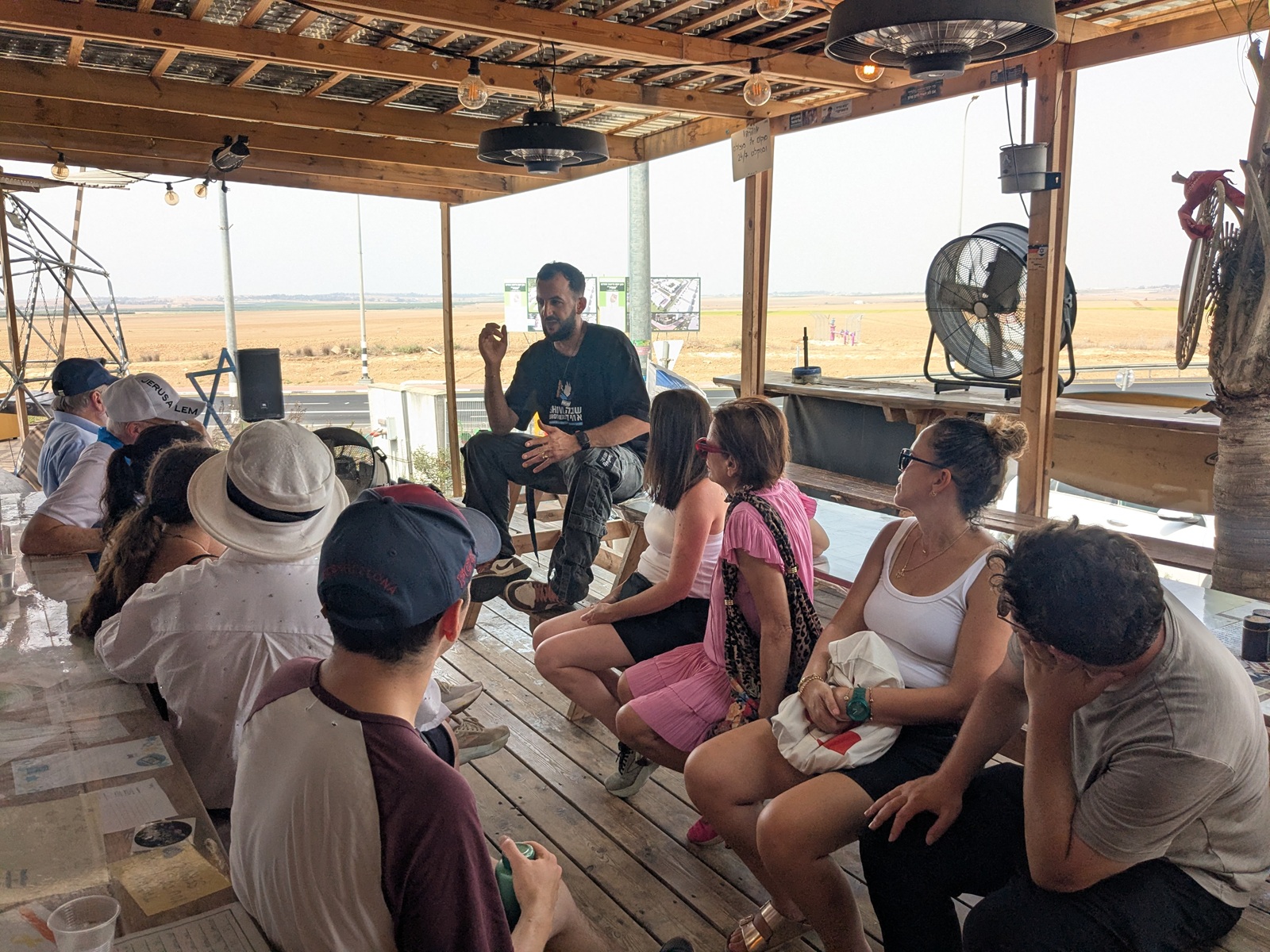
Dror Trabelsi speaks to the group at the Shuva Brothers rest stop, Aug. 12, 2025. (Addie J. Davis/The Media Line)
Though the tour did not include Israel’s most famous cultural sites, in some ways it offered deeper insight into modern Israeli experiences. Seen from October 2025, after a ceasefire and the release of the living hostages, those same stops now sit at the junction of grief and closure—sites where families still await final identifications, communities rebuild, and visitors try to understand what was lost and what remains.
Addie J. Davis is a recent graduate of the University of North Texas and an intern in The Media Line’s Press and Policy Student Program.
