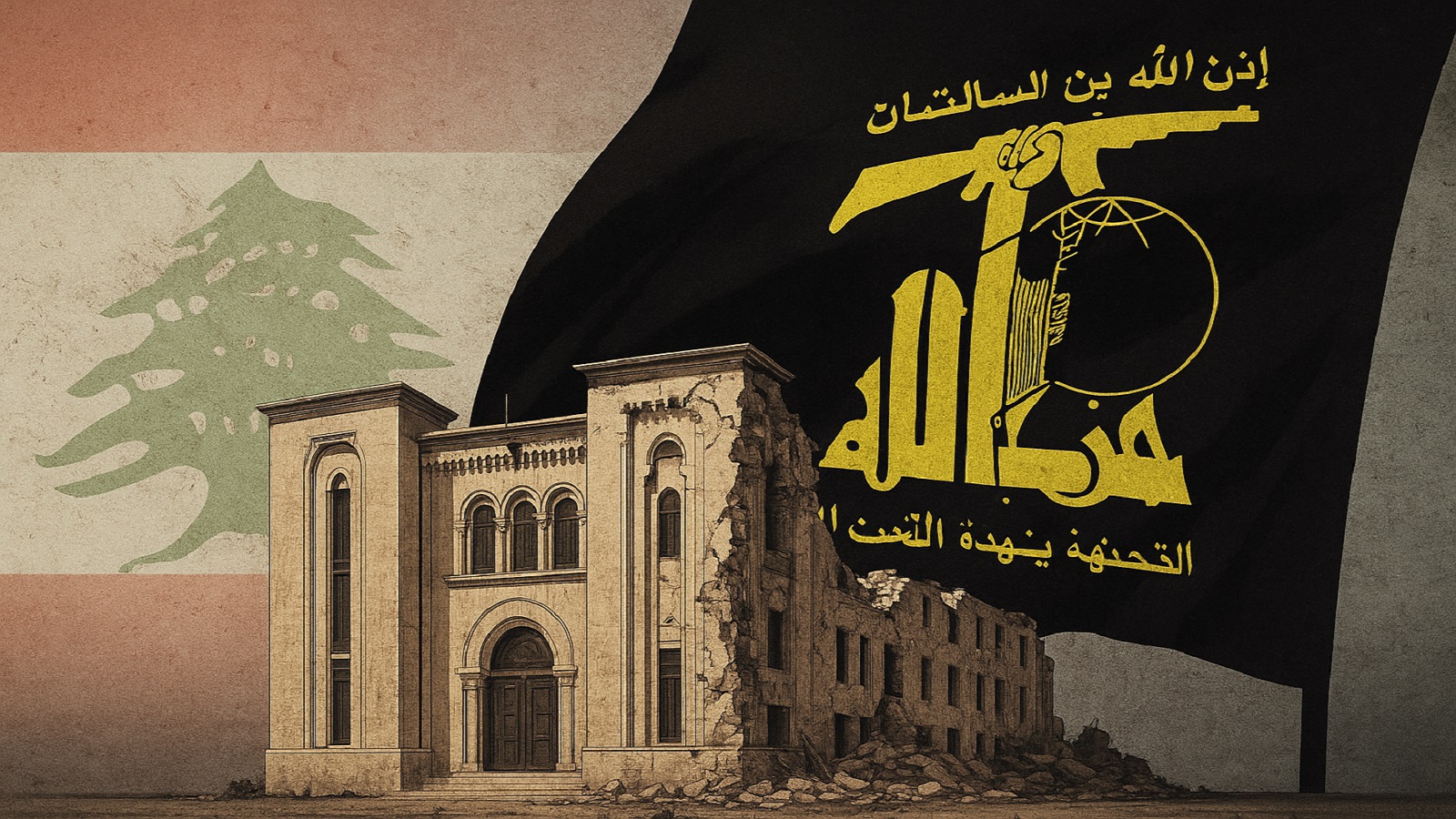
Are We Witnessing the Fall of the Hezbollah State?
Nida Al Watan, Lebanon, May 23
The Hezbollah state represents the extended arm of Iran’s Islamic regime in Lebanon. It has uprooted Lebanese Shiites from their own communities, erased their cultural and social history, and obstructed the establishment of national order by paralyzing institutional mechanisms and rendering the constitution ineffective. In its place, Hezbollah has constructed parallel regimes atop the carcass of the Lebanese state and its governing institutions.
What was once a “Shiite question” has metastasized into something far greater: the transformation of Lebanon into a “society without a state”—a landscape marked by bloodshed, ideological mobilization, a sanctions-driven economy, and a culture molded by command and control. These are the defining features of the Hezbollah state.
The proxy war, which exploited Lebanese Shiites as fodder for Iran’s geopolitical ambitions, has now also precipitated Hezbollah’s own deterioration. The movement has suffered staggering blows to its military and financial infrastructure, resulting in the unraveling of the very system upon which it built both its state-within-a-state and its ideological fervor.
Give the gift of hope
We practice what we preach:
accurate, fearless journalism. But we can't do it alone.
- On the ground in Gaza, Syria, Israel, Egypt, Pakistan, and more
- Our program trained more than 100 journalists
- Calling out fake news and reporting real facts
- On the ground in Gaza, Syria, Israel, Egypt, Pakistan, and more
- Our program trained more than 100 journalists
- Calling out fake news and reporting real facts
Join us.
Support The Media Line. Save democracy.
Looking ahead to the post-Hezbollah period, there must emerge from within the Shiite community a political project capable of challenging the prevailing reality and a cultural movement that engages with the tenets of modernity while harmonizing them with Shiite jurisprudence. The aim is to resolve the “Shiite question” and reclaim the Lebanese state, not to allow Hezbollah’s ruin to be interpreted as a Shiite defeat.
Muhammad Hasan al-Amin, widely recognized for his moderate stance and his outspoken criticism of Hezbollah’s dominance over the Shiite political landscape in Lebanon, once wrote with incisive clarity and conviction: “The authority of divine right is a conspiracy against Shiism.” In this declaration, al-Amin articulated a visionary call for reforming Islamic religious thought, liberating it from the pursuit of political power. He saw this renewal as contingent on a reconciliation with secularism—an idea long opposed by segments of the religious establishment—while recognizing that modernity has shaped the state as a functional institution overseeing societal life. The essential principles of modernity—secularism, the state, citizenship, and coexistence—find their rightful place as enduring concepts under this framework. In such a model, religion continues to hold meaning, not as a vehicle of domination, but as a personal and cultural expression within society.
Similarly, the prominent scholar Mohammad Mehdi Shamseddine made critical contributions to modern Shiite legal thought, advocating for a jurisprudence that could evolve into a cultural project mirroring modernity. He dismissed the doctrine of the jurist’s general guardianship, instead asserting that guardianship belongs collectively to the nation. Ali al-Amin, another notable voice, emphasized the role of the state as the sole legitimate authority responsible for organizing society through its exclusive functions and mandates.
From these intellectual currents emerges the possibility of a jurisprudential framework that resonates with Western political thought regarding the state, both its philosophical underpinnings and practical governance. Such a foundation would reintegrate Lebanese Shiites into the broader national project, reframing the burdens of Hezbollah’s dominion as lessons that could ultimately yield gains for both the Lebanese state and the Shiite community.
Ali Khalifa (translated by Asaf Zilberfarb)
