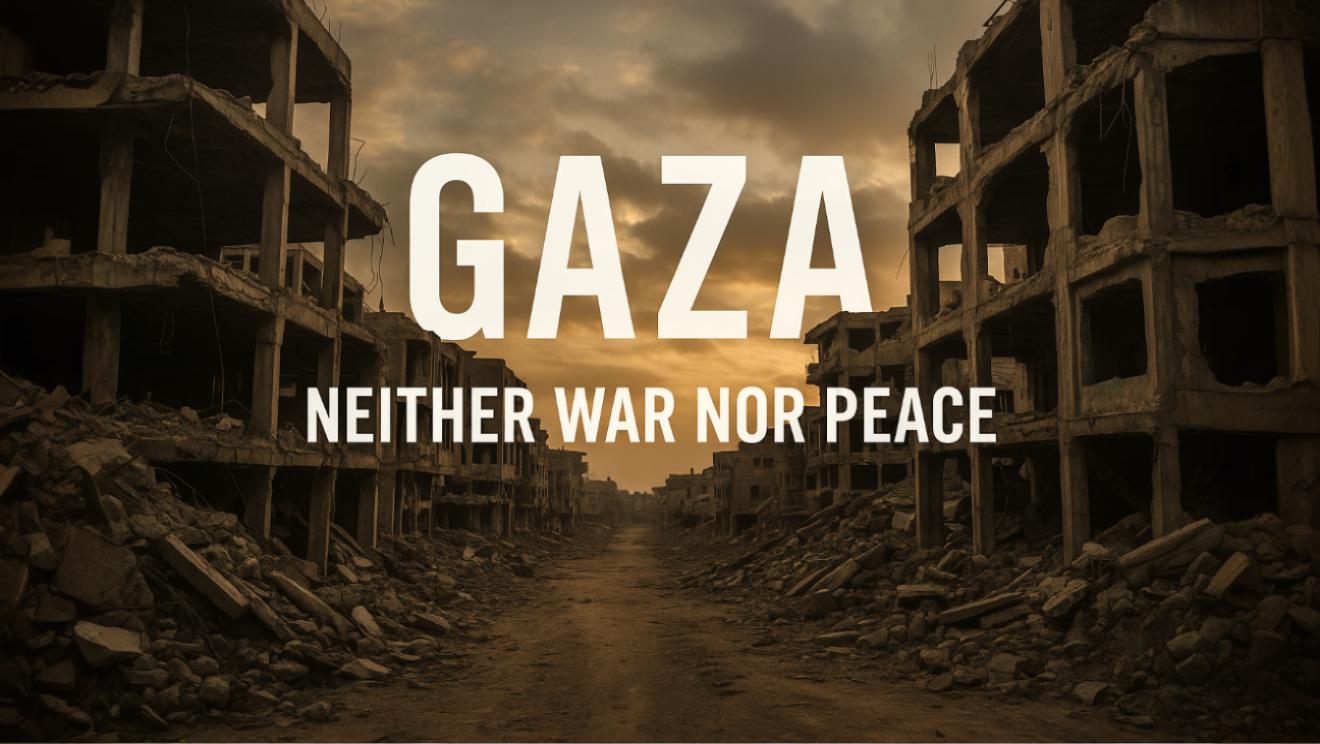
Gaza: A Forbidden Zone in History
Asharq Al-Awsat, London, November 8
Today, Gaza finds itself in a liminal state—neither engulfed in full-scale war nor basking in genuine peace. The same can be said of the West Bank, caught between two unrelenting forces, suspended in a grim equilibrium. Lebanon, too, drifts in a historical gray zone, belonging neither to open war nor to stable peace.
This suspended reality has turned Gaza, home to more than two million people, into a tragic emblem of frozen conflict and fading hope. Under siege, divided, and repeatedly destroyed, it stands as a symbol of human rights violations and a draining battlefield that exhausts Palestinians, Arabs, and global powers alike. When politics offer no exit, people become hostages to geography, and regions such as Gaza, the West Bank, and southern Lebanon remain trapped, unable to progress or break free.
Since 1948, the Palestinian territories have been perpetual victims of geography—hemmed in by Israel, which treats them as a security buffer; by a Palestinian Authority paralyzed by its own stagnation; by an Arab world torn between sympathy and confusion; and by regional actors exploiting the crisis for their own ends. It is a vivid example of what historians describe as a “deadly political vacuum,” a moment when history itself halts, rendering solutions impossible and societies immobile, left only to wait for deliverance from beyond the realm of politics.
Give the gift of hope
We practice what we preach:
accurate, fearless journalism. But we can't do it alone.
- On the ground in Gaza, Syria, Israel, Egypt, Pakistan, and more
- Our program trained more than 100 journalists
- Calling out fake news and reporting real facts
- On the ground in Gaza, Syria, Israel, Egypt, Pakistan, and more
- Our program trained more than 100 journalists
- Calling out fake news and reporting real facts
Join us.
Support The Media Line. Save democracy.
This is not unprecedented: The Korean Peninsula has remained frozen since the 1953 armistice, its borders tense, its people still waiting for a peace that may never arrive. Berlin once stood divided by a wall of fear and suspicion; its people imprisoned in competing ideologies until the Soviet Union’s fall opened a way out. Kashmir, too, has long been locked in a deadly stalemate between India and Pakistan, where periodic violence shatters lives and stifles progress.
Gaza today mirrors all these examples—sealed borders, a crippled economy, deep internal fractures, and a population suffering in silence. The internationalization of the conflict has stripped it of its human and national essence, leaving Palestinians torn between a self-preserving Authority and a Hamas leadership trapped in its own past. Amid this paralysis, Gazans survive between poverty, isolation, and dependence. Education and health systems have collapsed, an entire generation deprived of opportunity. They know only destruction and blockade, their days filled with unemployment and displacement. Palestinian ingenuity has turned inward—from building a nation to simply enduring its ruins. The middle class, once the stabilizing core, has eroded, and the concept of the state has crumbled into factional control.
The Palestinian national project itself risks shrinking into a fragment of land, a wounded memory, and a collection of sacrifices. Gaza’s tragedy has spilled across the Arab world, politically and emotionally. Arabs across the region debate its meaning, divide over “resistance” and “normalization,” and quarrel in capitals and cafés alike. This discord has weakened the Palestinian cause, turning it from a unifying symbol of liberation into a catalyst for fragmentation. Some Arab states, weary of endless turmoil, now prioritize their own security, while regional powers manipulate the conflict to serve their ambitions.
The result is fatigue in Western capitals—from Washington to London to Paris—where policymakers manage the crisis but no longer seek to solve it. The international momentum once pushing for peace has vanished, and even global sympathy, once rekindled by recent tragedies, has cooled. The stalemate has hardened into permanence. Yet the gravest danger lies not in Gaza’s physical ruin but in the decay of meaning itself. A Palestinian child grows up knowing only the whine of drones and the crash of bombs, learning that peace is an illusion and justice an empty word. Over time, despair turns to rage, and human lives are reduced to weapons. Gaza transforms from a cause into a curse, from a struggle of resistance into an enduring tragedy.
What Gaza needs is not pity or another conference, but a courageous, unified vision to break this historical impasse. The lessons of Berlin, Korea, and Kashmir teach us that a state of neither war nor peace is deadlier than war itself—it kills by suffocation. Breaking free demands that Arabs reclaim their role, not as passive spectators but as builders of renewal, urging Palestinian factions: Enough division—unite! Only then can the Palestinian people recover their dignity and restart history’s halted march. In the end, neither war has been salvation nor peace a fulfilled promise. Only a unified Palestinian will can forge a new meaning for life amid the ashes.
Mohammed Al Rumaihi (translated by Asaf Zilberfarb)
