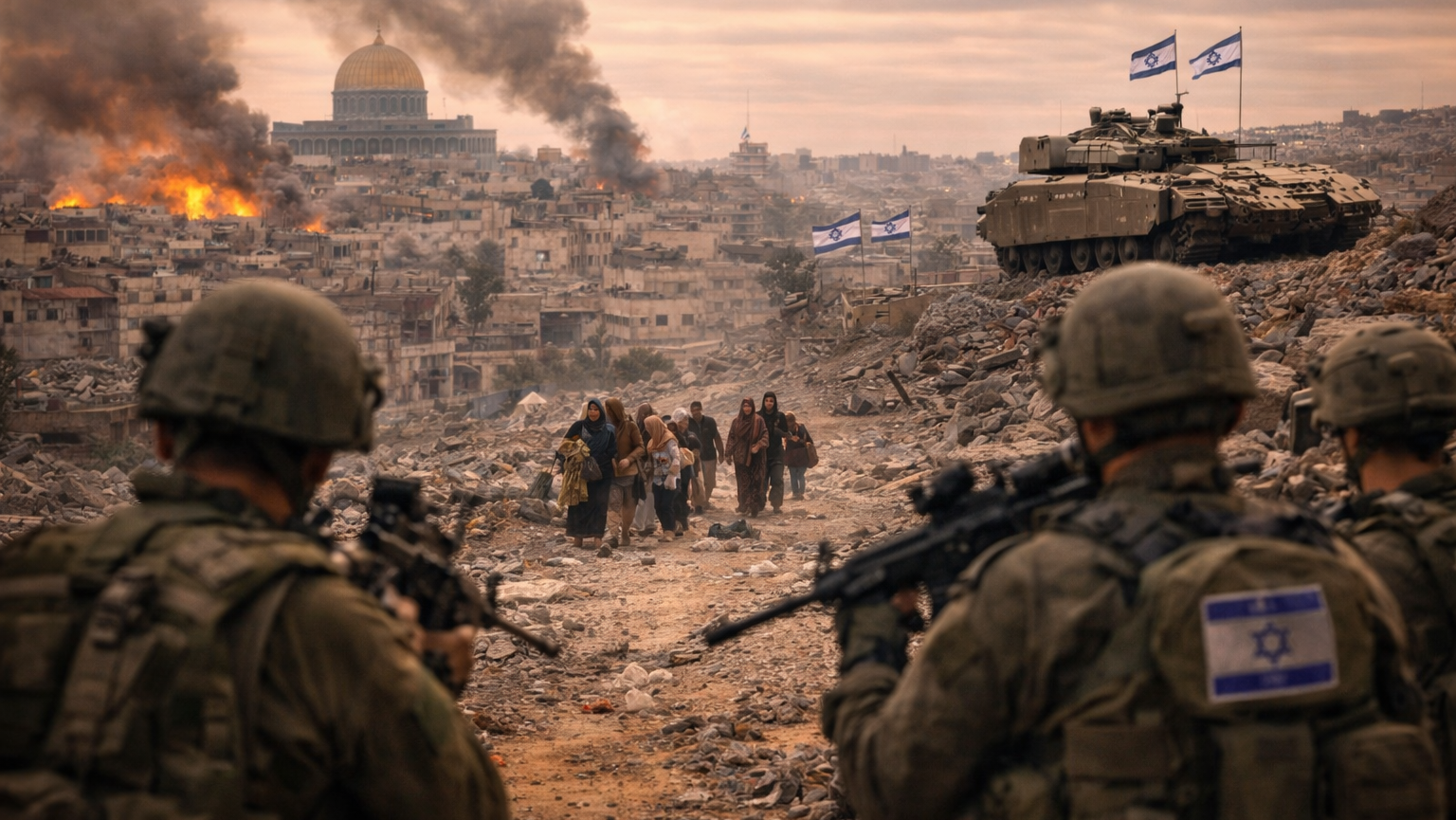
Israel’s 10 New Challenges
Al-Ittihad, UAE, August 30
Although the Israeli government has decided to launch a new operation in Gaza, the political and strategic realities point to an array of daunting challenges that Israel must confront, particularly given its continued violations in both the Gaza Strip and the West Bank.
The first challenge lies in the absence of a unified Israeli consensus on the operation’s feasibility. While military and political leaders have reached an agreement in principle, the trajectory of the operation remains uncertain. Occupying sections of Gaza will require time, extensive resources, and a heavy military cost. Although the defense budget has accounted for such expenditures, economic reservations persist, particularly regarding the long-term costs of occupation.
The second challenge is the lack of a political solution once Gaza is fully occupied and Israeli law begins to be enforced. A full occupation entails not only the maintenance of soldiers on the ground but also the responsibility of providing services and meeting the daily needs of Gaza’s residents—all under the glare of international media scrutiny critical of Israel’s conduct.
The third challenge centers on attempts to form a national unity government, led by former Chief of Staff Benny Gantz and backed by opposition figures such as Naftali Bennett and Yair Lapid. Their efforts suggest that the opposition is once again positioning itself not merely as a challenger to the government’s authority, but as a potential savior of the state, especially given the coalition’s refusal to deviate from its entrenched partisan course.
Give the gift of hope
We practice what we preach:
accurate, fearless journalism. But we can't do it alone.
- On the ground in Gaza, Syria, Israel, Egypt, Pakistan, and more
- Our program trained more than 100 journalists
- Calling out fake news and reporting real facts
- On the ground in Gaza, Syria, Israel, Egypt, Pakistan, and more
- Our program trained more than 100 journalists
- Calling out fake news and reporting real facts
Join us.
Support The Media Line. Save democracy.
Compounding this is another dimension of the third challenge: the issue of American backing. President Trump’s support for Prime Minister Netanyahu in pursuing the operation and freeing hostages presents a paradox for the Israeli public, which increasingly perceives key decisions as emanating not from Tel Aviv but from Washington. This dynamic risks casting Netanyahu as weak, overly dependent on Trump’s guidance and direction.
The fourth challenge reflects deep civilian reservations about Israel’s current trajectory, with many citizens lamenting the absence of rational governance, long-term vision, or effective leadership. The prevailing critique is that Israel relies on temporary and misguided policies that could push the country into chronic instability.
The fifth challenge stems from recent shifts within the military establishment. A new generation of officers and soldiers, lacking experience in past wars, is eager to establish its own military legacy. Their appetite for sustained campaigns risks pushing operations beyond Gaza into Lebanon, southern Syria, and potentially Iran, thereby opening additional fronts that could overwhelm Israel’s strategic capacity over the medium and long term.
The sixth challenge comes from the international community’s intensifying stance against Israel—not merely against its government, but against the state itself. Accusations of starvation tactics, civilian massacres, and violations of international and humanitarian law are mounting. This tide is expected to swell further, particularly during the upcoming UN General Assembly meetings in September, where Israel faces a storm of international condemnation for its actions in Gaza. The seventh challenge arises from the growing trend among major powers, including France, Britain, and a dozen other European states, to recognize Palestinian statehood. While linked to broader international support for the Palestinian Authority under the Oslo framework, Israel fears these developments could reverberate domestically, fueling public discontent and strengthening accusations that Netanyahu has undermined Israel’s standing in Europe.
The eighth challenge is the expanding global boycott movement, which poses the risk of a different kind of war—economic and political—that could erode Israel’s international status and force it to reassess long-standing security, political, and strategic policies.
For years, Israel has relied on military superiority and technological advances to impose a regional fait accompli, but such strategies may no longer suffice under sustained international pressure. The ninth challenge is the potential fallout on Israel’s role in the global arms market and its broader military-industrial complex. As a significant player in this sector, Israel could face painful setbacks should foreign partners begin reconsidering their defense ties, leading to major consequences for both the economy and strategic posture.
The tenth and final challenge is Israel’s underlying fear of a coordinated international campaign to delegitimize it in global forums, a possibility that continues to shape Israeli calculations and fosters an atmosphere of preemptive caution. Ultimately, Israel’s current strategy rests on advancing through force where alternatives are absent, driven by a societal determination to impose its vision unilaterally while denying the legitimacy of the other. What Israel now applies in Gaza and the West Bank may, in time, extend to the broader region, further entrenching the logic of confrontation that defines its present course.
Tarek Fahmy (translated by Asaf Zilberfarb).
