The Political System Is Stuck in October 6
Maariv, Israel, December 19
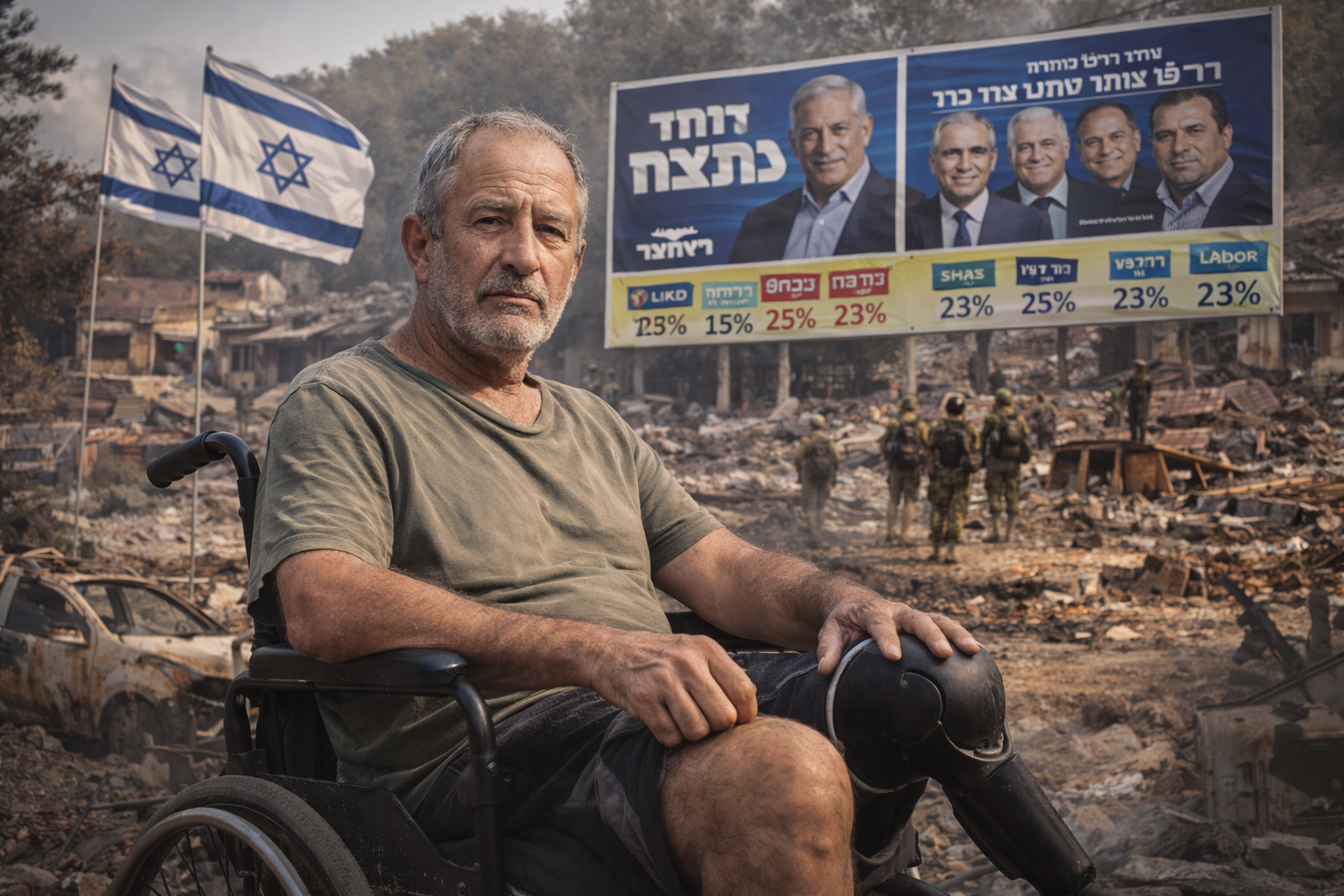
The first image that comes to mind in the context of the upcoming elections is the widely circulated interview with a member of Kibbutz Be’eri, Avida Bachar, who lost his wife, his son, and his leg on October 7. Avida chose words that were both piercing and courageous, words many of his fellow kibbutz members might not have endorsed: “It’s lucky that it happened here. It’s lucky that it happened in Be’eri and not in Havat Gilad or Itamar in Judea and Samaria, because if it had happened there, they would have said, ‘They deserve it.’ But because it happened here, everyone understands that it doesn’t matter. They want to kill us because we are Jews.”
What is astonishing about this interview is that Avida’s pursuit of justice seems stronger than the instinct for survival itself. A man who fought for hours to stay alive and lost what was most precious to him speaks of accepting the price he paid in bereavement, grief, disability, and death, because it freed him from a lie that had divided him from his brothers and sisters. Most of us do not live at such a level of uncompromising devotion to truth, yet after October 7 we discovered that we are far more committed to Israel’s collective good than we ever admitted.
Hundreds of thousands of reservists, alongside millions who stood behind them, risked livelihoods, health, and life to defend brothers they had never met, and political differences that once seemed irreconcilable suddenly became irrelevant. We sobered up and learned that cooperation in the name of the national interest comes to us more naturally than division. For any objective observer, then, the fact that polling data indicates the political reality will remain unchanged—with the same blocs, parties, personalities, and artificial rifts—appears almost absurd.
Although polls disagree over who will be prime minister and who will lead the opposition, they agree that the cast of characters and the nature of the disputes will remain the same. The coming elections resemble a game of musical chairs rather than the emergence of new leadership aligned with the transformed spirit of the public. This is deeply puzzling. How can a national-religious Jew, after paying such a heavy price for freedom, calmly vote for political actors who will join a coalition whose leaders openly chant “we will die rather than be drafted” and actively fight to evade the shared burden? Does ritual solidarity retain meaning if it fails to translate into shared destiny on the battlefield itself?
Give the gift of hope
We practice what we preach:
accurate, fearless journalism. But we can't do it alone.
- On the ground in Gaza, Syria, Israel, Egypt, Pakistan, and more
- Our program trained more than 100 journalists
- Calling out fake news and reporting real facts
- On the ground in Gaza, Syria, Israel, Egypt, Pakistan, and more
- Our program trained more than 100 journalists
- Calling out fake news and reporting real facts
Join us.
Support The Media Line. Save democracy.

And on the other side, how can a national-minded Israeli continue to support a leadership that refuses to renounce partnerships with pro-Palestinian Arab parties whose leaders have not unequivocally condemned the massacre or its planners, all so opposition leaders can maintain boycotts against Likud, despite the fact that many Likud voters fought shoulder to shoulder with their own supporters for the same national cause?
The gap between the people’s moral awakening and the anachronism of national politics is not a flaw in public consciousness but a structural feature embedded by the political system itself. The public wants change, but the gatekeepers of power locked the doors of the Knesset through a technical mechanism: the electoral threshold, which blocks renewal far more than any lack of public will. For much of Israel’s history, including Mapai’s dominance, the threshold stood at just 1%, allowing small forces to enter and gradually reshape national discourse, as Shulamit Aloni’s Ratz party and later the Shinui party under Tommy Lapid once did.
Over time, incumbents raised the threshold—first to 1.5%, then 2%, and finally to 3.25% in 2014 under the banner of “stability,” a move that paradoxically ushered in unprecedented political turbulence. Since 2019, Israel has endured repeated election cycles in which the same faces, feuds, and boycotts are endlessly recycled, replacing vision with personal vendettas.
Even now, after profound rupture and loss, the threshold convinces us that continuity is inevitable. Figures and movements outside the entrenched elite are instantly dismissed as quixotic, judged not on ideas but on whether they can forge alliances that would strip them of independence anyway. The names mentioned are only a fraction of the voices that never even try to step forward in a system that has become a closed garden. It is impossible to underestimate the danger of an awakened people led by a political leadership no longer suited to its moral scale.
The greatest responsibility Knesset members could take upon themselves before the elections is to recognize that they may no longer be the solution but the problem, and from that recognition—requiring real humility—to temporarily return to Ben-Gurion’s original electoral threshold. Only then can we test whether leadership truly reflects consent rather than coercion, and allow the public to choose a political future worthy of the hard-earned sobriety paid for in blood.
Rotem Sela (translated by Asaf Zilberfarb)
