
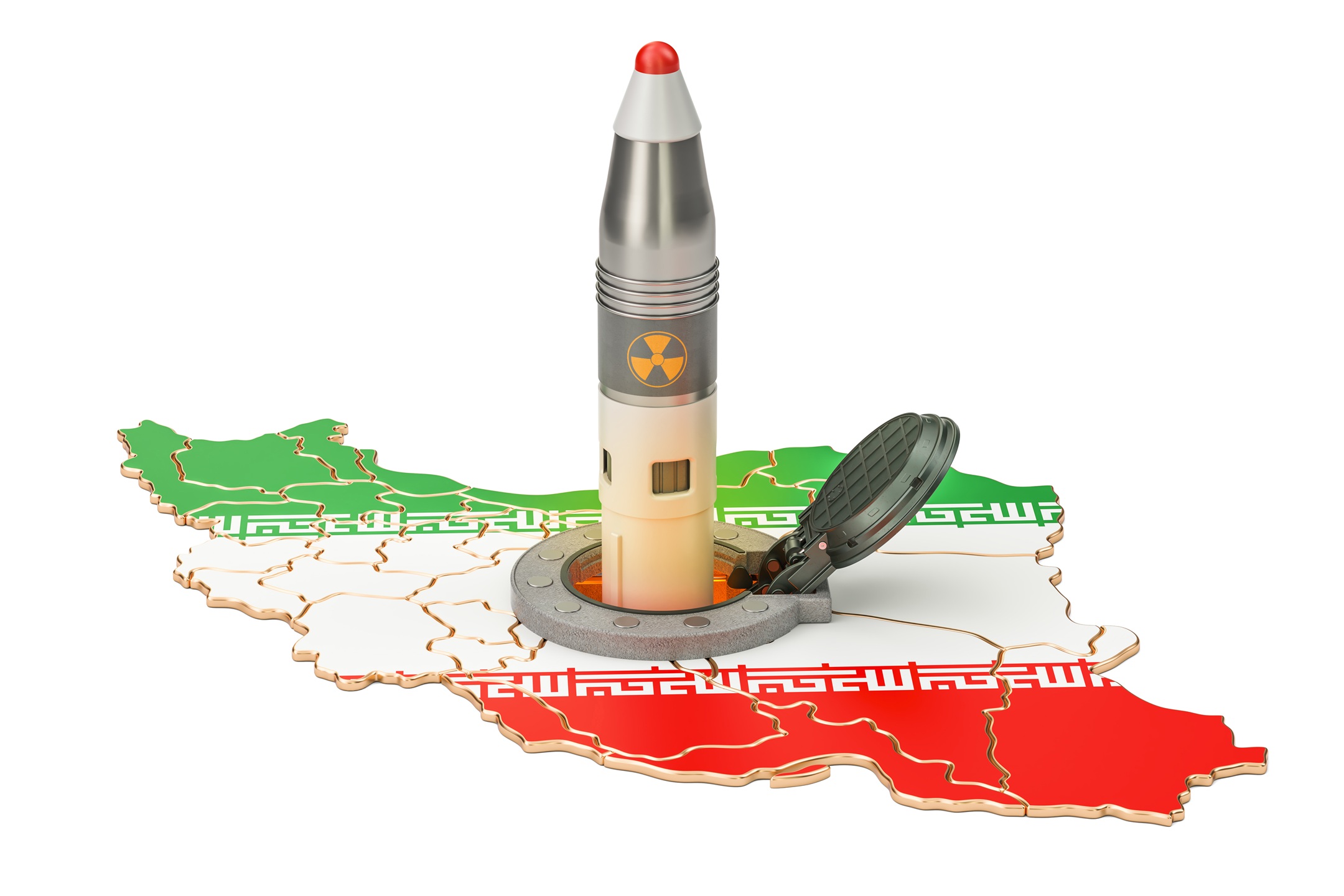
OPINION – If the Iranian Regime Possessed a Nuclear Bomb … Would It Hesitate To Use It?
There is a question many avoid in the international debate over Iran’s nuclear program, even though it may be the most important one.
If the Iranian regime possessed a nuclear weapon today, would it hesitate to use it or to hand it over to one of its militias spread across the region?
That question is not hypothetical. It is a real test of understanding the nature and behavior of this regime over the past four decades.
For 47 years, the Iranian regime has presented itself as a force working to export its scheme—built on exporting revolution, death, and destruction through armed chaos—rather than as a state seeking stability or regional partnership.
Tehran has invested hundreds of billions of dollars in building a cross-border network of militias, supplying them with missiles, drones, training, and funding.
In Lebanon, the state has become hostage to Hezbollah’s weapons.
Across Iraq, state sovereignty has been weakened under pressure from armed militias.
In Syria, hundreds of thousands of people have been killed as Iranian-backed militias poured across borders, turning the country into a regional battleground.
In Yemen, Iran’s support for the Houthis’ coup led to a long war that devastated the economy and plunged millions into an unprecedented humanitarian crisis, turning Yemen’s geography into a platform for targeting international trade and maritime routes.
This record is not a series of political mistakes or limited interventions. It is a fully integrated strategic pattern built on a clear principle: expanding influence through militias and achieving gains through chaos.
Yet what makes the nuclear issue even more dangerous is the ideological dimension of the Iranian regime. A regime whose official discourse is filled with slogans of death and hostility, and which presents conflict as part of its political identity. Its strategic approach cannot be evaluated using the traditional standards on which nuclear deterrence theories were built.
Classical nuclear deterrence assumes that states, no matter how deep their disputes, ultimately seek to avoid destruction.
Instead, the Iranian regime has built its strategy around pursuing weapons of mass destruction through developing its nuclear program, ballistic missile systems, drone capabilities, and armed proxies operating beyond its borders.
Give the gift of hope
We practice what we preach:
accurate, fearless journalism. But we can't do it alone.
- On the ground in Gaza, Syria, Israel, Egypt, Pakistan, and more
- Our program trained more than 100 journalists
- Calling out fake news and reporting real facts
- On the ground in Gaza, Syria, Israel, Egypt, Pakistan, and more
- Our program trained more than 100 journalists
- Calling out fake news and reporting real facts
Join us.
Support The Media Line. Save democracy.
This reality alone creates a dangerous strategic dilemma.
If Iran possessed a nuclear weapon, the question would not only be: Would the state use it?
An even more serious question would be: Could this capability, directly or indirectly, be transferred to one of its armed networks?
The history of the Iranian regime offers no reassuring reason to believe this possibility is unlikely.
Tehran has already transferred missile technology, drones, and advanced weapons to its affiliated terrorist militias over the years. With every round of conflict in the region, these capabilities have spread further.
Imagine for a moment the Middle East under such a reality: Picture a regime possessing a nuclear weapon, a network of cross-border militias, and open conflicts in several states.
In such a scenario, a nuclear weapon would not remain a traditional deterrent. It could become a new element in Tehran’s wars—and in those of its proxies.
That is the real danger.
The world today is not only facing a traditional nuclear proliferation issue, but also the possibility of a new model of nuclear spread—through nonstate armed networks.
This possibility alone should change how the international community deals with the Iranian regime.
The issue is no longer about the nuclear program, enrichment levels, or the number of centrifuges.
Rather, the issue is the nature of the regime seeking to acquire this weapon.
A regime that has spent decades building militias and undermining state stability will not suddenly transform into a responsible power once it obtains a nuclear weapon.
On the contrary, possessing such a weapon may give it a greater sense of immunity and encourage it to expand its activities in the region under the umbrella of nuclear deterrence.
In that case, the Middle East would not be the only region at risk.
Global energy security, international trade routes, and the stability of the world economy all pass through this region.
Allowing a regime built on proxy warfare and ideological mobilization to possess a nuclear weapon is not merely a strategic mistake; it is a gamble with the future of international security.
Diplomacy is important, and perhaps necessary.
But diplomacy that ignores the nature of the regime it is dealing with becomes nothing more than temporary crisis management—not a solution.
The past decades have shown that the Iranian regime does not retreat in response to political statements or goodwill gestures. It recalculates only when confronted with a clear and firm international stance.
Today, the international community stands before a moment of test.
The real question is not whether Iran can develop a nuclear weapon.
The real question is this: Can the world bear the strategic risks of a regime like this possessing the most dangerous weapon known to humanity?
Ignoring this question will not make it disappear.
But it may make the answer come far too late.
