After Australia Attack, US Envoy Warns Holocaust Education Is Not Enough
Expanding restitution, confronting denial, and protecting Jewish communities are urgent next steps as antisemitism rises, experts tell The Media Line
Holocaust education alone is not sufficient to combat the rise in antisemitism, according to Ellen Germain, the US special envoy for Holocaust issues.
Germain arrived in Israel the day of the Bondi Beach terror attack, which killed at least 15 people and wounded dozens more. The shooting was the deadliest attack in Australia in more than 30 years. She said Sunday she would not go so far as to claim the attack marked the start of something worse for Jews, but she acknowledged it raised troubling questions.

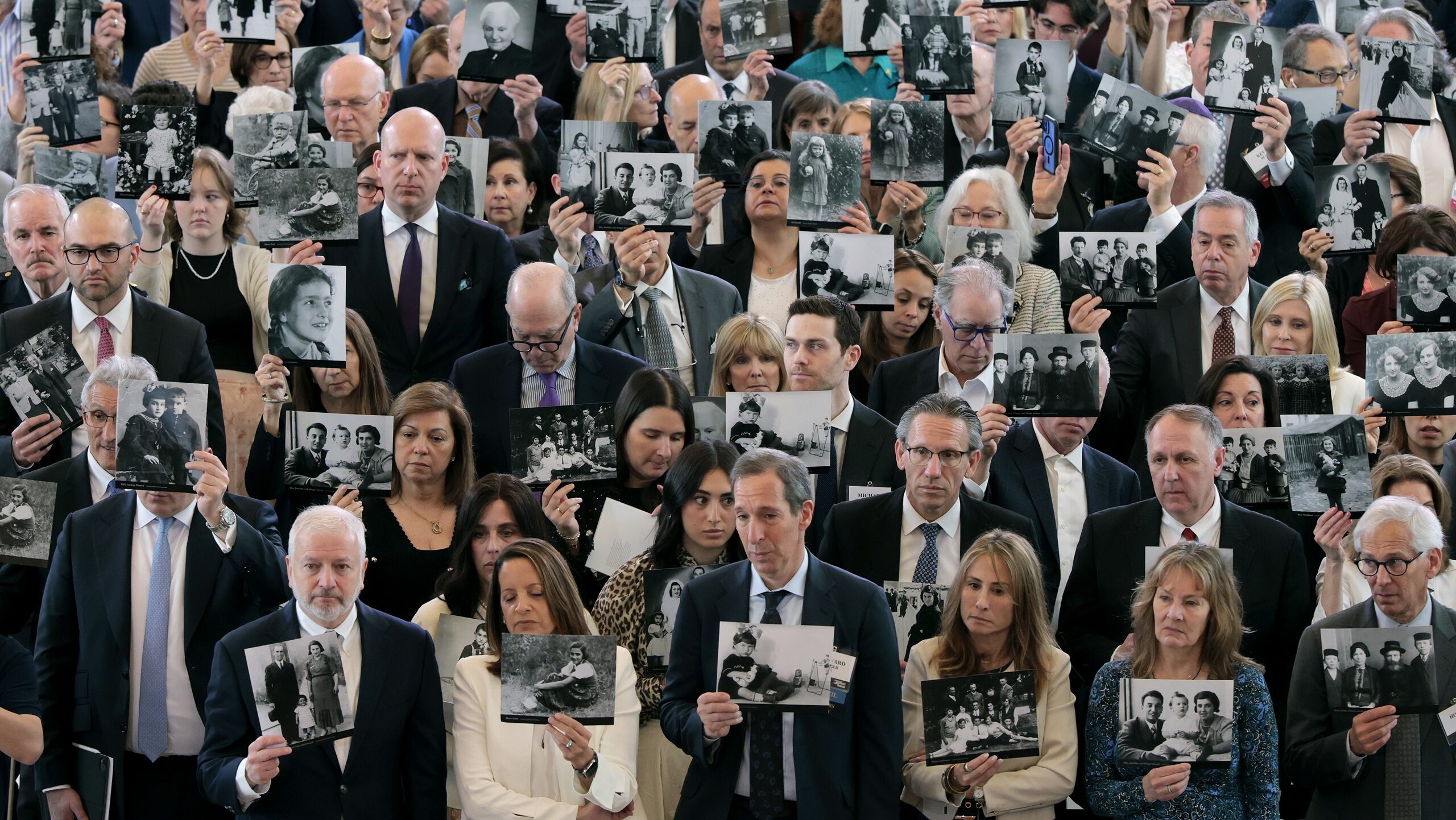
US Special Envoy for Holocaust Issues Ellen Germain, in Jerusalem, Dec. 14, 2025. (Maayan Hoffman/The Media Line)
“It could be the beginning of something, or it might not be. None of us knows,” Germain said.
Even so, she said the attack was a stark sign that Australia and the world are failing to stop antisemitism.
Holocaust education is still hugely important. It is still necessary. But it is not sufficient.
“Holocaust education has often been touted as the way to fight antisemitism,” Germain said. “We thought if people only understood, studied, if the world knew the history of the Holocaust, there would be no more antisemitism because it was so horrific. We see now that it is clearly not the case. Holocaust education is still hugely important. It is still necessary. But it is not sufficient.”
Her role at the State Department is separate from that of the special envoy to monitor and combat antisemitism, a position that remains unfilled. President Donald Trump has nominated Miami rabbi, businessman and fundraiser Yehuda Kaploun for that post, and Germain said she hopes the Senate will confirm him before year’s end.
Germain’s portfolio includes two main areas. The first covers restitution and compensation, including efforts to encourage governments to create processes or pass laws allowing claims for individual or communal property, as well as assets belonging to Jewish communities.
A second focus is promoting accurate Holocaust commemoration and education, including countering distortion and denial. Much of that work happens through international forums such as the International Holocaust Remembrance Alliance, whose conference has been taking place in Jerusalem this week. Germain spoke to The Media Line on Sunday evening on the sidelines of a two-hour World Jewish Restitution Organization (WJRO) event at the National Library of Israel in Jerusalem.
WJRO Chief Operating Officer Mark Weitzman said the organization’s work centers on private, communal, and heirless property, each representing a profound loss. He cited homes and businesses taken from families, synagogues, schools, and cemeteries seized from communities, and the property of those murdered with no surviving heirs.
“We also work extensively on looted art and cultural property,” Weitzman said. “Whether a painting in a museum, a kiddush cup, a family photograph, or a prayer book, these objects are not simply possessions; they are pieces of identity, memory, and heritage. Documenting and recovering them is an act of restoring dignity.”
He noted that WJRO launched the Holocaust Envoy Network, which, in close partnership with the State Department, produced Best Practices for the Washington Principles in March 2024. More than 30 countries have since endorsed the guidelines.
“They help create a more transparent, consistent, and fair approach to art restitution,” Weitzman explained.
Give the gift of hope
We practice what we preach:
accurate, fearless journalism. But we can't do it alone.
- On the ground in Gaza, Syria, Israel, Egypt, Pakistan, and more
- Our program trained more than 100 journalists
- Calling out fake news and reporting real facts
- On the ground in Gaza, Syria, Israel, Egypt, Pakistan, and more
- Our program trained more than 100 journalists
- Calling out fake news and reporting real facts
Join us.
Support The Media Line. Save democracy.
In recent years, there have been breakthroughs, including a 2021 agreement with Luxembourg and new laws in Latvia and Lithuania to compensate survivors for property seizures.
“We see every day how property, memory, and justice intersect,” said Dani Dayan, chairman of Yad Vashem. “Behind each looted painting, each seized storefront, each confiscated family archive, stands a human story: a life interrupted, a family dispersed, a world destroyed. When restitution succeeds, even partially, it restores not only assets but truth. And truth is the foundation both of remembrance and of justice.”
Germain said she does not like comparing the October 7 Hamas attack to the Holocaust.
“The Holocaust is unique,” she told The Media Line. “It doesn’t mean that other genocides are any less important, but the Holocaust really was unique in its scale, in the state-sponsored aspect of it, in the fact that it was transnational, and ultimately Hitler wanted to eradicate Jews from the world through a very institutionalized, mechanized method of killing.”
She added, “It was a watershed moment that challenged our values as human beings.”
At the same time, Germain said denial surrounding the October 7 massacre and the atrocities perpetrated by Hamas echoes the denialism seen in attempts to distort or deny the Holocaust. She also pointed to a wave of antisemitism that has swept across the world, including the United States, since the day after the massacre.
“These incidents have happened more often than any of us would like, of Jews being called out just for being Jewish, or told you can’t do this, or being blocked,” Germain said. “It is always, always incumbent on us to be absolutely vigilant when incidents like that happen.”
She said that “little steps led to the Holocaust. So I am not saying that these incidents will inevitably lead to anything, but we have to be really, really aware of them and try and address them, stamp them out, to try to address the prejudice and antisemitism that is causing these.”
Germain said vandalism of Holocaust institutions or monuments in response to the war in Israel is also antisemitism.
“Holocaust institutions have nothing to do with the policies of the State of Israel,” Germain said. “Blaming all Jews for the policies of the State of Israel is antisemitic. It’s one of the things that the IHRA definition of antisemitism has in its examples.”
She said she hopes the Australia attack will not be the first of many. Since the shooting, she said, the Secure Community Network in the United States and the National Security Council have warned Jews and Israelis to remain extra vigilant.
Australia has also suspended Hanukkah activities.
Germain said she believes many countries increasingly understand the horrific end to which antisemitism can lead—namely, the Holocaust.
She urged countries such as Australia to adopt the Washington Principles, which she described as a practical framework, and to conduct self-assessments. She said the principles include steps such as education, outreach, and protecting Jewish communities.
Antisemitism has also been rising in the United States. Still, Germain said both the Biden and Trump administrations have supported her work equally.
“There has always been really strong bipartisan support for Holocaust issues and for the Office of the Special Envoy for Holocaust Issues at the State Department,” Germain told The Media Line.
She has served in the role for more than four years and worked under both presidents.
“I get all the support and the backing that I need,” she said.
Germain said President Trump and Secretary of State Marco Rubio have made clear the United States will not tolerate antisemitism. She said a key test will be whether the US follows its own guidelines and actively protects Jewish communities.
“Clearly, we’re not doing enough of that,” Germain contended. “Jewish communities shouldn’t have to live under police protection. Jewish children should not have to go to school through a line of police protection. Jews should not have to go to synagogue passing police cars and policemen. … We need to get to the point where that’s no longer necessary. I think nobody knows how to do that.”
She continued, “What’s the next step? I don’t have an answer.”
Still, Germain said Holocaust issues—commemoration, education, restitution, and compensation—remain vital. She said the work of educating the world about why justice measures for Holocaust survivors and their heirs matter must continue.
“It’s a human rights issue, a rule of law issue, and we can’t forget,” she said.
Justice, justice shall you pursue
Weitzman closed by citing Deuteronomy: “Justice, justice shall you pursue.”
“WJRO is committed to the pursuit of justice in the name of the victims,” he said. “In doing so, we speak truth to power and remind the world that the dark legacy of the Holocaust must be honestly faced to give any real hope for the future.”
