
Jerusalem Pride Parade Marks a Decade Since Shira Banki’s Murder, Balancing Grief, Protest, and Pride
Under tight security, the annual event honored a murdered teen while also becoming a platform for protest, remembrance, and political expression
Thousands marched in Jerusalem on Thursday in the city’s 23rd annual Pride Parade, commemorating 10 years since 16-year-old Shira Banki was stabbed to death by a religious extremist during the 2015 march. With Israel at war in Gaza, hostages still held captive, and LGBTQ+ rights under pressure, the 2025 parade became a complex mix of grief, defiance, and political expression.
This year’s event unfolded under intense security. Police closed major roads, set up checkpoints, and deployed around 2,000 officers along the route from Liberty Bell Park to Independence Park. Participants were only allowed entry if they wore pink wristbands, part of a coordinated effort to prevent violence and control access.
President Isaac Herzog, who became the first sitting Israeli head of state to attend the Jerusalem Pride Parade, laid a wreath at the memorial site where Banki was murdered. “There is absolutely no place for violence,” Herzog said. “We demand love, respect, and equality — also for the LGBTQ+ community, which is an inseparable part of Israeli society.”
Ben Gvir and Smotrich can’t tell us who to love
Opposition Leader Yair Lapid also addressed the crowd, sharply criticizing right-wing politicians. “Ben Gvir and Smotrich can’t tell us who to love. The Haredim and the crazy people protesting against us can’t tell us who to love,” he said. “As long as Avi Maoz keeps pushing homophobic content into our schools, the struggle will continue.”
While many participants marched in rainbow flags and colorful outfits, others carried signs and wore shirts demanding the release of hostages still held by Hamas in Gaza. The Hostages and Missing Families Forum set up a table distributing posters and information. A forum representative told The Media Line that before the march began, “religious teens came, spit at us, and tore down our signs.”
A woman distributing posters summed up her message: “Freedom for the hostages; freedom to be who you want to be; freedom for the gays.” She accused the Israeli government of disliking “anyone who is different,” including both LGBTQ+ people and those urging a ceasefire to bring the hostages home.
Teenagers wearing Hapoel Jerusalem shirts and carrying flags referencing Hersh Goldberg-Polin — a fellow fan who was abducted from the Nova music festival and later confirmed killed in captivity — also joined the parade. “Jerusalem is for everyone; that’s how Hersh lived his life,” they told The Media Line, explaining that they marched to honor his inclusive spirit and the values he stood for.
Give the gift of hope
We practice what we preach:
accurate, fearless journalism. But we can't do it alone.
- On the ground in Gaza, Syria, Israel, Egypt, Pakistan, and more
- Our program trained more than 100 journalists
- Calling out fake news and reporting real facts
- On the ground in Gaza, Syria, Israel, Egypt, Pakistan, and more
- Our program trained more than 100 journalists
- Calling out fake news and reporting real facts
Join us.
Support The Media Line. Save democracy.
Jerusalem is for everyone; that’s how Hersh lived his life
The event was not without friction. A leftist, anti-war socialist group used the occasion to condemn the military campaign in Gaza, accusing Israel of “killing gay people in Gaza.” Members said Israelis should resist the draft and reject what they called “American imperialism.” Their presence sparked arguments with other marchers, and some clashed with police. One protester was detained after refusing to hand over a sign. Police have not commented on the incident.
Police clash with protesters at the Pride Parade in Jerusalem, June 5, 2025. (Sidney Zoll Fulford/The Media Line)
Some attendees expressed discomfort with how the hostage crisis and the war had been woven into the parade. One man, speaking to The Media Line, said he wasn’t against the Pride event itself, but didn’t think it should be combined with political campaigns. He was also frustrated by street closures that temporarily blocked access to his home.
Another marcher took a different stance, using the parade to champion anti-natalist views. “Make love, not babies,” he said, calling for Israeli couples to consider adoption over childbirth and criticizing societal pressure to have large families. “I support family values,” he said, “but not the glorification of endless reproduction.”
Throughout the day, many attendees stressed the political character of the Jerusalem Pride Parade. “This isn’t like Tel Aviv,” one participant said. “There, it’s just a big party. Here, it’s about change.” Others echoed that sentiment, criticizing Tel Aviv’s event for sidestepping deeper issues like the war, the occupation, and LGBTQ+ discrimination in religious communities.
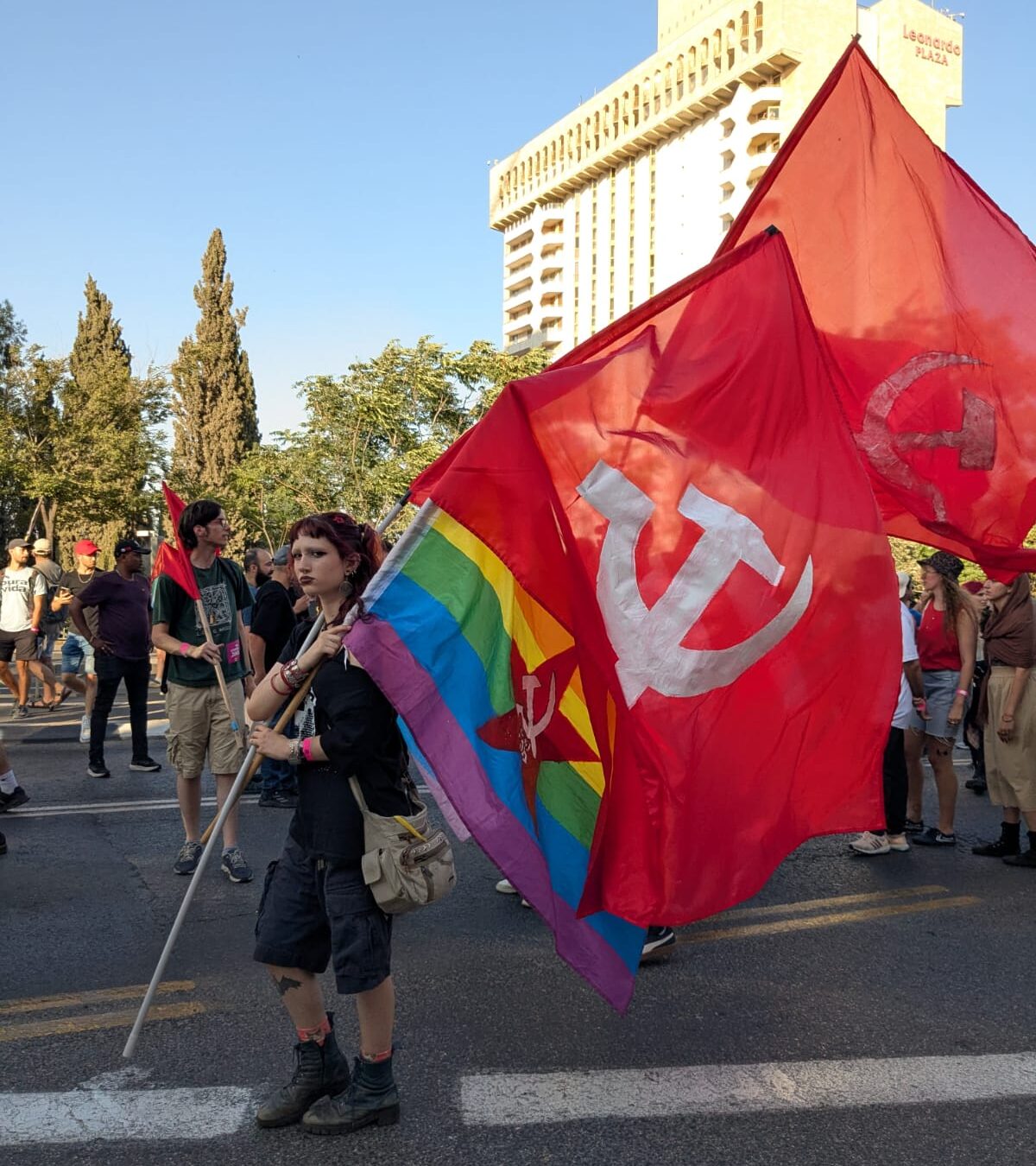
A participant carries a rainbow LGBTQ flag merged with communist symbolism, including the hammer and sickle, alongside red flags of the same iconography—reflecting the intersection of queer identity and anti-capitalist political protest, at the Jerusalem Pride Parade, June 5, 2025. (Addie J. Davis/The Media Line)
Jerusalem’s Deputy Mayor Yossi Havilio echoed concerns about growing hostility, both domestically and abroad. “Sinister winds are blowing,” he said. “In the US under President Donald Trump, in Europe, and yes — here in Israel — where some within the government seek to persecute the pride community.”
Havilio reminded the crowd that the parade has always been hard-won. “It was opposed by the municipality and government. It only takes place because of a High Court ruling. That’s why we must protect the judicial system — to safeguard our rights.”
Shira wasn’t killed by a foreign enemy. She was murdered by an Israeli citizen, as a direct result of incitement in Israel.
At the closing rally in Independence Park, Uri Banki, father of the murdered teen, told marchers, “Shira wasn’t killed by a foreign enemy. She was murdered by an Israeli citizen, as a direct result of incitement in Israel.” He added, “Her killer wasn’t insane or an outlier. He was supported by people — some out of ignorance, others knowingly.”
Ten years on, the memory of Shira Banki continues to shape the parade. But this year, her legacy unfolded alongside broader demands — for equality, for peace, and for a government that sees all its citizens.
Addie J. Davis and Sidney Zoll Fulford, interns in The Media Line’s Press and Policy Student Program, contributed to this report.
