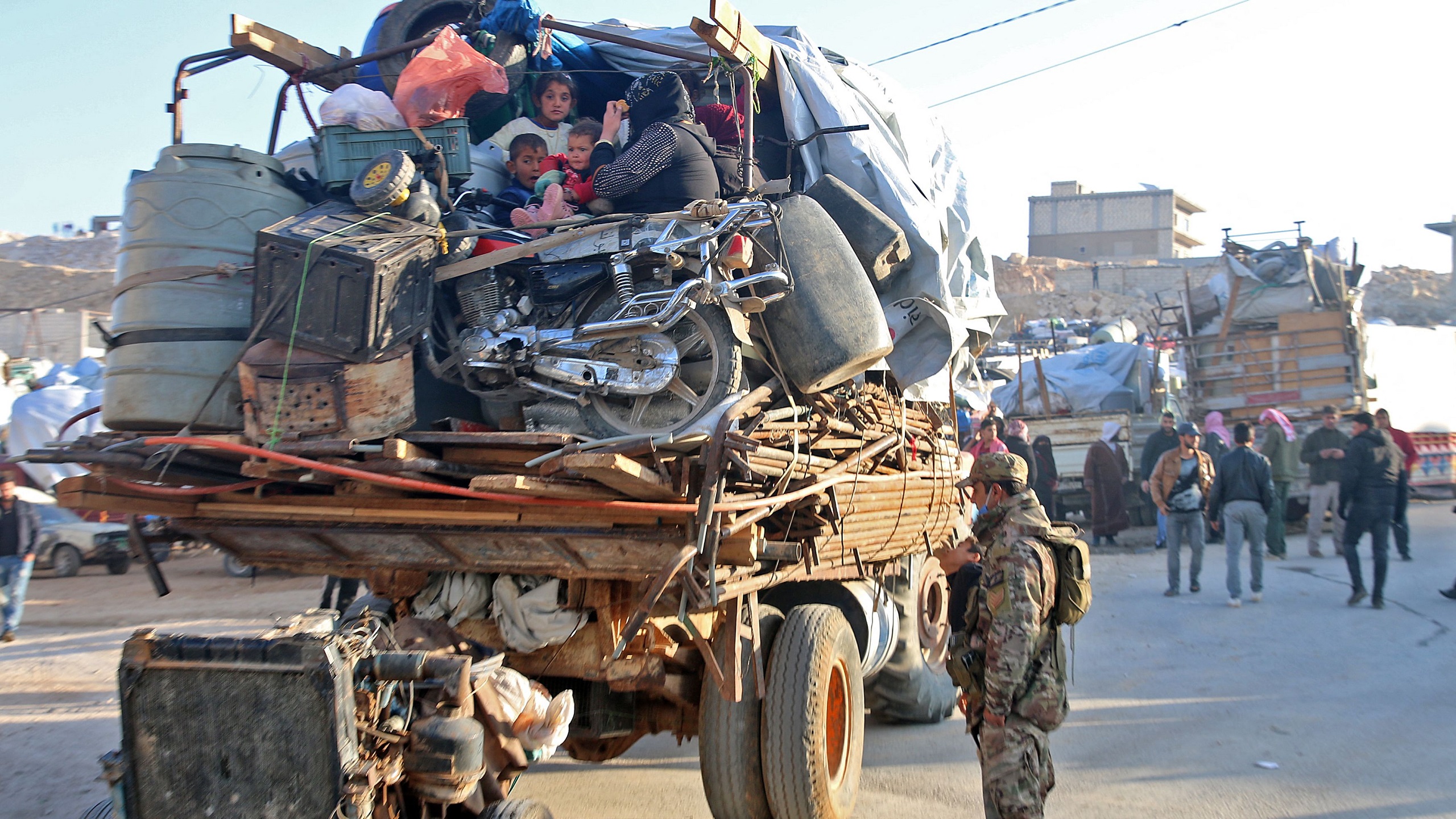
850,000 Refugees Return to Syria, but Financial and Security Concerns Keep Millions More Abroad
Researcher on Syria proposes a 3-point plan to help returning Syrian refugees overcome economic, political, and social obstacles
[Damascus] The fall of Bashar Assad’s regime in December 2024 has reignited debate over the fate of Syrian refugees across neighboring countries and Europe. After more than a decade of war and mass displacement, the collapse of the regime has brought renewed uncertainty about the future of millions who fled violence and repression in their homeland.
While large numbers of refugees have returned, many remain hesitant to take the final step, amid lingering fears for their security and financial stability. Refugees are divided between those who believe they are returning to their homeland and those who fear it is a leap into unknown territory.
Mazen Alloush, Director of Public Relations at the General Authority for Syrian Land and Sea Border Crossings, revealed in an interview with The Media Line that about 100,000 Syrian refugees returned to the country during September alone, bringing the total number of returnees since the fall of the regime to 825,000 people.
Alloush explained that most of the returnees, 540,000, came from Turkey, followed by Lebanon (155,000), Jordan (110,000) and Iraq (20,000).
He noted that the authority is working to “ensure an organized and safe reception environment for returnees” by expediting administrative and customs procedures, establishing medical stations and temporary rest areas, and granting customs exemptions for personal belongings.
“The return today is a strategic step to reunite families, stimulate the labor market, and build confidence in the new state,” Alloush added.
According to data from the United Nations High Commissioner for Refugees (UNHCR), as of autumn 2025, approximately 6.8 million Syrians reside outside their country.
Turkey hosts the largest number of Syrian refugees, with about 3.5 million people, followed by Lebanon with 1.2 million, Jordan with 660,000, Iraq with 260,000, and Egypt with 150,000. In Europe, Germany is home to roughly 800,000 Syrians, while significant communities also reside in Sweden, the Netherlands, France, and Austria.
Despite the significant number of returnees, more than five million Syrians remain abroad—many struggling with harsh economic conditions, while others have gradually integrated into their host communities.
In the Bekaa camp in eastern Lebanon, Samer stands in front of his tent surrounded by old bags he has gathered in preparation for return, but he remains hesitant. He spoke to The Media Line: “People have gone back, but no one guarantees what awaits them. Electricity is cut off and work is scarce. We want a safe country, not just the fall of a regime.”
People have gone back, but no one guarantees what awaits them. Electricity is cut off and work is scarce. We want a safe country, not just the fall of a regime
Umm Nasser, a Syrian woman living in Arsal, Lebanon, told The Media Line: “My son is ten years old and doesn’t know Syria, but every day he asks me when we will return to our country.”
According to UNHCR sources, about 155,000 Syrians have left Lebanon since the beginning of the year. However, the overall pace of return remains slow, hindered by the absence of legal and service guarantees inside Syria and the worsening living conditions in both countries.
Give the gift of hope
We practice what we preach:
accurate, fearless journalism. But we can't do it alone.
- On the ground in Gaza, Syria, Israel, Egypt, Pakistan, and more
- Our program trained more than 100 journalists
- Calling out fake news and reporting real facts
- On the ground in Gaza, Syria, Israel, Egypt, Pakistan, and more
- Our program trained more than 100 journalists
- Calling out fake news and reporting real facts
Join us.
Support The Media Line. Save democracy.


In Jordan, which hosts around 660,000 Syrian refugees, returns are being carried out through specific mechanisms coordinated between the government and the UNHCR.
Yasser, a resident of the Zaatari camp from Daraa, told The Media Line that some Syrian refugees who had returned to Syria later came back to Jordan “because of the shortage of water and electricity, and the lack of real stability that would allow a permanent return.”
A Jordanian government source confirmed to The Media Line that Amman “will not prevent return, but it will not encourage it unless security and service guarantees are available inside Syria.”
In Turkey, which hosts the largest number of Syrian refugees in the world, the pace of return is accelerating under the “voluntary safe return” programs launched by Ankara at the beginning of 2025 in coordination with the new Syrian authorities.
Abdul Karim, a refugee from Idlib living in Gaziantep, said: My wife and children returned to Syria two months ago, but I stayed to continue my work. Jobs in Syria are very scarce.
Turkish human rights groups have cautioned that some instances of “voluntary return” occur under pressure from difficult living conditions or as a result of local administrative decisions. They have urged authorities to ensure that every refugee’s return is truly voluntary and based on free choice.
In Europe—particularly in Germany—the number of Syrians who have returned since the fall of the regime has been limited to about 4,000, according to a study by the ARD channel. Returns are obtained through government programs that offer financial assistance to those who choose to go back.
Hala, a Syrian engineer in Berlin, said in an interview with The Media Line: My heart is with my country, but I’m afraid I’ll return and find it a different place. We need real guarantees, not political promises.
Migration experts believe that refugees in Europe “have rebuilt their lives completely,” which makes return for them “a moral decision more than a realistic one.”
The Syrian refugee needs to feel that the new state protects him, not monitors him, that the judiciary is independent, and that the law is equal for everyone
Dr. Khaled Darwish, a researcher on Syrian affairs, told The Media Line that “real return is not measured by numbers, but by trust.”
He added: “The Syrian refugee needs to feel that the new state protects him, not monitors him, that the judiciary is independent, and that the law is equal for everyone.”
He explained that the main obstacles to the return of refugees are poor infrastructure, limited job opportunities, and the lack of adequate health and education services.
Darwish suggested a three-part plan to address these challenges. On the economic level, he proposed launching small and medium-sized support programs for returnees, particularly in agriculture and construction. Politically, he called for a comprehensive amnesty law to ensure that no refugee would face prosecution on political or security grounds. Socially, he recommended initiating community reconciliation campaigns in areas that experienced internal conflict.
Economic expert Laila Sabbagh said that “encouraging return requires a national reconstruction plan” that involves private investors as well as returning refugees in rebuilding the country’s economy and communities.
She added in an interview with The Media Line: “Syrians abroad can be partners in rebuilding the economy if there are transparent policies that encourage investment and protect property.”
In rural Homs, Laila (35 years old) returned from Lebanon three months ago. She said, wiping dust off the partially destroyed walls of her home: “There’s still not much electricity, and water is scarce, but we came back. We want to start again, even step by step. “
Stories like this are repeated in Aleppo, Daraa, and rural Damascus, where families are rebuilding their lives amid challenges to their livelihoods and services. Despite the difficulties, some see return as a decision of dignity before comfort.
We came back because we were tired of exile, but we don’t want to live another exile inside our country
After ten months of political transition, Syria appears to be at the early stages of a long and uncertain path to recovery. The numbers point to a noticeable wave of returns, yet it remains limited and fragile. Refugees say their foremost hopes are for safety, justice, and a homeland that truly belongs to all its people.
As Abu Nader, one of the returnees from Jordan, said: “We came back because we were tired of exile, but we don’t want to live another exile inside our country.”
