Exclusive: Azerbaijani Presidential Adviser Warns DC on Gaza, Don’t Repeat Our Mistakes—As Ties With Russia Fray
Hikmet Hajiyev draws on Azerbaijan's postwar experience to warn against security-only stabilization plan
[BAKU] As Israel weighs Turkey’s role in any Gaza stabilization force, Azerbaijan is warning that security-first approaches to postwar reconstruction will fail without local acceptance and economic integration—advice drawn from its own post-conflict experience and aimed at proposals circulating in Washington and Jerusalem.
Any stabilization force must be realistic, not symbolic. It has to be accepted locally and coordinated internationally.
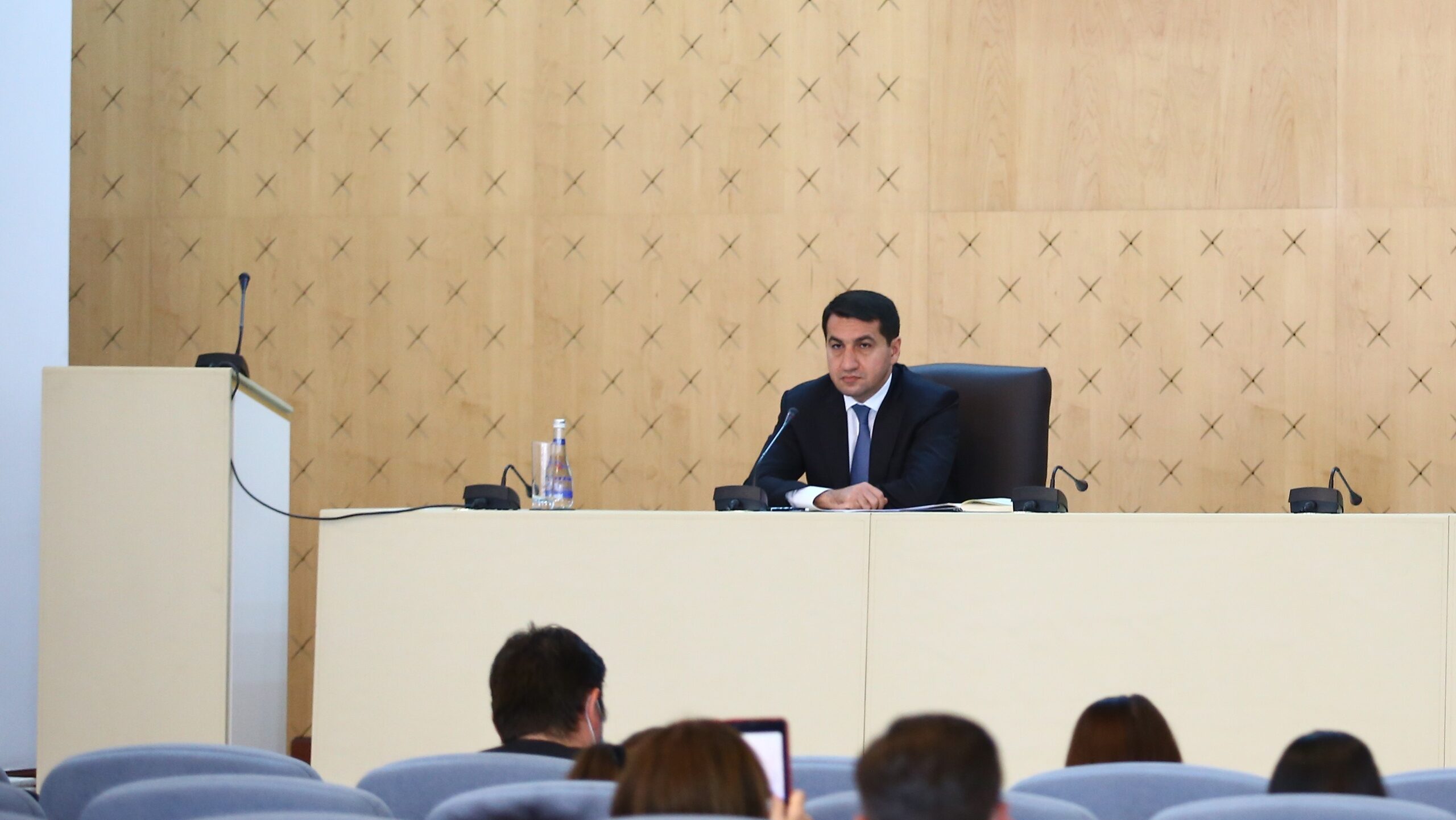
“Any stabilization force must be realistic, not symbolic,” Hikmet Hajiyev, senior foreign policy adviser to President Ilham Aliyev, told The Media Line. “It has to be accepted locally and coordinated internationally. We have seen many cases where security arrangements failed because they were imposed rather than constructed.”
The warning comes as Azerbaijan navigates increasingly volatile regional alignments. Baku maintains a strategic alliance with Israel while its closest partner, Turkey, positions itself as a key broker in Gaza’s future—a role that worries Israeli planners already wary of Ankara’s ambitions in Syria and the eastern Mediterranean.
For Azerbaijani officials, the stakes extend beyond Gaza. The country is positioning itself at the center of a geopolitical contest that stretches from Israel and Turkey through Iran, Russia, and the South Caucasus—a contest increasingly defined by corridors, energy routes, and strategic alignment rather than ideology alone.
“Azerbaijan does not see itself as a bystander,” Huseyn Huseynov, an adviser to Azerbaijan’s minister of economy, told The Media Line. “We are building systems that link regions, reduce dependence, and create shared interests. That is how stability is constructed.”
Reflecting on Azerbaijan’s own postwar reconstruction, Hajiyev warned that approaches focused solely on security will collapse. “If there is no political horizon, no security mechanism will be sustainable,” he said. “Reconstruction without integration only postpones the next crisis.”
That strategy is already translating into measurable results at home. Container throughput at the Baku International Sea Trade Port rose by more than one-third in 2025, surpassing 100,000 TEUs for the first time—a threshold long viewed as critical for commercial viability. Nearly 40% of that cargo originated in China, reflecting a growing shift by Asian exporters away from Russia-linked northern routes and sanctions-exposed transit corridors.
The gains follow Azerbaijan’s consolidation of port, rail, and customs operations, reducing transit times across the Caspian Sea and strengthening the Trans-Caspian “Middle Corridor” linking China and Central Asia to the Caucasus, Turkey, and Europe. Parallel investments in rail electrification, digital customs clearance, and logistics hubs in Karabakh and Zangilan highlight Baku’s intent to anchor east–west connectivity regardless of political uncertainty elsewhere in the region.

Fariyaz Rustamov of Azerbaijan Railways reviews corridor mapping at a rail construction site near Aghali, Zangilan District—part of the Middle Corridor infrastructure connecting the Caspian Sea to Turkey through territories retaken from Armenia in 2020. (Jacob Wirtschafter/The Media Line)
At the center of Azerbaijan’s regional posture is a deepening partnership with Israel—one that officials and analysts describe as structural rather than transactional.
Israel and Azerbaijan have a real strategic alliance, not a transactional one
“Israel and Azerbaijan have a real strategic alliance, not a transactional one,” said Brenda Shaffer, a faculty member at the US Naval Postgraduate School specializing in energy and Eurasian security. “It goes far beyond oil and arms and has been developing steadily for three decades.”
That alliance is anchored in concrete exchange. Azerbaijan supplies roughly 40% to 50% of Israel’s crude oil imports, primarily via the Baku-Tbilisi-Ceyhan pipeline and Mediterranean shipping routes. In return, Israeli defense firms have been among Azerbaijan’s most important military suppliers over the past decade, providing drones, air defense systems, and precision technologies that reshaped the military balance in the South Caucasus.
October 7 and Israel’s war in Gaza placed that relationship into sharper relief. As much of the Muslim world distanced itself from Israel, Azerbaijan maintained—and in some cases expanded—cooperation.
Hajiyev emphasized that Baku views its relationship with Israel as a long-term stabilizing partnership rather than a short-term tactical alignment.
Azerbaijan matters strategically because it is the only country in the world that borders Russia and Iran. It also borders Turkey through its exclave. Azerbaijan sits at the intersection of multiple important geopolitical fault lines.
“Azerbaijan matters strategically because it is the only country in the world that borders Russia and Iran,” Shaffer said. “It also borders Turkey through its exclave. Azerbaijan sits at the intersection of multiple important geopolitical fault lines.”
The exclave, Nakhchivan, is an Azerbaijani territory cut off from the rest of the country by Armenian land—making direct land access a core strategic priority for Baku.
That geography has elevated Baku’s value in Washington as the Trump administration looks to revive and expand the Abraham Accords—the 2020 agreements that normalized relations between Israel and several Arab states—beyond the Arab world. According to Shaffer, the administration views Azerbaijan as “a strategically reliable Muslim-majority partner aligned with US and Israeli interests,” particularly as Washington seeks to translate diplomacy into physical infrastructure—rail, pipelines, electricity grids, and fiber-optic cables—that can endure beyond electoral cycles.
Energy remains a cornerstone of Azerbaijan’s regional influence, particularly as Europe and Israel seek alternatives to Russian supply.
Give the gift of hope
We practice what we preach:
accurate, fearless journalism. But we can't do it alone.
- On the ground in Gaza, Syria, Israel, Egypt, Pakistan, and more
- Our program trained more than 100 journalists
- Calling out fake news and reporting real facts
- On the ground in Gaza, Syria, Israel, Egypt, Pakistan, and more
- Our program trained more than 100 journalists
- Calling out fake news and reporting real facts
Join us.
Support The Media Line. Save democracy.
“Azerbaijan’s energy role isn’t about replacing Russian gas,” Shaffer said. “It’s about diversification. Even modest volumes from an additional supplier fundamentally reduce vulnerability by taking away Russia’s ability to hold all the cards.”
That logic now extends beyond crude oil. In 2025, Azerbaijan’s state energy company SOCAR acquired a 10% stake in Israel’s Tamar natural gas field in a deal valued at approximately $900 million, one of the largest single Azerbaijani investments in Israel to date. As part of the same package, SOCAR—alongside BP—won a tender for offshore gas exploration in Israeli waters.
Officials in Baku describe the deal as strategic rather than purely commercial, signaling a shift toward long-term production, upstream cooperation, and shared energy security planning.
Azerbaijan regained control of Karabakh and surrounding districts in a six-week war with Armenia in 2020, ending nearly three decades of Armenian occupation that began during the Soviet collapse. The conflict displaced close to 1 million Azerbaijanis in the early 1990s. A Russian-brokered ceasefire left the territorial status unresolved until September 2023, when Azerbaijan launched a brief military operation that effectively ended Armenian control.
The war reshaped regional alignment: Russia’s inability to protect Armenia undermined decades of dependence, while Turkey’s military and political support for Azerbaijan solidified Ankara’s role as Baku’s primary strategic partner.
Nowhere is that logic more sensitive than westward, through Armenia, where negotiations over transport access and post-conflict normalization remain fragile.
“The real strategic problem for both Armenia and Azerbaijan today is Russia, not each other,” Shaffer said.
For decades, Armenia’s dependence on Russian-owned energy, transport, and communications infrastructure has constrained its strategic autonomy. Corridors that pass through or around Armenia could either entrench that dependence or begin to loosen it.
“Reducing Armenia’s dependence on Russian-owned infrastructure—energy, transport, and communications—is central to making any peace durable,” Shaffer said.
Corridors, she stressed, are not merely trade routes. “They can include energy lines, electricity connections, and fiber-optic cables that can reduce Armenia’s dependence on Russia.”
Diaspora politics further complicate the picture. “The main Armenian-American lobby group, the Armenian National Committee of America, focuses most of its current activity against the Pashinyan government,” Shaffer said, highlighting a growing divergence between diaspora advocacy and Armenia’s domestic strategic calculations.
Russia looms over Azerbaijan’s corridor strategy not only as a structural constraint but increasingly as an operational risk. That tension sharpened following the recent downing of an Azerbaijani civilian aircraft, which Baku-based news outlet AnewZ reported was struck by a missile fired from a Russian Pantsir air defense system. Azerbaijani officials have stopped short of public escalation, but the incident reinforced longstanding concerns about the unpredictability of Russian military activity across shared airspace and transit zones.
In background briefings, officials framed the episode as emblematic of a broader problem: a regional security environment in which Moscow’s actions, whether intentional or negligent, complicate civilian transport, trade routes, and energy infrastructure.
Those tensions surfaced again this week when President Ilham Aliyev skipped an informal Commonwealth of Independent States summit in Saint Petersburg, with his office citing a busy schedule. Moscow’s spokesman said the decision was understood and emphasized continued cooperation. Aliyev also skipped a related meeting of the Supreme Eurasian Economic Council, a body Azerbaijan is not formally part of—highlighting cautious, transactional engagement with Russian-led formats.
If Russia is the primary obstacle to Armenia’s reorientation, Iran looms as the most consequential long-term variable for Azerbaijan itself—and a central concern for Israeli planners.
“Iran’s behavior toward Azerbaijan was hostile from the moment the Soviet Union collapsed—well before Israel-Azerbaijan ties became close,” Shaffer said.
Tehran’s concerns, she added, are demographic and geopolitical rather than ideological. “The main factor in Tehran’s hostility toward Baku is that Iran fears Azerbaijan being a source of attraction to its own ethnic Azerbaijani minority, which comprises about a third of the population of Iran.”
Ethnic minorities make up more than 60% of Iran’s population, with Azerbaijanis the largest group after Persians—yet none are permitted schooling in their native languages.
Iran’s policies are driven by geopolitical interests, not religious alignment. When its interests are at stake, ideology is secondary.
“Iran’s policies are driven by geopolitical interests, not religious alignment,” Shaffer said. “When its interests are at stake, ideology is secondary. For instance, Tehran supported Christian Armenia over Shia-majority Azerbaijan in a conflict where the Armenians kicked close to 1 million Azerbaijanis from their homes.”
Publicly, Azerbaijani officials describe relations with Iran as “working,” echoing language used by President Aliyev. Privately, analysts say Baku views Iran as both a neighbor and a latent destabilizer, particularly if unrest inside Iran spills northward.
“Azerbaijan is a pressure point on Iran due to ethnic composition and proximity,” Shaffer said, adding that regional actors are quietly preparing for multiple Iranian contingency scenarios.
Turkey’s role further complicates Azerbaijan’s balancing act, especially as Ankara seeks influence in Gaza’s postwar future.
When you have close allies operating militarily in unstable environments, proximity itself becomes a risk. Accidents and misunderstandings can easily happen.
“When you have close allies operating militarily in unstable environments, proximity itself becomes a risk,” Shaffer said. “Accidents and misunderstandings can easily happen.”
While Turkey strongly wants a role in Gaza, Israeli discomfort is clear. “… Israel is deeply uncomfortable with Turkish forces operating there,” she said.
Analysts suggest Azerbaijan would be unlikely to deploy forces independently, but could align politically or logistically with Turkish initiatives—a scenario that worries Israeli planners already wary of Ankara’s ambitions in Syria and the eastern Mediterranean.
For now, the shape of any Gaza stabilization force remains undefined, as Hamas’s position on disarmament continues to shift and Washington and Jerusalem diverge on Turkey’s appropriate role.
As regional tensions reshaped travel patterns, Baku quietly emerged as both a transit hub and a destination for Israeli travelers. During the Hanukkah holiday period, hotels in central Baku reported being filled with Israeli tour groups and families arriving via European and Caucasus routes, as direct air travel between Turkey and Israel remained suspended.
Around Fountains Square, flanked by synagogues serving both the indigenous Mountain Jewish community and Ashkenazi Jews, Hebrew was heard openly in cafés and hotel lobbies—a rare sight in a Muslim-majority capital at a moment of heightened polarization.
Israeli travel agents increasingly market Baku as a stopover between Israel and Europe, alongside Athens, reflecting Azerbaijan’s unusual position as accessible, secure, and politically stable.
Azerbaijan’s growing diplomatic role reflects its ability to maintain dialogue with actors that often refuse direct contact.
Azerbaijan speaks to many sides who do not speak to each other. We do not see mediation as taking sides. We see it as preventing escalation.
“Azerbaijan speaks to many sides who do not speak to each other,” Hajiyev told The Media Line. “We do not see mediation as taking sides. We see it as preventing escalation.”
Conflicts like Gaza, he warned, do not remain local. “Their consequences travel,” he said.
From Baku’s perspective, corridors are not neutral projects but instruments of alignment. They reduce dependence on hostile powers, bind partners through shared assets, and narrow the space for coercion by larger neighbors.
“Any stabilization effort that ignores economic and political realities will fail,” Hajiyev said. “That lesson applies in the South Caucasus, and it applies in the Middle East.”
