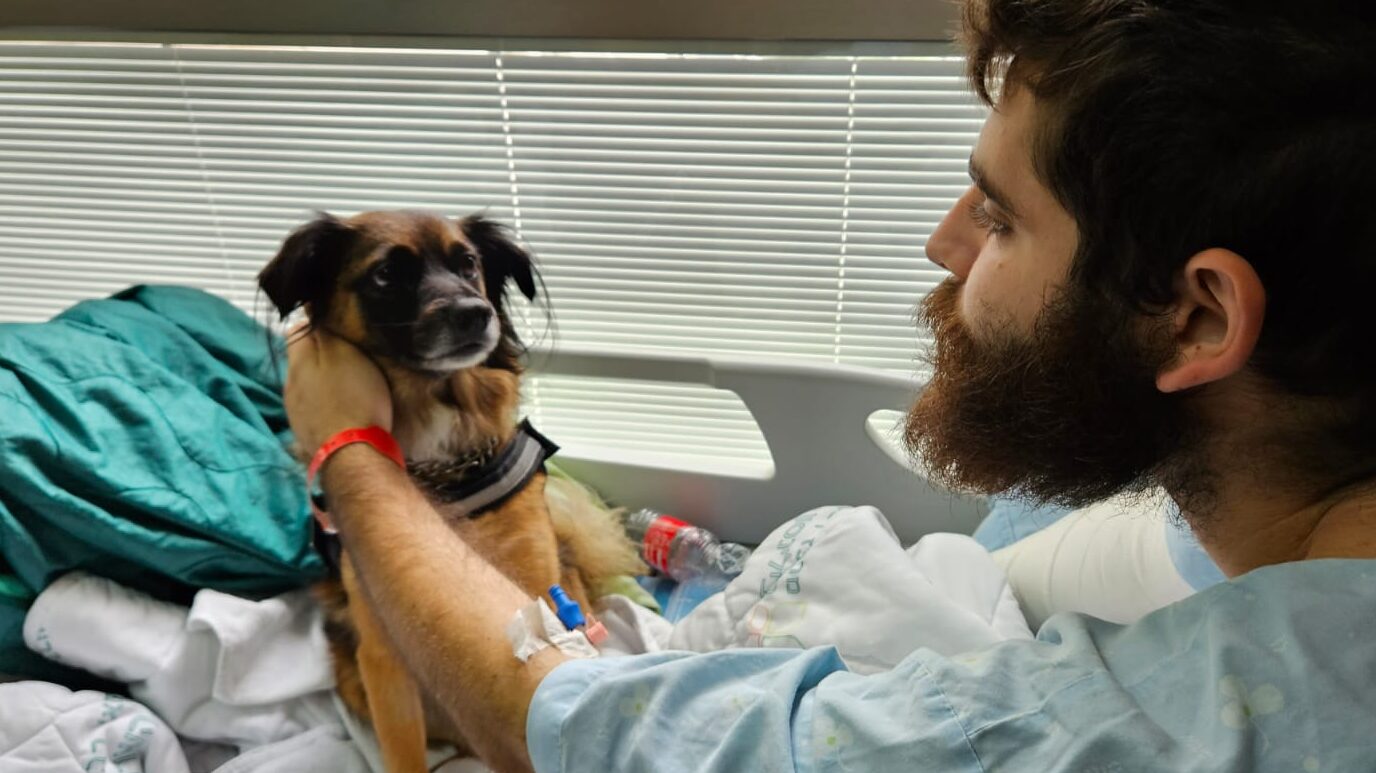
Can a Wagging Tail Speed Recovery? Inside Rabin Medical Center’s ‘Dog Medicine’ Program and New Study
Senior nurse Keren Matry says a therapy dog is “better than a drug from a doctor or a nurse”
At Rabin Medical Center (RMC), a team of clinicians is exploring whether “dog medicine” can do more than lift spirits. They are asking a serious medical question: How will integrating a trained medical therapy dog into the rehabilitation of certain patients improve their recovery outcomes?
The clinical research initiative, conducted in the neurology department, specifically examines the impact of integrating a trained medical therapy dog into the rehabilitation of patients in the acute phase after stroke and could have implications for patients with other challenges as well. The researchers are evaluating whether combining standard physiotherapy with structured sessions involving a medical therapy dog can improve rehabilitation outcomes.
Patient progress is assessed using objective physiotherapy-based clinical measures, such as the standardized six-minute walk test, as well as participant interviews that examine motivation, cooperation with therapy, engagement in rehabilitation, and mood.
The standardized six-minute walk test measures the maximum distance a person can walk on a flat surface in six minutes, along with additional clinical evaluations.
The research protocol was developed and is being led by senior nurse Keren Matry; physiotherapists Shlomi Shochat and Yuval Levinsky; and in collaboration with Dr. Yonatan Naftali, a senior physician in the neurology department.
The research comes at a critical moment. Since Oct. 7, 2023, the number of patients requiring physical rehabilitation has risen sharply. It also builds on four years of a unique dog medicine program at the hospital, an initiative that has led staff to believe these animals may be capable of changing the trajectory of care.
On an early morning visit to RMC, Matry and her medical therapy dog, Teddy, can be found walking through the hallways. With each step, patients in the corridors turn their heads, take notice and smile. The dog’s presence is immediately felt.
Teddy is not what most people picture when they imagine a standard medical therapy dog. He is a tiny, furry mutt with a wildly wagging tail and little feet that scamper across the floor.
Matry recalls the story of a soldier who lost an eye in the war. A missile struck his head as he tried to protect a colleague who ultimately died. Afterwards, the soldier refused to talk. Then Teddy came to see him. Something shifted, Matry recalled. The soldier opened up, began to cry and spoke to Teddy. By the end of the visit, he placed his Givati Brigade beret on the dog’s head.
In another case, a soldier who had been intubated and suffered brain damage lay unresponsive in his hospital bed. Matry brought Teddy to his bedside. She covered the bed with a sheet and let the dog hop up. Then she took the soldier’s hand and gently used it to pet Teddy. The soldier opened his eyes and tried to follow the movements.
“This gave so much hope to the family,” Matry told The Media Line.
That soldier is now in rehabilitation.
In another case, a Nova survivor did not want to leave his hospital bed. But when he heard that Teddy was downstairs, he decided to visit.
Matry said the dog’s presence helps people open up.
“He does not judge them,” she told The Media Line.
Give the gift of hope
We practice what we preach:
accurate, fearless journalism. But we can't do it alone.
- On the ground in Gaza, Syria, Israel, Egypt, Pakistan, and more
- Our program trained more than 100 journalists
- Calling out fake news and reporting real facts
- On the ground in Gaza, Syria, Israel, Egypt, Pakistan, and more
- Our program trained more than 100 journalists
- Calling out fake news and reporting real facts
Join us.
Support The Media Line. Save democracy.


In yet another case, unrelated to the war, a young woman who had been involved in a car accident was receiving oxygen through her nose. Doctors wanted to remove it, but she did not believe she could breathe on her own. Matry brought Teddy in, and they began to play on the patient’s bed. Slowly, Matry turned the oxygen down until it was entirely off. After 15 minutes, she told the patient that she had been breathing on her own. That realization gave the patient the confidence to continue.
Medical therapy dogs are commonly used to assist patients struggling with mental health disorders, particularly post-traumatic stress disorder. At RMC, however, a program unique in Israel and rare globally brings therapy dogs into mainstream hospital wards to support patients in a wide range of medical settings. These include the intensive care unit, geriatrics and, very often, neurology.
Many hospitals avoid such programs due to concerns about germs and infection. To make it work safely, Matry shampoos Teddy and his sister, Yuli—who also works as a medical therapy dog—whenever they come to the hospital. She places a clean sheet over a patient’s bed before Teddy jumps up. She wipes the patient’s hands with antibacterial gel before and after any interaction.
Because Matry is a trained nurse, she can check for allergies or other potential medical complications and carefully select which patients the dogs meet.
The medical dog program began at the hospital six years ago, and Matry joined it four years ago, training the dogs herself. It initially focused on geriatrics but quickly expanded to other departments. Teddy was Matry’s personal pet before his training, and he still lives with her and serves as a house dog. A couple of years ago, she rescued Yuli and trained her as well.
Today, the therapy is fully integrated into hospital care. Doctors and nurses can request Teddy or Yuli through the hospital system, and Matry, after reviewing a patient’s file, delivers the treatment.
According to Matry, “Teddy is better than a drug from a doctor or a nurse.”
She explained that when a dog is placed near a patient, and the patient interacts with it, oxytocin levels rise and stress hormones decrease. This effect has been scientifically demonstrated in studies conducted outside of Israel.
There is also a growing body of research supporting the therapeutic impact of dogs.
For example, a study published last year in the journal Neurology found a 43% average decrease in 28-day seizure frequency among individuals paired with seizure-alert dogs compared with those who were not.
Another paper, published by the International Journal of Environmental Research and Public Health, reviewed 17 trials involving dogs and found that animal-assisted therapy in various neurological diseases offers significant benefits. These ranged from improvements in motor and physical ability to gains in mental and behavioral health.
“Conclusions: This systematic review provides occupational therapy practitioners with evidence on the use of activity-based animal-assisted therapy as a novel field of intervention that can complement other therapies and obtain benefits in different populations,” the authors wrote.
There’s certainly lots of research that has been done in the field of autism and use of animals with people with autism, where the connection is much easier with an animal than it is with a human being
Dr. Mark Hellmann, a senior neurologist and head of the Neuroimmunology Clinic at RMC, told The Media Line that formal research shows that interacting with dogs can provide patients with an alternative channel of communication.
“There’s certainly lots of research that has been done in the field of autism and use of animals with people with autism, where the connection is much easier with an animal than it is with a human being,” Hellmann said.
He explained that when patients have neurological diseases that affect their ability to react and interact, the presence of a dog can help them respond more effectively.
That same morning at RMC, Hellmann and Matry visited a man who had recently suffered a stroke on his left side, leaving him struggling to move his right. Matry placed a piece of dog food in the patient’s hand and asked him to feed Teddy. At first, he could not, or the food slipped from his grip. Still, the man remained determined, smiling throughout. Eventually, he succeeded.
“Animals have sensors that we don’t have,” Hellmann said. “So there are all sorts of diseases like epilepsy and others where there are subtle things that happen to a patient and a dog, through their senses, can detect things that we wouldn’t be able to detect. … Animals can cause stimulation of areas that human beings wouldn’t be able to reach and therefore improve rehabilitation and speed up rehabilitation.”
Hellmann added that emotionally, dogs can also accelerate the rehabilitation process. He said they may be invaluable in the immediate aftermath of a traumatic experience, reducing the likelihood of developing post-traumatic stress disorder.
After a traumatic event, a soldier could be in acute stress, and doctors or nurses may not be able to read him. Somehow, when the dog is there, you ask the soldier not to speak to the nurse or doctors, but speak to the dog
“After a traumatic event, a soldier could be in acute stress, and doctors or nurses may not be able to read him. Somehow, when the dog is there, you ask the soldier not to speak to the nurse or doctors, but speak to the dog,” Hellmann said. “Just looking into the dog’s eyes, there’s something in the chemistry that happens between a human and a dog that can break that threshold and let things come out.”
Teddy and Yuli work hard. Matry said there are times when she needs to keep them home if they are not feeling well, or remove them from situations when they become too tired. Just as dogs absorb the positive emotions of the people around them, they also take on the emotions of the patients they serve. By the end of the day, they can be exhausted.
“Dogs are our mirror,” Matry said.
This field should have more dogs and more in the hospital. Every department needs to have a dog like this.
The research team’s study focusing on stroke patients is expected to be completed in about a year. The team hopes to publish the findings and receive formal recognition for the program within that department. At the same time, plans are to expand the program further across RMC.
“This field should have more dogs and more in the hospital,” Matry said. “Every department needs to have a dog like this.”
This report is part of Traumatech, a new series developed and created by Maayan Hoffman and debuting on The Media Line. The series explores how Israel is building and exporting breakthrough mental health technologies that can transform life at home and bring hope to communities worldwide.
