Can Protests Inside Iran Sever the Houthis’ ‘Umbilical Cord’?
Figures and testimonies indicate Yemenis no longer see Iran’s protests as distant or internal, but as a potential regional lever that could break Yemen’s political and economic deadlock
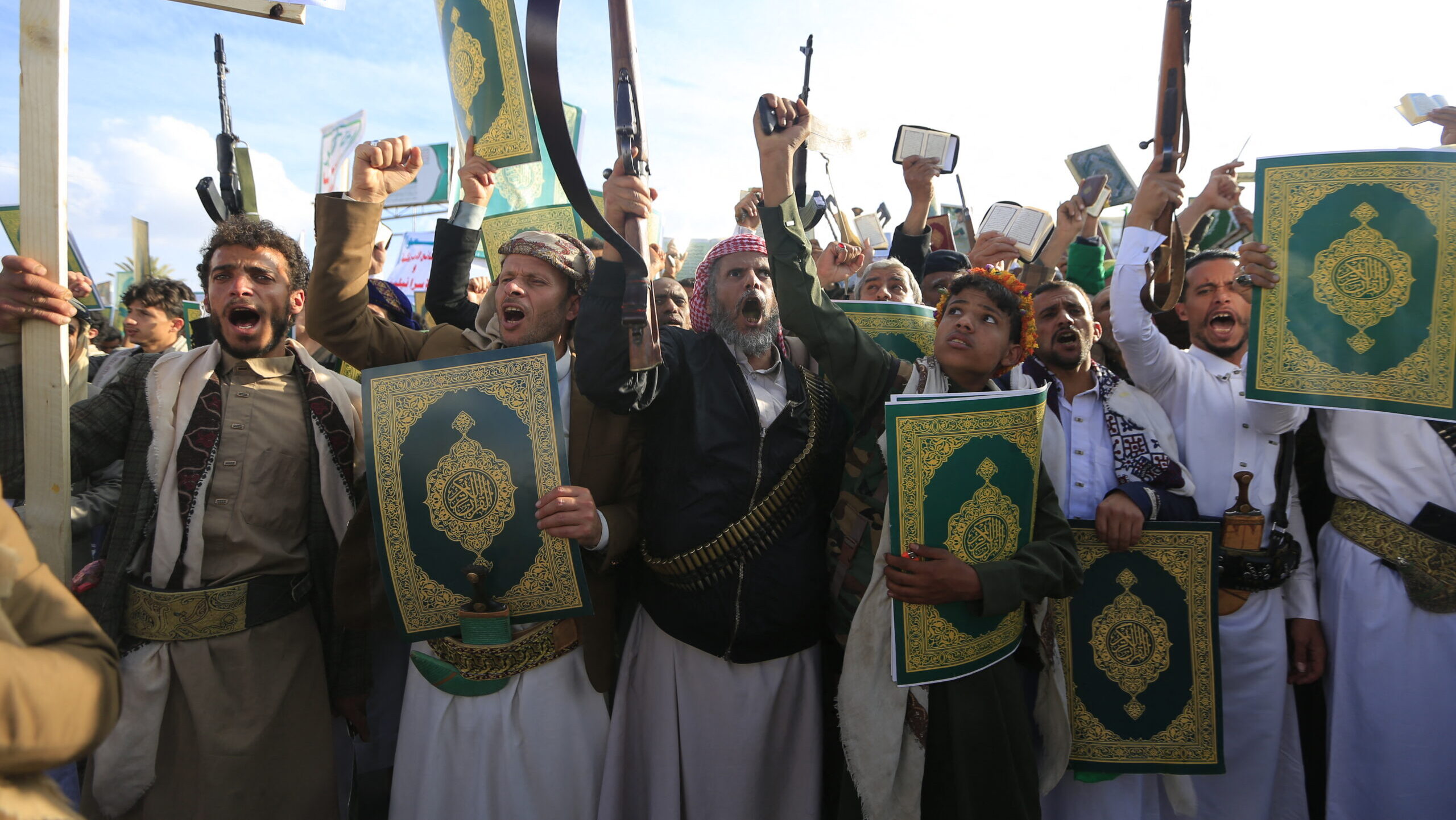
[SANAA] A large segment of Yemenis believe that Tehran has never been a mere bystander in their country’s long war. Rather, it has been, and remains, a central actor in engineering the crisis. The Ansar Allah movement (the Houthis), through years of systematic political and military support, has consolidated its grip on the capital, Sanaa, and large swaths of northern Yemen, transforming an internal conflict into an open-ended proxy war. The result has been the exhaustion of Yemen’s land and people, and one of the world’s worst humanitarian crises, with nearly 20 million Yemenis today in need of assistance to survive.
Against this heavy backdrop, recent demonstrations in Iranian cities have raised an unprecedented question: How do Yemenis view protests targeting the very “backing regime” that underpins the de facto authorities ruling their areas?
A qualitative opinion survey conducted by The Media Line, involving 40 participants including academics and journalists living in Houthi-controlled areas of Sana’a, Amran, and Dhamar governorates, reveals a notable shift in public sentiment toward the group and Iranian intervention.
The survey found that 32 participants, representing 80%, expressed unequivocal support for the protests in Iran, describing them as a “legitimate right” to reclaim a hijacked state. Many believe that the success of the Iranian protest movement could curtail Tehran’s regional influence, thereby weakening the ability of its allies in Yemen to persist in political intransigence.
In a striking comparison, respondents linked “Iranians’ right to reclaim their state” with “Yemenis’ right to reclaim their hijacked state,” suggesting that breaking Iran’s influence is the unavoidable gateway to resolving Yemen’s stalled political process.
Beyond the chants echoing through Tehran’s streets lie hard numbers that help explain why Yemenis in Sanaa are watching these protests with hope. The relationship between the center in Tehran and the periphery in Yemen is not merely an ideological alliance; it is a financially and militarily documented “umbilical cord,” widely seen by Yemenis as the greatest obstacle to restoring their state and stabilizing their collapsed currency.
United Nations reports indicate that the Houthis’ “war economy” breathes through an Iranian lung. In its latest report, the UN Security Council Panel of Experts (S/2024/731) documented that the Houthis reaped massive profits through the importation of smuggled Iranian oil and gas using falsified certificates of origin.
These operations generated customs revenues at Houthi-controlled ports, estimated at approximately $4 billion between 2022 and 2024. According to the report, funds that could have alleviated the suffering of millions of unpaid public-sector workers were instead funneled into strengthening the group’s military “empowerment machine.” This helps explain why 80% of survey respondents in Sanaa viewed the fall of the Iranian regime as key to reducing the Houthis’ capacity to maintain political obstruction and reject dialogue.
Give the gift of hope
We practice what we preach:
accurate, fearless journalism. But we can't do it alone.
- On the ground in Gaza, Syria, Israel, Egypt, Pakistan, and more
- Our program trained more than 100 journalists
- Calling out fake news and reporting real facts
- On the ground in Gaza, Syria, Israel, Egypt, Pakistan, and more
- Our program trained more than 100 journalists
- Calling out fake news and reporting real facts
Join us.
Support The Media Line. Save democracy.
This connection is emphasized by Mubarak Al-Najjar,* a Yemeni journalist who argues that those Yemenis backing the protests understand that regime change in Iran would inevitably sever this financial and military umbilical cord. The collapse of Iran’s model of “exporting the revolution,” he adds, “would mean drying up the $4 billion oil revenue stream and halting the flow of military technology.”
This view is echoed by tenured professor at Sanaa University, Nabil Ahmed,* who contends that ending Iranian intervention is the only pathway to compel the Houthis to shift from an armed “regional proxy” to a Yemeni political actor compelled to participate in peace talks.
According to Ahmed, the Houthis are living in a state of “suppressed panic.”
They know the Iranian experience is their mirror. They are watching how the fear of the security forces dissipated in the face of protesters, and they fear this contagion spreading to an already exhausted Yemen.
“They know the Iranian experience is their mirror,” he said. “They are watching how the fear of the security forces dissipated in the face of protesters, and they fear this contagion spreading to an already exhausted Yemen.” This, he argues, explains the uniformity of their media narrative, which portrays protests in Tehran as a “global conspiracy.”
He added that Yemenis—unable to demonstrate openly for fear of repression—have launched a form of “digital resistance” on social media, expressing deep resentment toward a regime they believe has usurped their country’s sovereignty. A widely shared cartoon captures the peak of this sentiment, depicting a vacuum cleaner of protests sweeping away symbols of regional influence, while the Iranian regime clings to the Houthi card as its last stronghold.
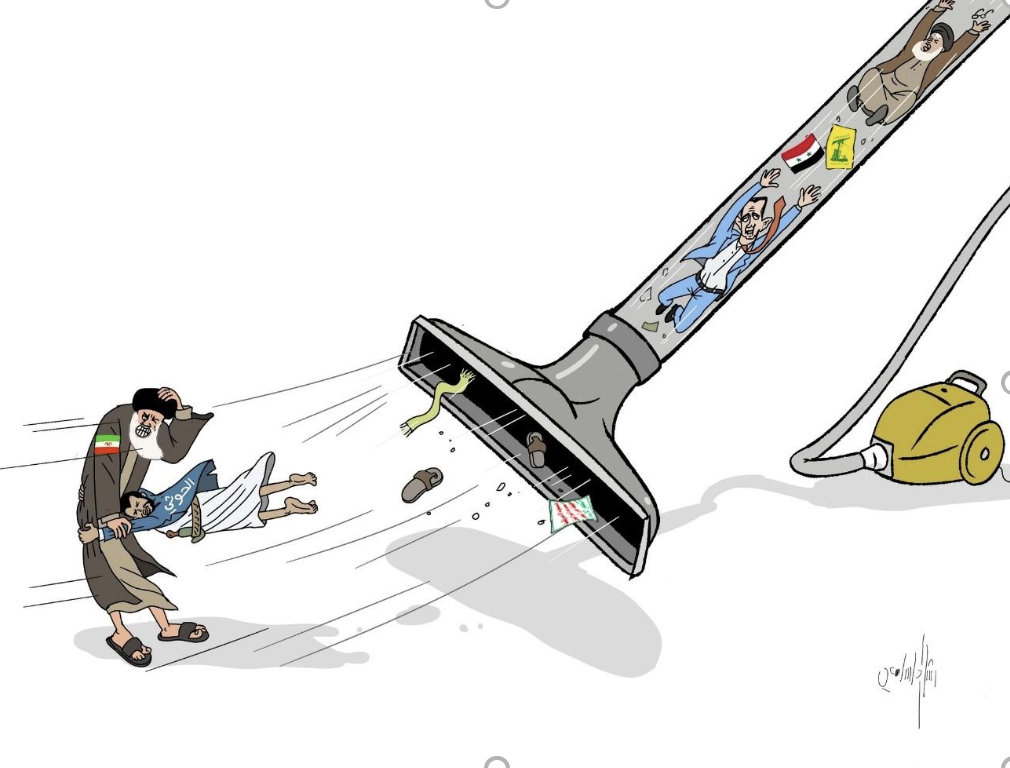
Screenshot of an X post featuring a cartoon by artist Rashad Al-Sami’i. (Screenshot: X)
Ahmed further warned that if Tehran were to fall into chaos or undergo radical change, it would not be just a regime that collapses. The Houthis, he said, would face what could be described as “strategic orphanhood.” A movement that has drawn surplus power from Iranian expansion would suddenly find itself confronting a hungry population and an angry regional environment, without financial or logistical cover.
Such a rupture could push the region down one of two paths: either a “peace of necessity,” in which the Houthis submit to political realities, or a “suicidal escalation” aimed at drawing attention and easing pressure on the center.
However, a policy brief by Clingendael, the Netherlands Institute of International Relations, argues: “The Houthis are not an Iranian proxy in the sense of unquestioningly doing Tehran’s bidding, voluntarily or under pressure.” The brief continues: “Yet, the movement can be viewed as an informal partner of Tehran. Their relationship has evolved from a partnership of convenience into a more strategic one. Despite this evolution, the Houthis have remained autonomous with respect to their domestic constituencies, political strategy, and battlefield operations.”
Despite the prevailing sense of optimism, around 12.5% of survey participants voiced reservations, warning that a collapse in Iran could trigger an uncontrolled regional explosion—one that Yemenis would once again pay for. Yemen, long a battlefield for settling external scores, can scarcely endure another wave of proxy conflicts fought on its soil.
At the official level, the Houthis have adhered closely to Tehran’s established media narrative. Al-Masirah TV and affiliated outlets have covered the Iranian protests as “riots” orchestrated from operation rooms in Washington and Tel Aviv. Official rhetoric at rallies and group events has framed the unrest as an “attack on the Axis of Resistance” and an attempt to destabilize a state that, they claim, stood with Yemen against “aggression.” They argue that any weakening of Tehran directly serves “colonial projects” in the region.
Taken together, these figures and testimonies suggest that Yemenis no longer see Iran’s protests as a distant, internal matter. Instead, they are watching them as a potential “regional lever” capable of breaking Yemen’s political and economic deadlock.
*A pseudonym is used for security reasons.
