Christian Lawmakers See Legislation on Israel as Local and Personal
The National Association of Christian Lawmakers uses Scripture, security concerns, and firsthand exposure to Israel to shape legislation from Arkansas to Indiana and beyond
Former state Sen. Jason Rapert is an ordained minister whose Southern drawl and easy charm call to mind US Ambassador to Israel Mike Huckabee, himself an ordained preacher. The two men share more than a pulpit background—they both come from Arkansas and carry a deep affection for Israel.
Back in 2018, Rapert says, he first began to wonder why there was no national organization for Christian lawmakers and asked then-Gov. Mike Huckabee, “I don’t understand why we don’t have that. Why don’t you do that?”
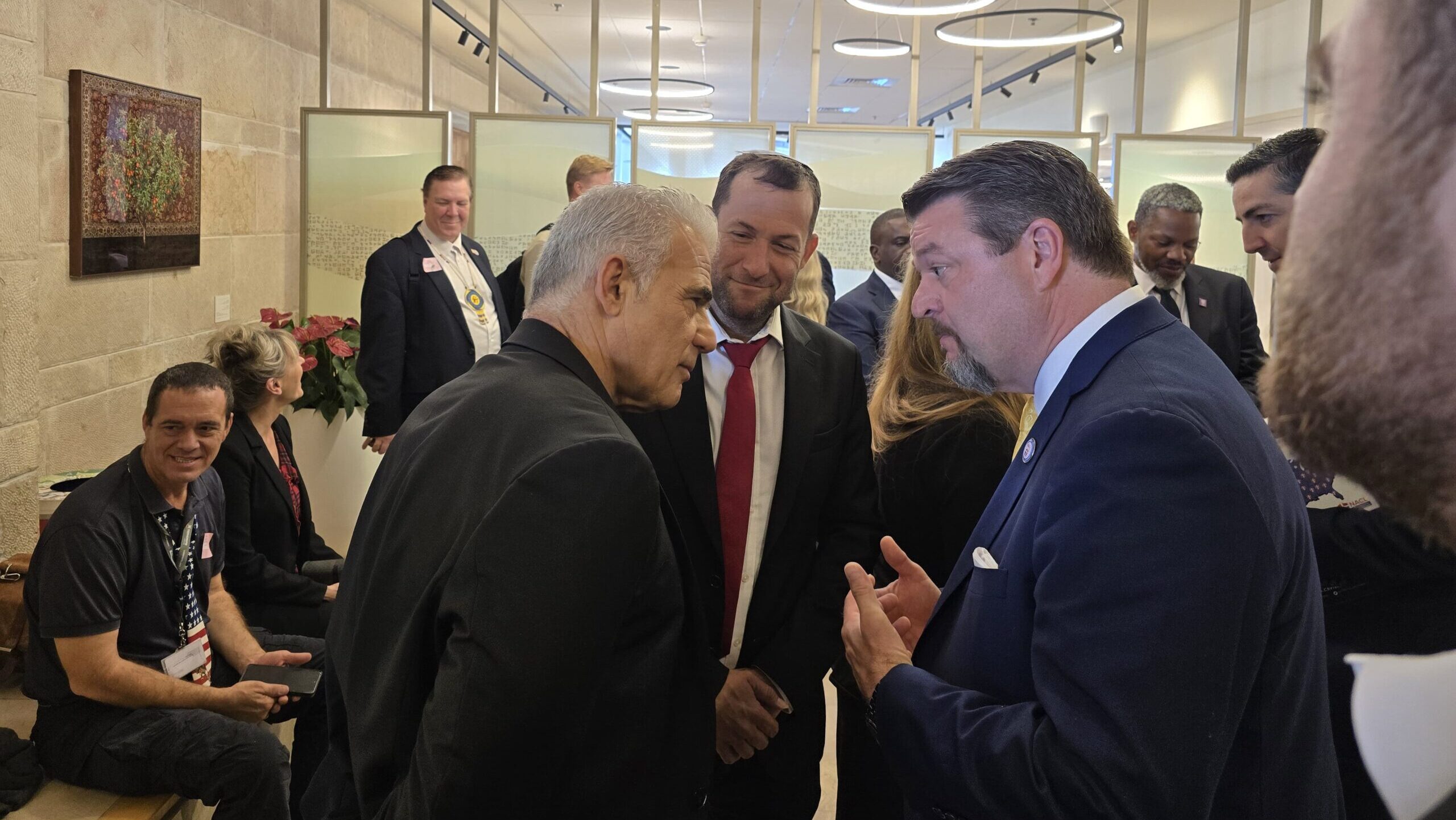
During a whirlwind visit to Israel, Rapert and several state legislators spoke to The Media Line about how the National Association of Christian Lawmakers (NACL) was formed in 2019 and, during the early days of COVID-19 in 2020, launched its first national meeting in Florida.
Since that debut, the member roll has grown, with supporters in all 50 states and a state senator or representative in 41.
“We’re probably going to be 42, 43 very soon,” Rapert said. “New York and Connecticut are talking to me.”
Today, the first US House of Representatives chair is Congressman Marlin Stutzman from Indiana, and the NACL—described as the only faith-based para-legislative organization in the country—will soon announce a US Senate chair.
Faith, Rapert explained, is central to the organization’s mission, along with close ties to Israel. “We took stands against Hamas in the Oct. 7 event,” he said. “Many of our people have carried Israel bonds legislation. … Many of us passed anti-BDS legislation.”
Arkansas wrote those views into policy. “Even in Arkansas, my home state, we actually included a provision that said, you have got to check off that you are not boycotting or you can’t do business with us,” he added.
In June 2025, the NACL passed the first Judea Samaria Act and put it forward as a model bill. It calls on states and localities to use the historical name “Judea and Samaria” rather than the more common term “West Bank” for the western bank of the Jordan River, usually described as part of the Palestinian territories.
Asked about antisemitism in Arkansas, Rapert pointed to the case of National Guard member Pvt. Andy Long, who was killed by a terrorist while another soldier was wounded. The gunman had returned from Yemen but was originally radicalized at a university in Tennessee and had also tried unsuccessfully to firebomb a rabbi’s house in Kentucky.
We can go after any organization that radicalizes people and go after their money and stop them, because they’re terrorist organizations
“I carried Andy’s Law in my state, and this organization, NACL, just endorsed that as a national model, and it said that we can go after any organization that radicalizes people and go after their money and stop them, because they’re terrorist organizations,” Rapert said.
Indiana state Sen. Jeff Raatz told The Media Line that “the proliferation of jihadists” is not yet a major problem in his home state, but the trend “is real in neighborhoods in Michigan and other states. … It’s something we need to be educated on and vigilant to make sure that this kind of behavior doesn’t affect the country.”
Raatz, along with other NACL members, visited the tomb of Joseph located in Shechem, or Nablus, in the West Bank. The area is under the control of the Palestinian Authority, and due to frequent clashes, visits to Joseph’s Tomb are strictly monitored by Israel Defense Forces.
Travel around the globe has shaped Raatz, but he says the place that speaks to him most is Joseph’s Tomb. “There was no anxiety whatsoever,” Raatz recounted. “There were a lot of troops around, that’s for sure, protecting us. But just something internal that brought comfort to me, being on the ground here in this nation.”
Michigan state Sen. Lana Theis, chair of the America-Israel Relations Committee for NACL, says the map of Israel compared to the rest of the Middle East tells the whole story.
Give the gift of hope
We practice what we preach:
accurate, fearless journalism. But we can't do it alone.
- On the ground in Gaza, Syria, Israel, Egypt, Pakistan, and more
- Our program trained more than 100 journalists
- Calling out fake news and reporting real facts
- On the ground in Gaza, Syria, Israel, Egypt, Pakistan, and more
- Our program trained more than 100 journalists
- Calling out fake news and reporting real facts
Join us.
Support The Media Line. Save democracy.
“In America, we have a mentality of a huge geography,” she said. “When you see the maps of Israel, all you see is Israel itself.”
“You don’t see the entire Middle East. You don’t get the context of the actual size of Israel and the fight that is going on for their very existence. It’s a misunderstanding of what Israel is actually dealing with,” she added.
Theis also talked about the lack of public awareness that attacks against Israel are ongoing and involve missiles frequently fired at Jerusalem and Tel Aviv—incidents that, she said, rarely receive adequate coverage in mainstream media.
“I think there is a lot of misinformation. If you go to our colleges, you can see the Middle East Studies are obviously biased in a direction against Israel, and that’s heartbreaking,” Theis said.
To change perceptions, Theis replied, “I purchased a map of the entire Middle East, and I’ve now started showing that to people to help them understand how tiny Israel is compared to other Muslim nations that surround it.”

Dr. Julie Pickren. (Courtesy)
Dr. Julie Pickren, a member of the Texas State Board of Education and of the NACL, identified the “indoctrination of students” as a key factor shaping the environment in schools, universities, and society at large.
“About a decade ago, we really left teaching critical thinking and a classical education and substituted it with more of what we call woke or social Marxist indoctrination of children, and really this is being driven by the UN,” Dr. Pickren told The Media Line.
She blamed the UN 2030 Agenda for Sustainable Development—a voluntary global framework adopted in 2016 with targets in 17 areas including climate change, access to resources, and education—for what she sees as a crisis in education.
Dr. Pickren described the UN’s sustainability goals as “anti-Western civilization. They’re really anti-Judeo-Christian values.”
The answer, in Dr. Pickren’s view, is to return to the fundamentals of American education.
“Our education system for the first 120 years in America was based on the word of God and Judeo-Christian values,” she added. “When you teach your children to love freedom, to love God, to love human life and respect human life and do all things as according unto the Lord, then you have a society that strives for the better of humanity.”
Implementing those fundamentals, she argues, will help the US “maintain the lead in the world and maintain being a world superpower.”
“That’s what America has to return to in order for America to maintain the lead in the world and maintain being a world superpower,” she concluded.
For Texas state Rep. Mark Dorazio, visiting Israel for the second time drove home his belief that the land historically belongs to Israel.
He told The Media Line: “We were in Samaria and we were standing right at the center point where that’s the land the foreigners wanted Israel to give away to the Palestinians. We stood there, and I could see to the left, and I could see Tel Aviv.”
Dorazio added, “I could look to the right and I could see Jerusalem.”
Shomron Regional Council head Yossi Dagan said, “Why would we want to give this up?”
Contemplating that this was the very spot targeted by Palestinian rocket fire, Dorazio recalled thinking, “Why in the world would anybody in their right mind want to give it up?”
There was one obvious answer to that question in Dorazio’s mind: “They haven’t been here.”
Those who live in comfortable, secure environments, he explained, may think that what happens in Israel does not affect them, but he encouraged looking at the bigger picture “because more technology is coming out of Israel than we’ve seen before.”
He sees a strong economic case for supporting Israel. “America is benefiting greatly from what happens with the technology, the irrigation systems that have been developed here in Israel. America puts money in Israel. We’re getting a 1,200 percent return on our money.”
“So why not protect Israel, just for the economic reasons alone?” Dorazio asked.
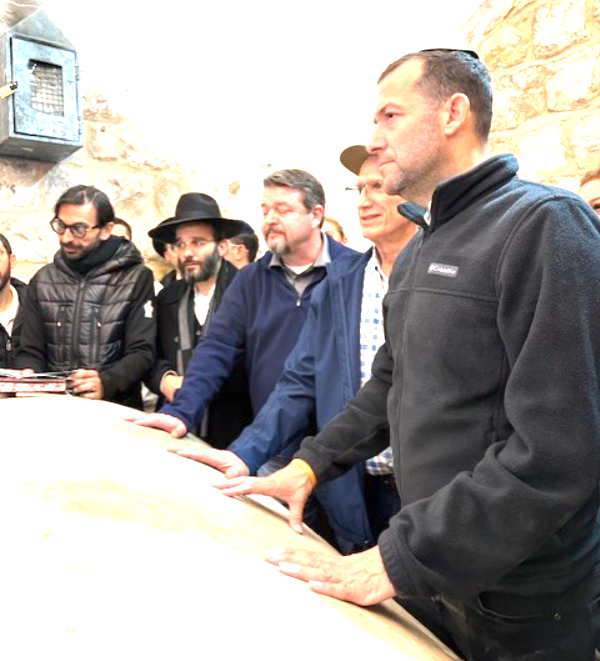
From left: Jason Rapert, Mark Dorazio, Yossi Dagan at Joseph’s Tomb, Nablus, in the West Bank. (Courtesy)
Too many Americans see a distorted picture of “the Jewish homeland and the birthplace of Jesus,” Tennessee state Rep. Chris Todd told The Media Line.
“I think having firsthand knowledge of what’s going on and actually seeing it with my own eyes gives a perspective that most people will trust,” he said, pointing to widespread skepticism about mainstream media.
Todd urges Americans to learn about Israel’s society, politics, and leadership directly, rather than relying only on filtered or distorted portrayals.
The NACL looks to the Bible—not the media—for guidance on dealing with today’s key issues.
“As American citizens, we have to return to that foundation if we’re going to save the country,” Rapert declared.
We’re going to choose to stay where God is
Rapert recalled US President Harry Truman’s recognition of the State of Israel as a modern state in 1948, and continued, “The Bible says blessed are those who bless Israel, and cursed are those who curse Israel. As for the NACL, and as for me and my house, we’re going to choose to stay where God is.”
