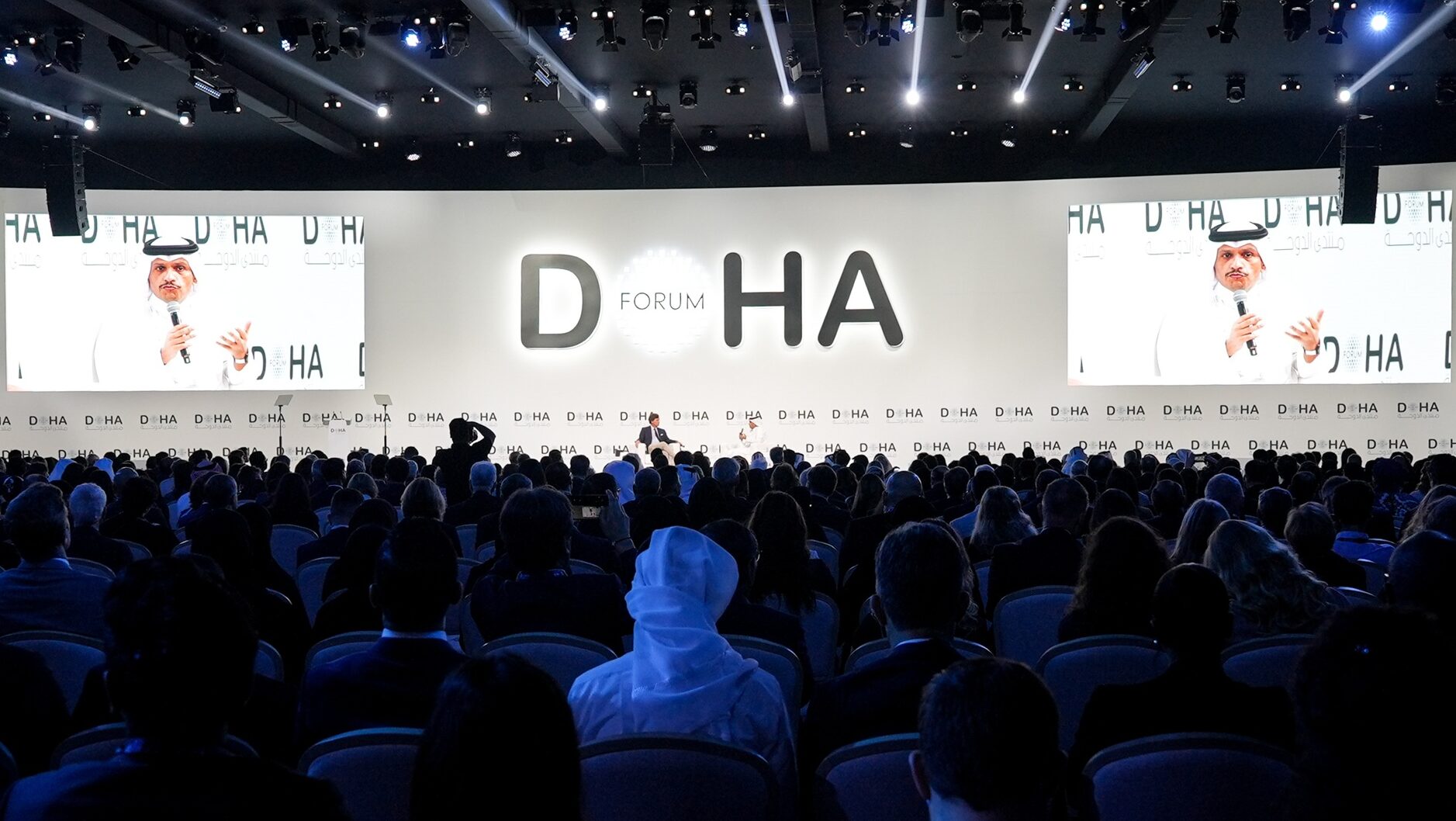
Doha Forum Opens With Gulf Anxiety Over Israel’s Regional Conduct
Officials from across the Middle East question Israel’s strategy and warn that escalation risks derailing diplomatic progress
[DOHA] This year’s Doha Forum, under the theme “Diplomacy, Dialogue, Diversity,” opened with unmistakable tension in a capital that has been bombed over the past six months by both Iran and Israel—yet only one of those countries was represented on stage.
That contradiction framed a regional mood already shifting before the forum even began. One day earlier, in Abu Dhabi, former Saudi intelligence chief Prince Turki Al-Faisal was asked a question that once would have drawn a predictable answer: Which state poses the more immediate threat to regional stability—Iran or Israel?
For the moment, definitely it is Israel
“For the moment, definitely it is Israel,” he replied, citing daily Israeli strikes on Syria, continued military operations in Gaza, and repeated ceasefire violations along the Lebanese border. “They are hardly a harbinger of peace in our part of the world.”
The remark, delivered roughly 200 miles from Doha, crystallized what Gulf officials have been discussing privately for months. By the time the forum opened, Turki’s framing had become the subtext of nearly every conversation about security in a Middle East navigating a new US doctrine of burden-sharing and a grinding Gaza ceasefire whose second phase remains precarious.
Qatar has endured the sharpest edge of that instability. An Iranian missile struck Al Udeid Air Base in June 23. On September 9, an Israeli drone strike hit central Doha, killing Hamas negotiators and a Qatari security officer. The target: Hamas officials who were in the capital to consider a US ceasefire proposal.
Qatar’s prime minister, Sheikh Mohammed bin Abdulrahman Al Thani, said the attack “shocked” US President Donald Trump, who had backed Qatar’s role as mediator.
“The concept of mediation is that it is a safe place for the two parties,” he told American political commentator Tucker Carlson on the forum’s main stage. “To have the mediator hit by one of the parties is unprecedented.”
Washington ultimately compelled Israeli Prime Minister Benjamin Netanyahu to issue a rare apology, but the strike drove home the core dilemma Gulf states now face: They host US facilities, facilitate US-backed diplomacy, and then find themselves targeted by the very actors they are asked to calm.
Ilan Zalayat, a researcher at Tel Aviv University’s Institute for National Security Studies, argued that Gulf reactions stem from territorial expectations shaped by the 1991 Gulf War, not a modern geopolitical realignment. “There’s no alignment across the Gulf states regarding Israel,” he said, “but rather a shared belief that Gulf territory must remain inviolate. This is solidarity rooted in 1991, not a new political axis,” he told The Media Line.
By contrast, Ali Bakir, senior fellow at the Atlantic Council’s Scowcroft Middle East Security Initiative, said Gulf leaders increasingly see Israeli behavior as destabilizing. “Israel operates with no red lines, no concern for regional escalation, and no fear of accountability,” he told The Media Line. “This directly contradicts the GCC [Gulf Cooperation Council] agenda of stability, economic continuity, and de-escalation.”
Carlson’s exchange with the Qatari prime minister drew the forum’s largest audience and quickly became one of its defining moments. Responding to criticism that he has become a “tool” of Qatar, Carlson said: “I’m American and a free man and I’ll be wherever I want to be. I have never taken a dollar from the Qatari government.”
He announced he is buying a home in Doha, saying Qatar is “a country playing a mediating role the world needs.”
Although critics have claimed Carlson has acted as an agent of Qatar, public records do not show him registered under the Foreign Agents Registration Act. The allegation stems from a FARA filing by Lumen8 Advisors, a US consulting firm hired by Doha, which arranged Carlson’s March 2025 interview with the Qatari prime minister as part of a broader influence campaign aimed at US conservative media. The filing lists Lumen8—not Carlson or the Tucker Carlson Network—the media company he launched after leaving Fox News—as the registered agent, showing payments from Qatar and identifying Carlson’s show as a key outreach target rather than a foreign-funded partner.
A former Biden administration State Department official watching from the floor said the optics were intentional. Inviting Carlson to interview the prime minister, the official told The Media Line, was Qatar’s “lethal response to the September strike”—a signal that Doha would shape the conversation rather than be shaped by it.
Optics aside, Sheikh Mohammed warned that the Gaza ceasefire remains fragile.
“We are at a critical moment,” he said. “What we have done is a pause. We cannot consider it yet a ceasefire.”
Give the gift of hope
We practice what we preach:
accurate, fearless journalism. But we can't do it alone.
- On the ground in Gaza, Syria, Israel, Egypt, Pakistan, and more
- Our program trained more than 100 journalists
- Calling out fake news and reporting real facts
- On the ground in Gaza, Syria, Israel, Egypt, Pakistan, and more
- Our program trained more than 100 journalists
- Calling out fake news and reporting real facts
Join us.
Support The Media Line. Save democracy.
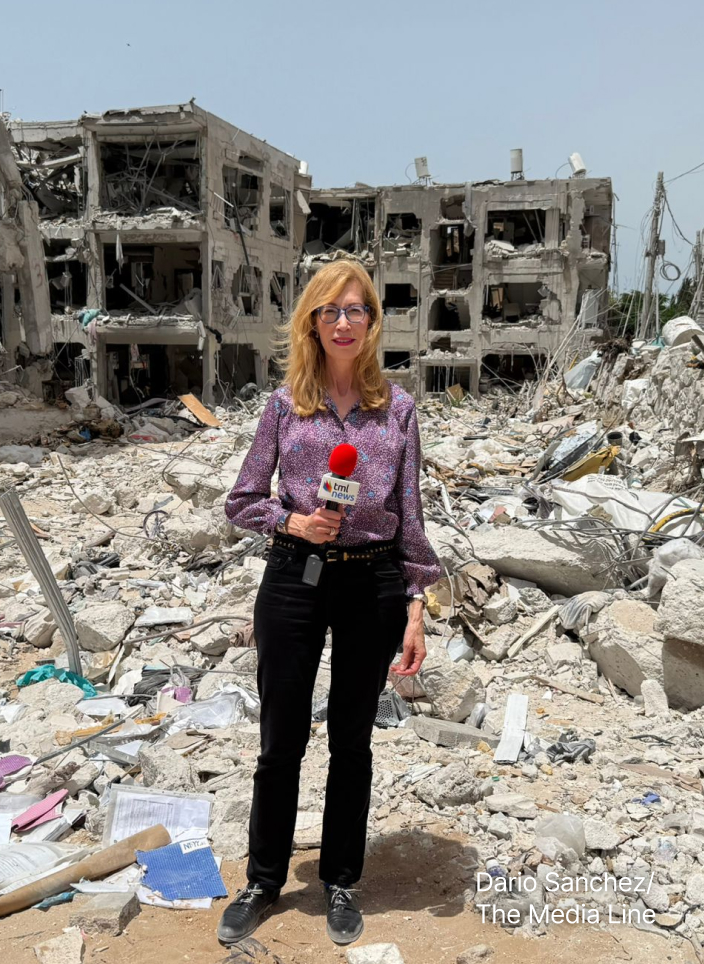
More than 590 alleged Israeli violations have been reported by Gaza authorities since the pause took effect, with over 360 Palestinians killed. A genuine ceasefire, the Qatari leader said, requires “full withdrawal of Israeli forces, stability in Gaza, and the restoration of movement for people in and out.”
Turkey’s foreign minister, Hakan Fidan, used his stage time to warn that the diplomatic clock is running out.
US mediators, he said—including Special Envoy Steve Witkoff and Secretary of State Marco Rubio—“know they have to intervene timely” to secure the second phase of the deal.
“Hamas has almost delivered what they’ve been asked,” Fidan said, referring to the release of hostages. “If we fail to move into the second phase, momentum will be lost.”
Forum organizers invited senior figures from every major regional actor except Israel. Iran was represented by former Foreign Minister Mohammad Javad Zarif, who said Tehran’s security posture “remains autonomous and robust” despite US and Israeli strikes this year. He also called for improved relations with Arab neighbors.
Israel had no delegation. The sole Israeli figures spotted were former Knesset Speaker Avraham Burg and two researchers from Israeli think tanks, attending in a private capacity.
Syria’s president, Ahmed al-Sharaa, accused Israel of escalating violence inside Syrian territory and pledged that his transitional roadmap—including new elections after a five-year period—remains intact. “Strong institutions, not individuals, guarantee continuity of the state,” he said.
In Doha, Hamas political bureau member Bassem Naim told The Associated Press that the group was prepared to discuss “freezing or storing” its weapons as part of a long-term process leading toward a Palestinian state. But he defended the Oct. 7 attack as “an act of defense.”
The second phase of the ceasefire involves the creation of an international stabilization force and a technocratic Palestinian committee expected to be led by Palestinian Authority Health Minister Maged Abu Ramadan. Hamas will not accept a foreign force with disarmament authority, Naim said, but welcomes an international presence focused strictly on reconstruction and humanitarian support.
A State Department spokesperson, speaking on background, called these developments the first building blocks of the post-ceasefire plan and said Washington sees rapid progress on President Trump’s 20-point peace plan, from launching the Civil-Military Command Center and winning UN Security Council backing for a new stabilization force and Board of Peace to securing World Bank approval for a Gaza reconstruction fund and expanding humanitarian flows into the territory. “The people of Gaza want a brighter future—one free of Hamas, with economic opportunity and self-governance.” The spokesperson added that, while significant work still lies ahead, the administration believes the trajectory for Gaza and the wider Middle East is unusually positive and that there is broad international support to keep the peace process moving forward.
A packed Atlantic Council panel became the forum’s most explicit test of the burden-sharing strategy of the Trump administration.
Heritage Foundation Vice President Victoria Coates framed the shift as necessary: “Our partnerships are strongest when they revolve around shared requirements: energy security, technological competition, political stability,” she said. “We are aligning interests, not underwriting endless commitments.”
Former Assistant Secretary of State for Near Eastern Affairs David Schenker challenged that view sharply. “Policy has not yet translated battlefield or tactical gains into political gains,” he said. “This is aspirational rather than reflective of the present.”
Former Secretary of State Hillary Clinton criticized what she called unnecessary division from US allies. She warned that distancing from Europe “weakens the very coalitions we rely on,” particularly during ongoing ceasefire diplomacy in both Gaza and Ukraine.
Perhaps the most consequential intervention came from Saudi scholar Abdulaziz Alghashian, who said the current moment reflects overlapping national interests.
“This is a Saudi-first moment that overlaps with an America-first moment,” he said. “It does not mean drifting toward China. It means diversifying—but not in a zero-sum way with Washington.”
On Gaza, he said Riyadh made clear from the beginning: “We are not going to be a proxy for anyone.”
Israel cannot be expected to dance at two weddings—to hedge and to escalate at the same time
Schenker later added a line that circulated widely in the hallways: “Israel cannot be expected to dance at two weddings—to hedge and to escalate at the same time.” The Yiddish phrase “tantsn af tsvey khasenes” (dance at two weddings) drew nods from diplomats juggling their own competing priorities.
US Ambassador to NATO Matthew Whitaker reinforced Washington’s message. “The United States cannot be the world’s policeman,” he said. Allies like Qatar will need to “do some of the heavy lifting.” He described Qatar as “one of our best allies outside NATO.”
Donald Trump Jr. echoed that sentiment, saying the American public “has no appetite for writing blank checks for Ukraine or the EU.”
The message resonated unevenly. Gulf governments have watched US commitments fluctuate across three administrations and fear that the new framework risks pushing them deeper into economic and technological partnerships with China—the opposite of what Washington intends.
Zalayat said the burden-sharing model presents Israel with both vulnerabilities and opportunities.
“The United States’ reduced commitment will apply to Israel as well,” he told The Media Line. “But Israel’s intelligence and technology advantages could make it a more valuable asset for Saudi Arabia as it pursues normalization.”
Bakir warned that unless Washington reins in escalation, Gulf states will be reluctant partners. “Israeli actions are increasingly perceived as catalysts for instability,” he said. “Gulf governments will not engage in security cooperation unless the U.S. actively works to contain this escalation.”
For Qatar, the stakes are immediate. Hosting Hamas and facilitating talks have produced concrete outcomes—from the 2020 Doha Accord to repeated ceasefires—but at rising cost.
“If we don’t keep open channels with them, none of these conflicts can be solved,” Sheikh Mohammed said.
This year proved that argument comes with risks. Two external powers struck Qatari territory. Only one was invited to Doha.
As the forum wound down, Turkish Foreign Minister Fidan captured the region’s unease—and the narrowing diplomatic window.
In this region, missed moments become new conflicts
“The moment is extremely sensitive,” he said, referring to the next phase of the Gaza agreement. “If we fail to move forward now, we may lose the chance entirely.”
He paused, then added a line that several diplomats later repeated: “In this region, missed moments become new conflicts.”
