Iran Talks Show Momentum, but Explosion at Shahid Rajaee Raises Questions
Israel has been carefully watching developments in the negotiations between Iran and the US regarding the Iranian nuclear program, considering its own steps should the talks fail
On Saturday, a third round of talks between American and Iranian negotiators ended in Oman. The talks aim to curb Iran’s nuclear aspirations while offering the Islamic Republic relief from the sanctions regime it is under. Senior American officials were quoted as saying the talks were “positive and productive,” indicating that more work was needed to clinch a deal.
The talks are expected to resume in a week.
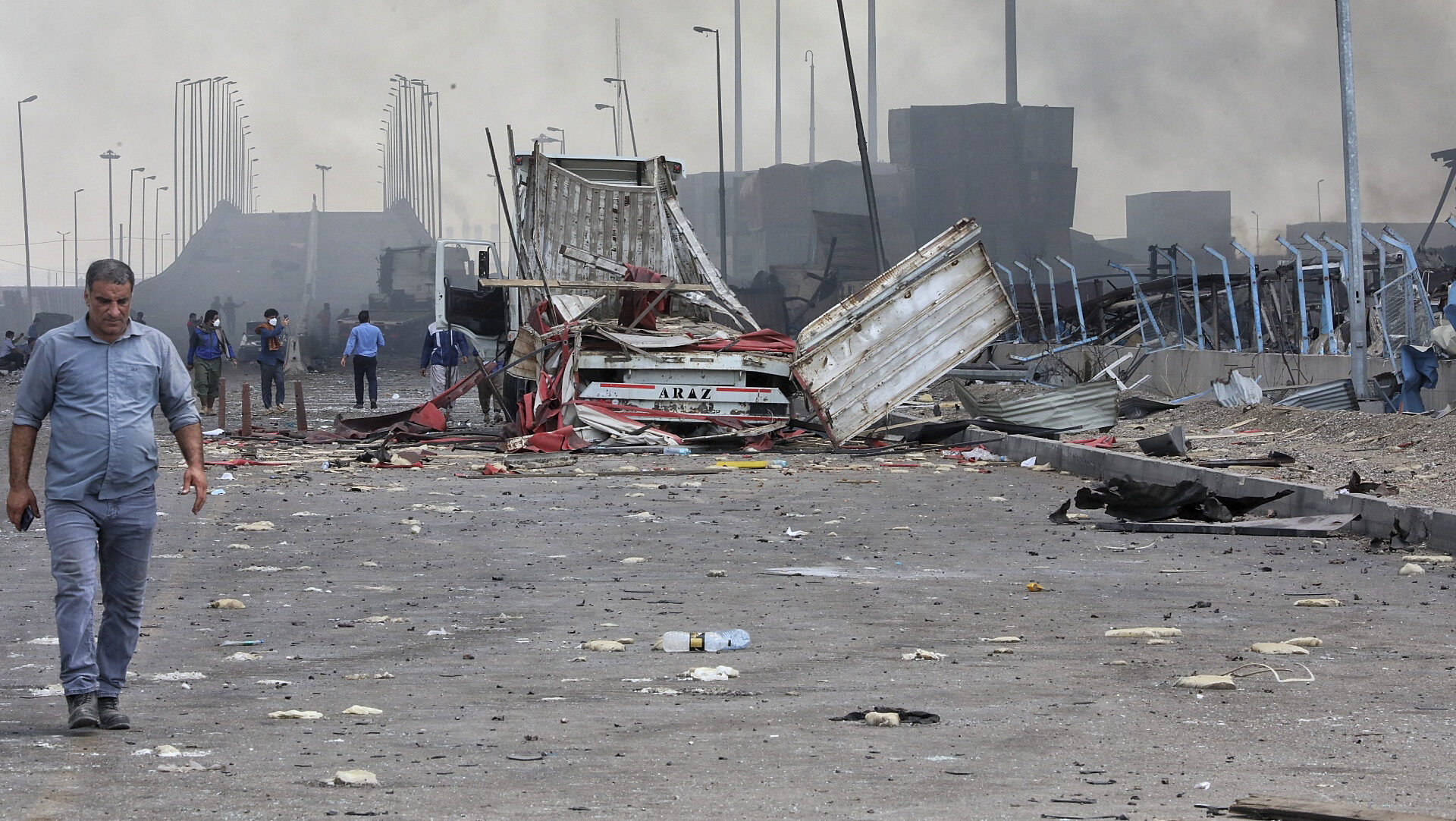
As the talks were held, a massive explosion rocked the Shahid Rajaei port in southern Iran. Iranian officials said at least 25 people were killed and hundreds were injured at the site, which purportedly stored a recent shipment of a chemical ingredient used to make missile propellant. There was no official statement regarding the circumstances of the explosion, and no one blamed an attack as the possible cause.
Israel is believed to be behind several attacks against Iran’s nuclear facilities and scientists throughout the years, as part of its covert war against the Iranian nuclear program. There was no official Israeli statement on the latest incident in southern Iran, leaving room for speculation about whether or not Israel played a role in the explosion.
For Israelis, the direct talks between Iran and the US are somewhat of a difficult pill to swallow.
US President Donald Trump has repeatedly said he prefers a deal to an attack, although he has not ruled out an attack led by either Israel or the US.
The conduct of this administration is messy, and it is unclear what exactly they want to achieve.
“The conduct of this administration is messy, and it is unclear what exactly they want to achieve,” Dr. Yoel Guzansky, a senior researcher at the Institute for National Security Studies, told The Media Line.
Israel has been contemplating a pre-emptive strike on Iran’s nuclear facilities for years now. But at this point, with significant changes in the region, many in the Jewish state believe the time is ripe for such an attack.
Many experts believe Iran is on the cusp of acquiring nuclear capability, perhaps just a decision away from crossing the threshold.
Israel has said it will not tolerate a nuclear Iran, classifying it as an existential threat. After over a year and a half of a regional war that began with Hamas’ surprise offensive against Israel on October 7th, 2023, Iran’s proxies that have threatened Israel have been severely weakened.
Perhaps the most critical development is the first-ever direct confrontations between Iran and Israel that occurred twice in the past year. In April 2024, Iran launched a massive drone and missile barrage at Israel in retaliation for an airstrike on its consulate in Damascus, prompting Israel to respond with a limited strike inside Iranian territory days after. Then, in September of 2024, tensions between Israel and Iran spiked again. Israeli special forces raided an Iranian missile production site near Masyaf, Syria, and weeks later, Israeli airstrikes in Beirut killed Hezbollah leader Hassan Nasrallah. Hamas’ political chief, Ismail Haniyeh, was assassinated in Tehran by a mysterious explosion. Iran vowed retaliation and delivered it days later by launching about 200 ballistic missiles at Israeli military bases, marking the most direct and large-scale Iranian attack on Israel to date.
In response, Israel launched a significant retaliatory operation weeks later, marking Israel’s most extensive direct strike on Iranian territory ever, involving over 100 aircraft targeting many targets across Iran. The operation focused on debilitating Iran’s missile production capabilities, destroying key air defense systems, and damaging a suspected nuclear weapons research facility at Parchin.
After the operation, there were calls in Israel to engage in further attacks that would directly target Iran’s nuclear facilities.
Give the gift of hope
We practice what we preach:
accurate, fearless journalism. But we can't do it alone.
- On the ground in Gaza, Syria, Israel, Egypt, Pakistan, and more
- Our program trained more than 100 journalists
- Calling out fake news and reporting real facts
- On the ground in Gaza, Syria, Israel, Egypt, Pakistan, and more
- Our program trained more than 100 journalists
- Calling out fake news and reporting real facts
Join us.
Support The Media Line. Save democracy.
“We are talking about a real opportunity here, and this is perhaps the most important thing, more than any specific detail of a deal,” said Guzansky. “Iran’s weakness, regionally, internally, and financially, means now is the time to pressure it.”
Israel will scrutinize every detail of a possible agreement meticulously.
“What is needed is much more diligent inspection,” Guzansky said. “As long as there are inspections and limitations, Israel will have to agree. Israel cannot oppose a civilian nuclear program in Iran.”
US envoy Steve Witkoff has made several statements signaling the Americans would agree to a certain degree of uranium enrichment, statements that elicited alarm in Israel.
“The problem is what Iran is doing in developing other weapons, and what it has done in parallel and hiding, especially in facilities that have not been inspected or only partially so,” Guzansky added. This is where inspection becomes critical. “There are still a lot of open questions about inspection in the past. Iran managed to liquify previous agreements and backtracked on many understandings.”
The Joint Comprehensive Plan of Action (JCPOA) signed between Iran and the P5+1 in 2015 was viewed by many as a flawed deal. The International Atomic Energy Agency (IAEA) was supposed to be granted widespread inspection capabilities, and sanctions were to be imposed if Iran failed to comply with these capabilities. Iran did comply initially, but after the US withdrew from the agreement in 2018, it began to impose restrictions on inspectors and even went as far as cutting off IAEA surveillance cameras at some facilities.
“It’s all in the fine print,” Maj. (ret.) Alex Grinberg, a former Israeli military intelligence officer and an expert on Iran at the Jerusalem Institute for Strategy and Security, told The Media Line. “Once the Iranians start to manipulate the agreement, no amount of inspection will help.”
If Iran gets rid of all of the uranium it has enriched and reduces enrichment only to the needs of a civilian nuclear program, Israel should not have a problem with this.
“If Iran gets rid of all of the uranium it has enriched and reduces enrichment only to the needs of a civilian nuclear program, Israel should not have a problem with this,” said Guzansky.
In the past, Iran has claimed its nuclear program is meant for peaceful and civilian purposes alone. However, the very public quest by its leadership to seek the destruction of Israel has Israelis suspicious. In addition, Iran’s efforts to hide its nuclear activities have raised doubts about its true intentions.
Witkoff has indicated the US is willing to put a cap on Iranian uranium enrichment levels and not dismantle its program, allowing the Islamic Republic to obtain civilian nuclear capabilities.
“The difference between a civilian and military program is the level of uranium enrichment needed,” said Grinberg. “If Iran agrees to a tight American inspection regime that will only allow them to generate electricity from nuclear power, this might work. But the chances for Iran agreeing to this are very slim.”
Just before the latest round of talks, Iran’s foreign ministry spokesperson Esmaeil Baghaei told Iranian state TV that Iran’s defense capabilities and missile program were not on the agenda for Saturday’s talks.
Iran’s conventional missile program is one of Israel’s greatest concerns. Although Israel proved in the past year that it can face the threat from Iran, the last two attacks may not represent the full scale of Iranian capabilities.
“The development of ballistic missiles is just a cover for them to become a delivery platform for a nuclear weapon,” said Grinberg.
One of the main criticisms of the JCPOA was that it did not address this issue at all and avoided dealing with Iran’s regional behavior, namely its funding and training of terrorist groups who threaten Israel at its borders.
The nature of the regime cannot be ignored.
“The nature of the regime cannot be ignored,” said Grinberg. “The discussion about a nuclear Iran cannot just be a technical one. The fact that such a country that has threatened Israel wants to possess such capabilities is a problem.”
Another weakness singled out by Israel in the JCPOA was the ‘sunset clauses’, which set expiration dates on many of the restrictions placed on Iran. The number of centrifuges Iran was allowed to develop, the arms embargo on the country, and he level of enrichment all had expiration dates. Israel is concerned that similar clauses will exist in any future agreement. These make any deal temporary, leaving Israel under threat.
“Any agreement won’t be for an unlimited time,” said Grinberg, raising another red flag for Israel.
According to Guzansky, one of the most critical aspects of the original JCPOA that should be included in a future deal is Iran’s agreement to adhere to the IAEA’s “Additional Protocol,” which allows for more stringent inspections of nuclear sites.
While Witkoff negotiates with Iran, Israelis have been warning about the dangers of a return to the 2015 deal.
At the time, the deal caused great tension between Israel and the US, led by President Barack Obama.
In 2018, the US, under Trump, withdrew from the JCPOA, essentially nullifying the agreement. Israel, led by Prime Minister Benjamin Netanyahu, saw the US’s abandonment of the agreement as a victory.
But Iran has since intensified its uranium enrichment, and while Trump hasn’t ruled out a pre-emptive strike, he is giving diplomacy a chance.
Negotiations to reach a different deal than the one agreed upon in 2015 have been ongoing intermittently in recent years with no success. It remains to be seen whether the Trump administration will be successful not only in clinching a deal, but one that satisfies Israel enough for it to abandon possible attack plans.
