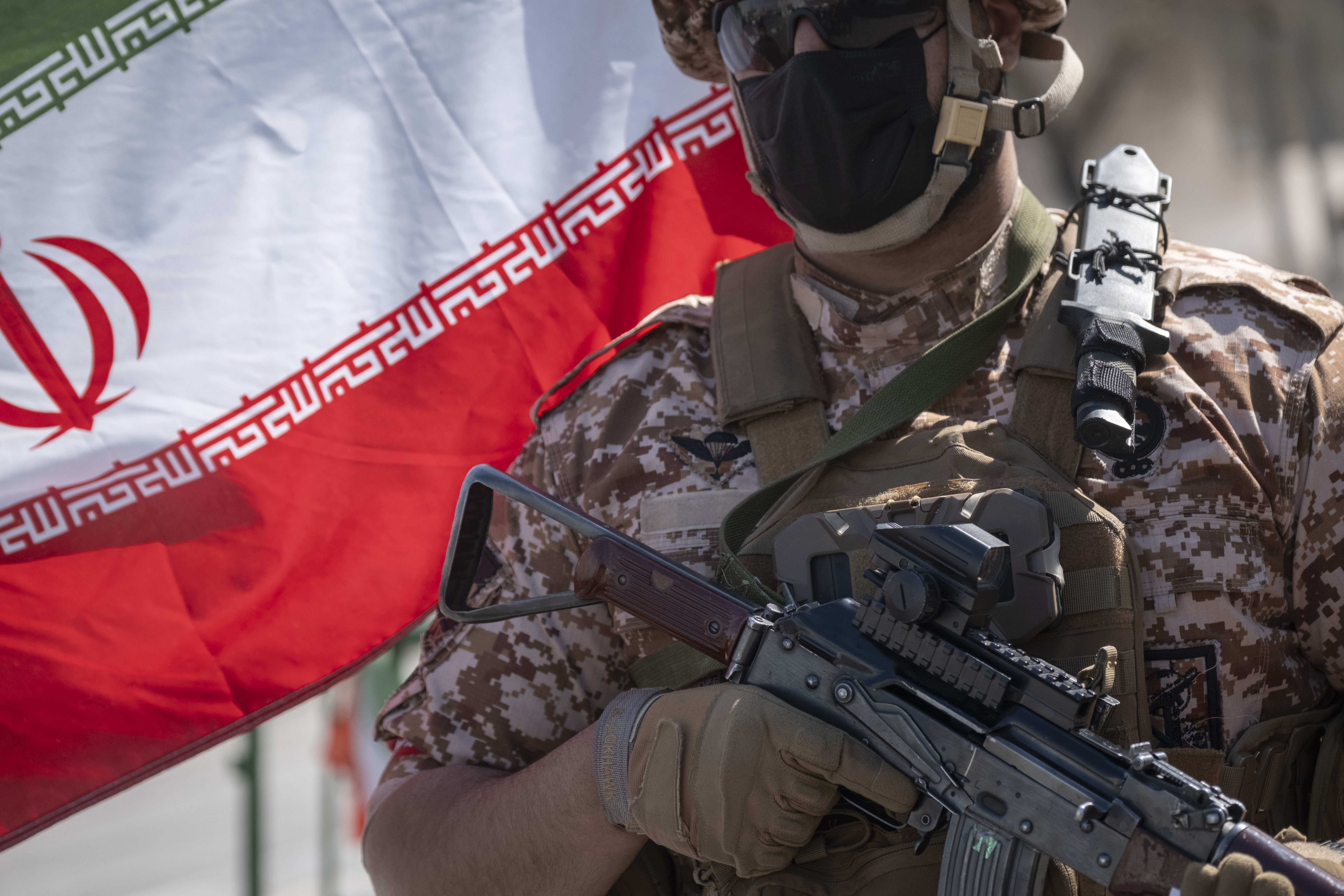
Iranian Military Officer Tells TML: ‘The Fall of the Regime Is Inevitable’
Members of the IRGC, the Basij, and other repressive forces still deployed in the streets have become fatigued and desperate, the officer said.
After a week of American and Israeli strikes on the command centers of the Islamic Revolutionary Guard Corps (IRGC), and the elimination of the leader of the Islamic Republic, the figure who served as the nexus linking the IRGC to Iran’s political and economic power structure, there are growing signs that this military organization, which also exerts control over Iran’s economy, may be approaching the point of collapse.
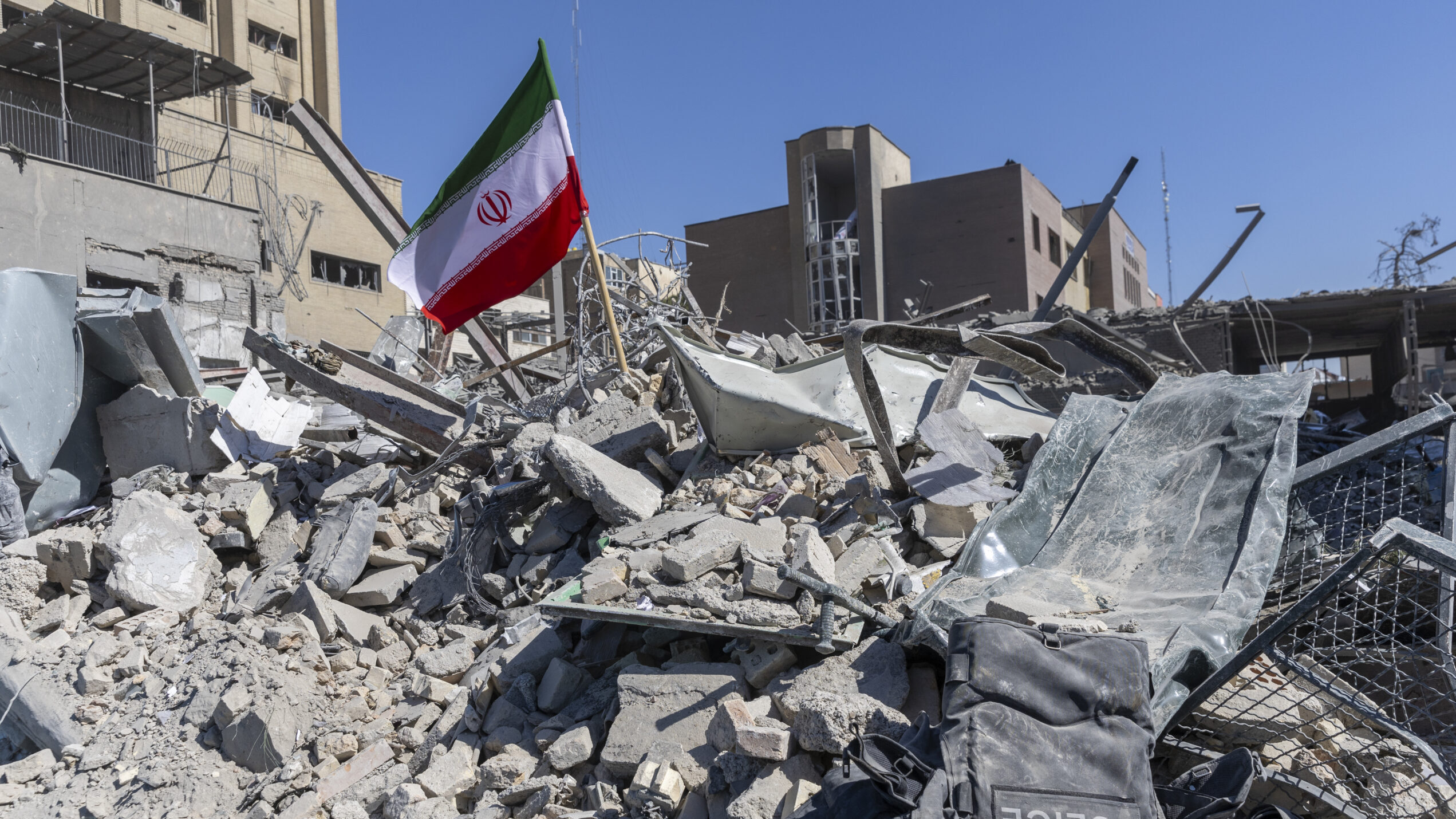
An Iranian flag is planted in the rubble of a police station, damaged in airstrikes on March 3, 2026 in Tehran, Iran. Nearly all IRGC and Basij centers in Tehran that were located in residential areas have been struck several times, and the attacks are continuing. (Majid Saeedi/Getty Images)
An expert in Tehran familiar with the operations of the IRGC told The Media Line that, beyond the fact that the IRGC capacity to respond has diminished in recent days — despite repeated threats to deploy advanced missile weapons and other indirect measures, and despite their failure to inflict meaningful blows on American and Israeli military bases — the central issue is that the IRGC appears to be steadily losing its grip on the situation inside the country and its ability to manage wartime conditions.
While the IRGC still appears to be launching missiles at Israel, firing missiles and drones toward countries in the region, threatening to close the Strait of Hormuz, and carrying out other disruptive measures, it has reserved its most important capabilities for suppressing armed opponents. At a moment when the authorities face the immediate danger of protesters returning to the streets, armed opposition groups capable of leading people in direct action against the IRGC, the Basij, and other organs of repression are viewed by the regime as a serious threat.
For this reason, the IRGC has, since the outset of the war, continuously fired missiles and drones at the positions and bases of Kurdish opposition groups in the Kurdistan Region of Iraq. The formation of a front uniting the principal Kurdish parties active against the Islamic Republic has also become a major source of anxiety for the Islamic regime.
Dispersal of IRGC into these unusual locations, including hospitals and schools, is a core part of their strategy for survival … is a page out of the Hamas playbook
Dr. Emily Blout, an Iran specialist with policy and research experience at the Pentagon, told TML: “Dispersal of IRGC into these unusual locations, including hospitals and schools, is a core part of their strategy for survival. And the strategy actually makes sense by decentralizing command into local autonomous units and by dispersing munitions across the country, the IRGC aims to maintain control even though its central leadership is eliminated. But hiding in places, especially in hospitals, is a page out of the Hamas playbook.”
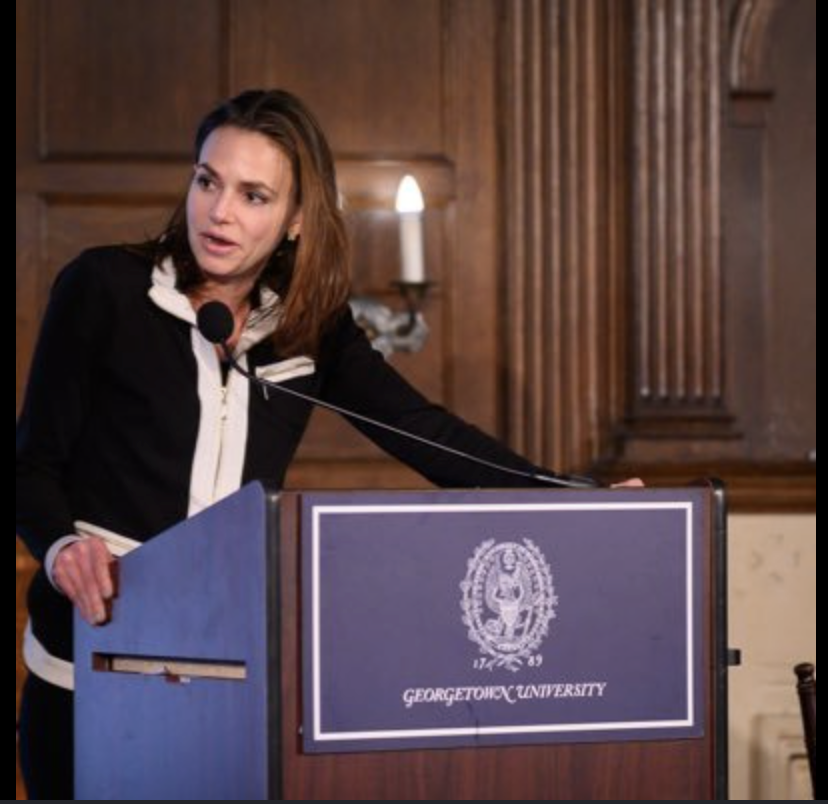
Dr. Emily Blout. (Screenshot: X)
Blout predicts that the overthrow of the Islamic Republic would come through armed urban conflict that would shatter the IRGC: “They may enter weeks or even months of guerrilla warfare,” viewing this as their “Karbala moment,” a regime fighting for its survival, willing to endure heavy losses and even die. “But this will not be an easy endgame.”
In total, the IRGC has roughly 250,000 personnel, with reserve forces numbering about twice that. Including the Basij, the total number of armed personnel stands at roughly 900,000 nationwide. Yet after one week of war, the IRGC’s internal communications have been severely disrupted, and signs of organizational disorder have become visible.
Many of these forces, who recently had staged a conspicuous show of strength in the streets with armored equipment and, in some cases, opened fire on civilians, are now exhausted, worn down, and left without secure bases or headquarters. Even their makeshift cover locations, such as sports stadiums, have come under air or missile attack. With the loss of central command, they appear to be moving toward breakdown.
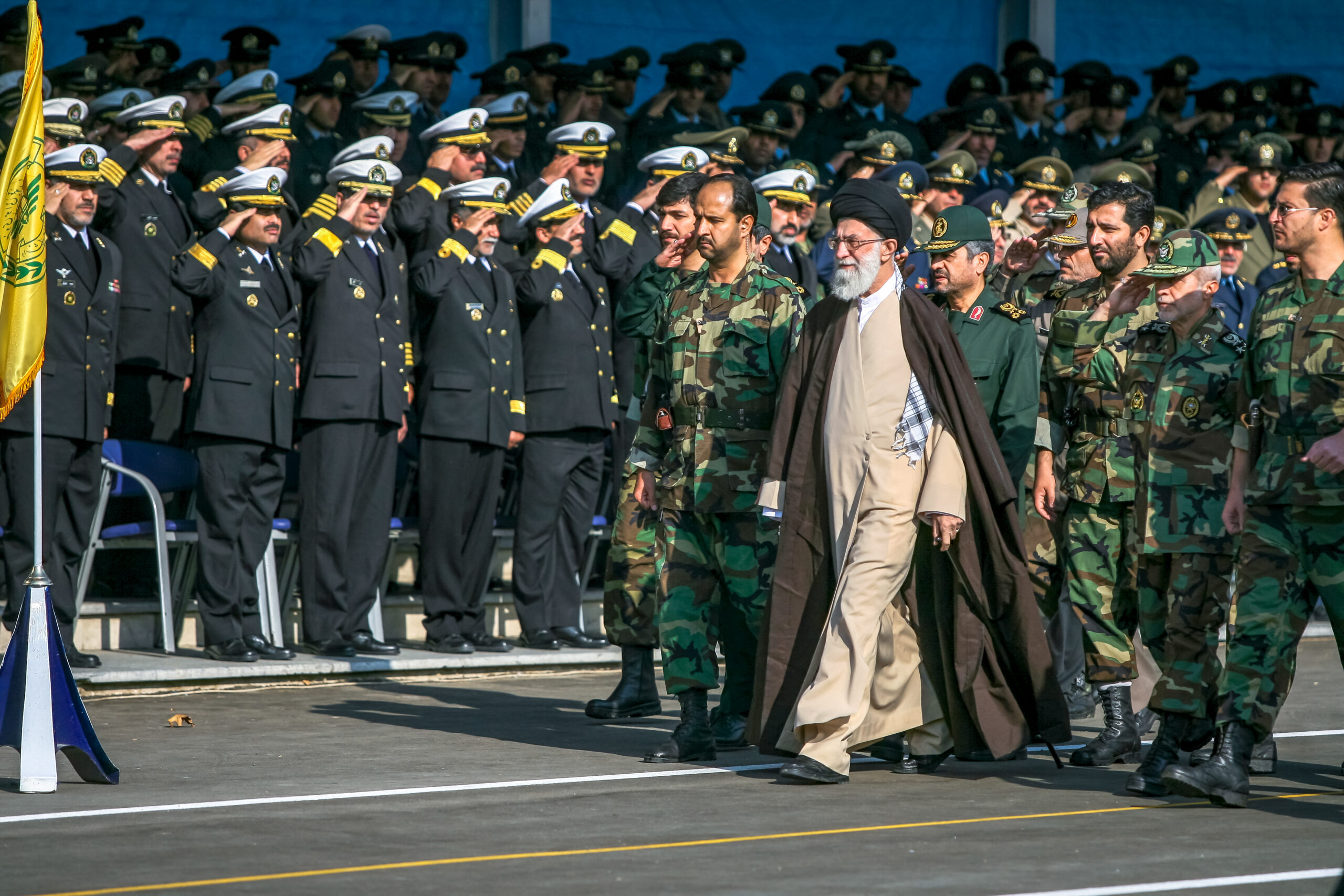
Iran’s Supreme Leader Ayatollah Ali Khamenei walks alongside senior military commanders during a graduation ceremony at Shahid Sattari Air Force Academy in Tehran, Iran, on October 24, 2007. For nearly four decades, Khamenei had command of the armed forces; with his killing and that of most senior military commanders, the IRGC has descended into disarray. (Hossein Fatemi / Middle East Images / AFP via Getty Images)
An officer in one of Iran’s military forces told The Media Line that the fall of the Islamic Republic is inevitable because members of the IRGC, the Basij, and other repressive forces still deployed in the streets have become fatigued and desperate.
He said the tactic of wearing down and rendering the Islamic Republic’s military and security apparatus effectively homeless in the cities has begun to work within a matter of days, and it is unlikely they will be able to sustain this condition for the coming weeks; they may collapse even sooner.
Give the gift of hope
We practice what we preach:
accurate, fearless journalism. But we can't do it alone.
- On the ground in Gaza, Syria, Israel, Egypt, Pakistan, and more
- Our program trained more than 100 journalists
- Calling out fake news and reporting real facts
- On the ground in Gaza, Syria, Israel, Egypt, Pakistan, and more
- Our program trained more than 100 journalists
- Calling out fake news and reporting real facts
Join us.
Support The Media Line. Save democracy.


This Iranian military member said the repeated bombardment of the leader’s residence and the cover sites used for the deployment of IRGC forces indicates an effort to crush the organizational structure of these forces so that they can no longer maintain coherent resistance or command. That, he said, would facilitate defections from the ranks of the IRGC, the Basij, and other repressive bodies. If the government descends into deeper disintegration, the IRGC will soon collapse.
According to this military source, Iranian protesters could seize the initiative at a decisive moment and enter a phase of armed insurrection. But one weakness in the minds of some people is the prospect of foreign military intervention, along with the pull of nationalism, and the negative perception of an “external leader” once again arriving in the country by airplane under the protection of foreign-backed forces.
One week after the outbreak of war, the IRGC has lost its commander and nearly all of its field commanders. It is said that at least 800 of its members have been killed, and that in terms of military capacity and organizational cohesion, it has reached the terminal phase of its 47-year existence.
Even if the IRGC avoids total collapse in the coming weeks, it is likely to face mounting internal rivalries, the erosion of its vast economic privileges, and the possible rupture of its ties to the wider financial networks on which it has long relied. Together, these pressures could seriously weaken the IRGC’s financial base and, in turn, further destabilize the government.
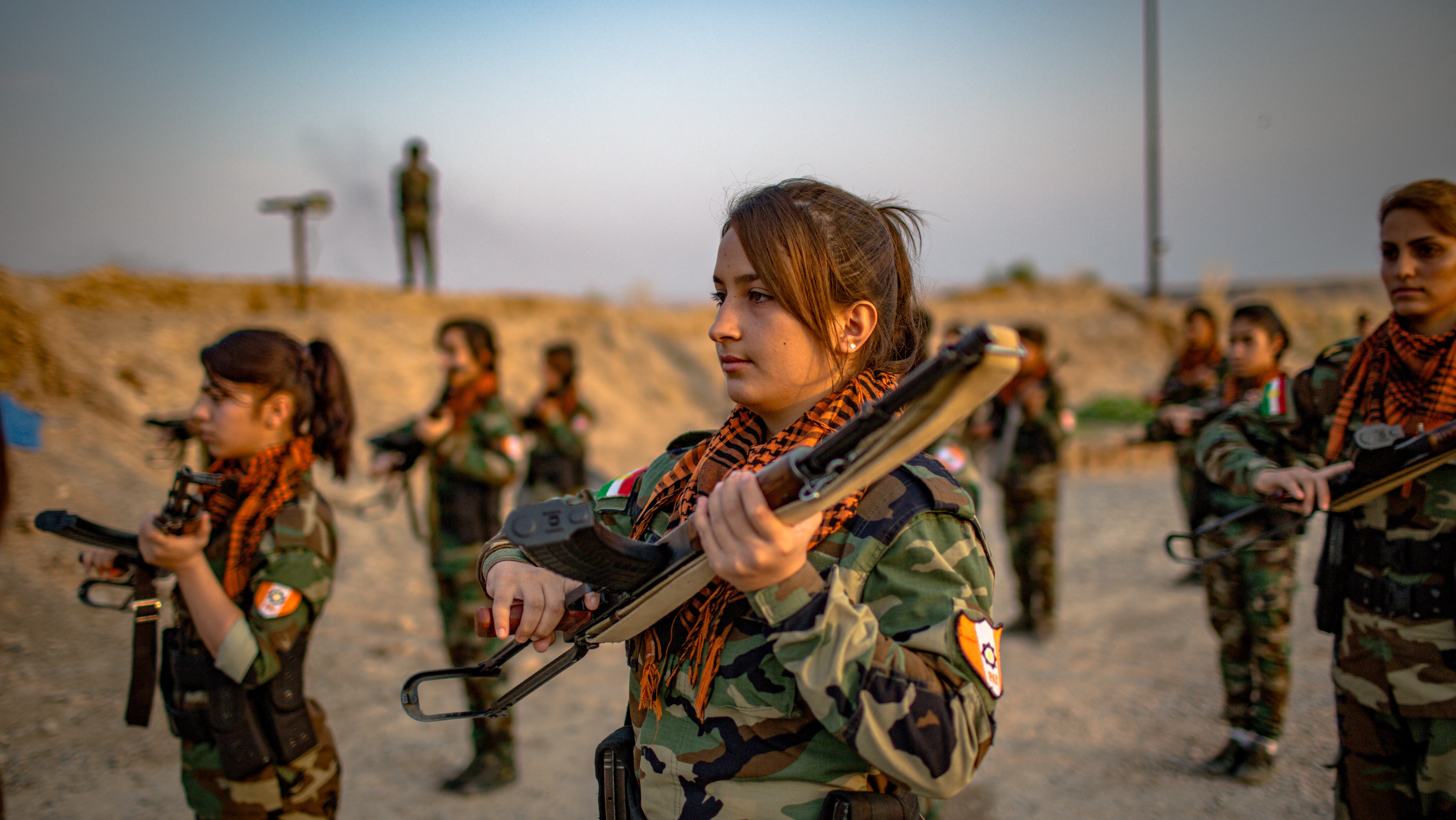
Kurdish Iranian women peshmerga fighters from the Kurdistan Freedom Party (PAK) stand in formation at their base near Kirkuk, Iraq, on Aug. 30, 2019. These forces enjoy considerable support in Iranian Kurdistan, and they could open a new front against the IRGC. (Hossein Fatemi/Middle East Images/AFP via Getty Images)
At present, the only armed force the IRGC appears to regard as a serious threat consists of the thousands of Kurdish peshmerga fighters who, following the Iran-Iraq security agreement, have been compelled to reside in areas of the Kurdistan Region far from the border. These Kurdish parties, which have recently united, enjoy broad support in Iranian Kurdistan.
Shukriya Bradost, a security analyst in the Middle East, stresses that the capacity to mobilize the public is stronger in Kurdistan, and this opportunity can be used for the liberation of all of Iran. She argues that the “Kurdish card” can be used to bring down the Islamic Republic. In the first step, Bradost says, the creation of a free zone in Kurdistan could provide a base from which to expand the battle and ultimately crush the regime. She recently wrote that this opportunity for the “Kurdish card” still exists.
۴ ماه پیش این پیشنهاد من برای مبارزه علیه رژیم بود و توضیح دادم که چگونه میتوان کردستان و احزاب آن را بهعنوان یک فرصت دید.
امروز در موقعیتی قرار داریم که این فرصت هنوز وجود دارد.#IranMassacre #IranProtests pic.twitter.com/xob5jNTq6u— Shukriya Bradost (@ShukriyaBradost) January 16, 2026
Apart from the Kurds, the only other organized force capable of carrying out armed operations is the Mojahedin-e Khalq (MEK). Although the MEK, in a striking report published a few days before the war began, claimed responsibility for an attack on the Leader’s residence (Beyt e Rahbari), and although they maintain an organized support base inside the country, their cult-like nature, isolationism, lust for domination, religious roots, and deep unpopularity among many Iranians inside the country have in practice led them to be set aside as a potentially armed opposition force.
Their supporters, under the banner of “rebel units,” do carry out limited disruptive operations and send footage to Simaye Azadi television. However, their claim of an attack on the Khameni’s residence by hundreds of armed fighters has been widely met with skepticism.
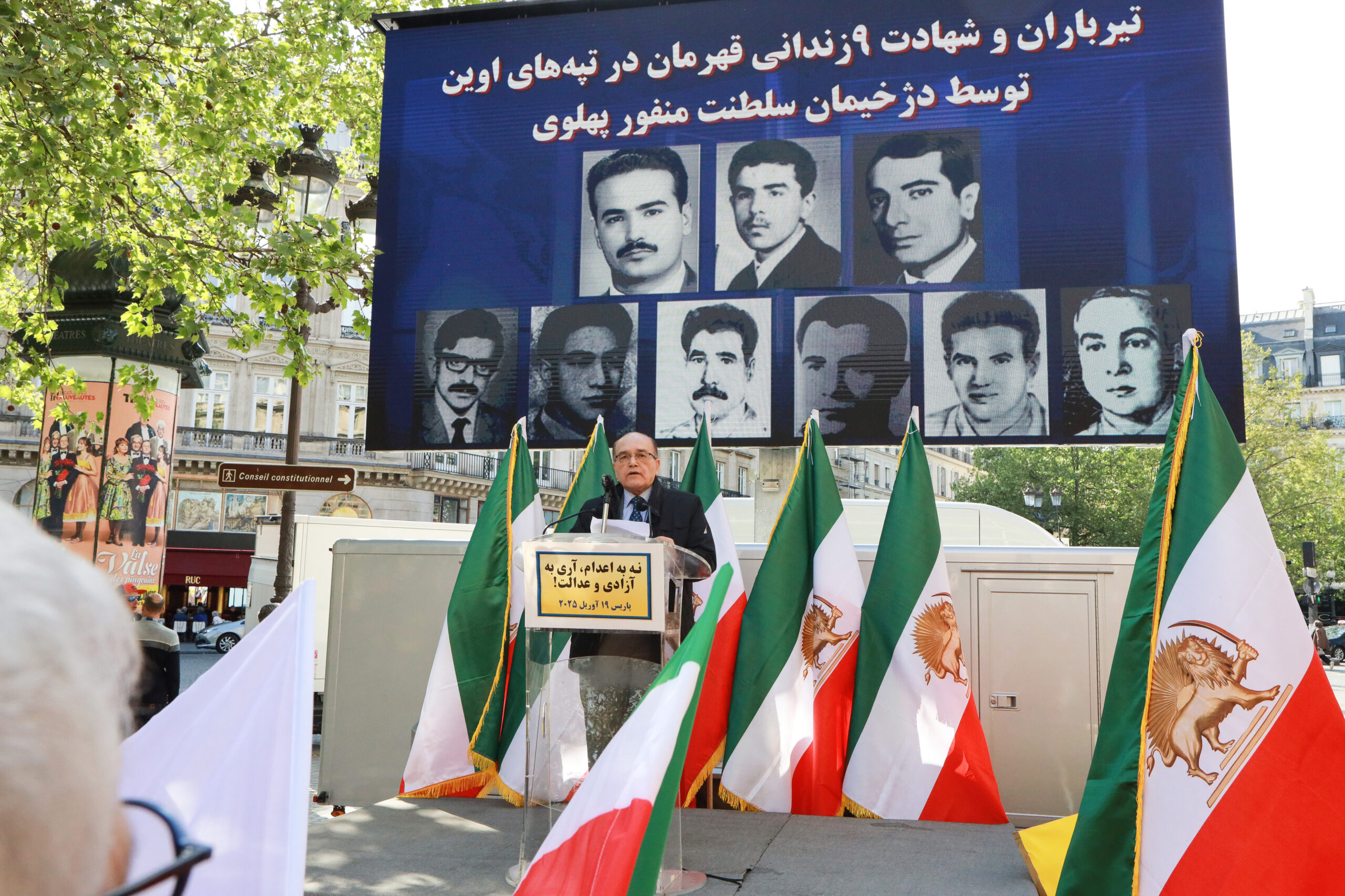
Abolghasem Rezaie from MEK delivers a speech behind a podium surrounded by flags during the rally in Paris, April 19, 2025. A few days before the war, the Mojahedin claimed to have attacked Khamenei’s residence, in what appears to have been an attempt to present themselves as a force with military capabilities inside Iran. They have supporters both inside Iran and abroad, but they enjoy little popular support among the public. (Siavosh Hosseini/SOPA Images/LightRocket via Getty Images)
More than 44 years have passed since the MEK was engaged in urban warfare with the IRGC and Islamic Police (Committee). Their military operations, such as mortar attacks on security centers and the assassination of officials, ended years ago, with their activities now largely confined to infiltration and the exposure of the regime’s secret nuclear information.
Iran, however, is a country of multiple nations, ethnic communities, tribes, and minorities, some of whom, particularly in western and southwestern Iran, are armed and could, at a critical moment, play a vital role alongside the “Kurdish card,” tying down the IRGC on several fronts.
If protesters once again pour into the streets and confrontations spread across the capital and other major cities, as they did during the January uprising, the regime’s military and security bodies could begin to fracture rapidly under the pressure of a war it seems increasingly incapable of managing. That experience left many Iranians not only enraged but also determined to exact retribution, with some now openly saying that their aim is to strike directly at the regime’s machinery of repression.
An Iranian protester who was detained for several days during the January protests also told The Media Line that after hours of trying to gain internet access, the practical field leaders of a nationwide uprising are now available, and there is deep concern about political prisoners.
Those who possess revolutionary experience and knowledge, and who have devoted their lives to Iranian society and to the struggle for freedom, are fully capable of carrying this revolution forward until it achieves an “Iranian Republic” with all the characteristics laid out in the Woman, Life, Freedom manifesto, she said.
See Related Story: Iranian Opposition Pushed for Unity After Decades of Fragmentation
Quite apart from the deeply radicalized Woman, Life, Freedom movement, student groups, labor activists, syndicates and trade groups, and elements of the remnants of left-wing parties crushed in Iran during the 1980s, could also play a significant role in the course of a final uprising. It can be said that, although the Left is not united, it still retains a latent capacity for mobilization, organization, and leadership.
The IRGC, despite its nearly half-century grip on power, its multilayered structure, and its deep entrenchment in Iran’s political and economic order, may ultimately prove more fragile than it appears. Sustained by vast economic interests, patronage networks, logistical reach, propaganda, proxy forces, and, above all, the regime’s clerical and financial core, it could still be shattered if its underlying structure takes a sufficiently severe hit.
If the war drags on while the Guards are drawn into direct confrontation with protesters in the streets, the notorious force could begin to collapse with remarkable speed and vanish from history altogether.
