Jerusalem Prayer Breakfast Enters Its 10th Year, Iran’s Exiled Crown Prince Set To Address Mar-a-Lago Event
Veksler said Pahlavi’s presence “creates hope that there will be regime change. … Wouldn’t it be something of a relief, not just for us, but for the Iranian people?”
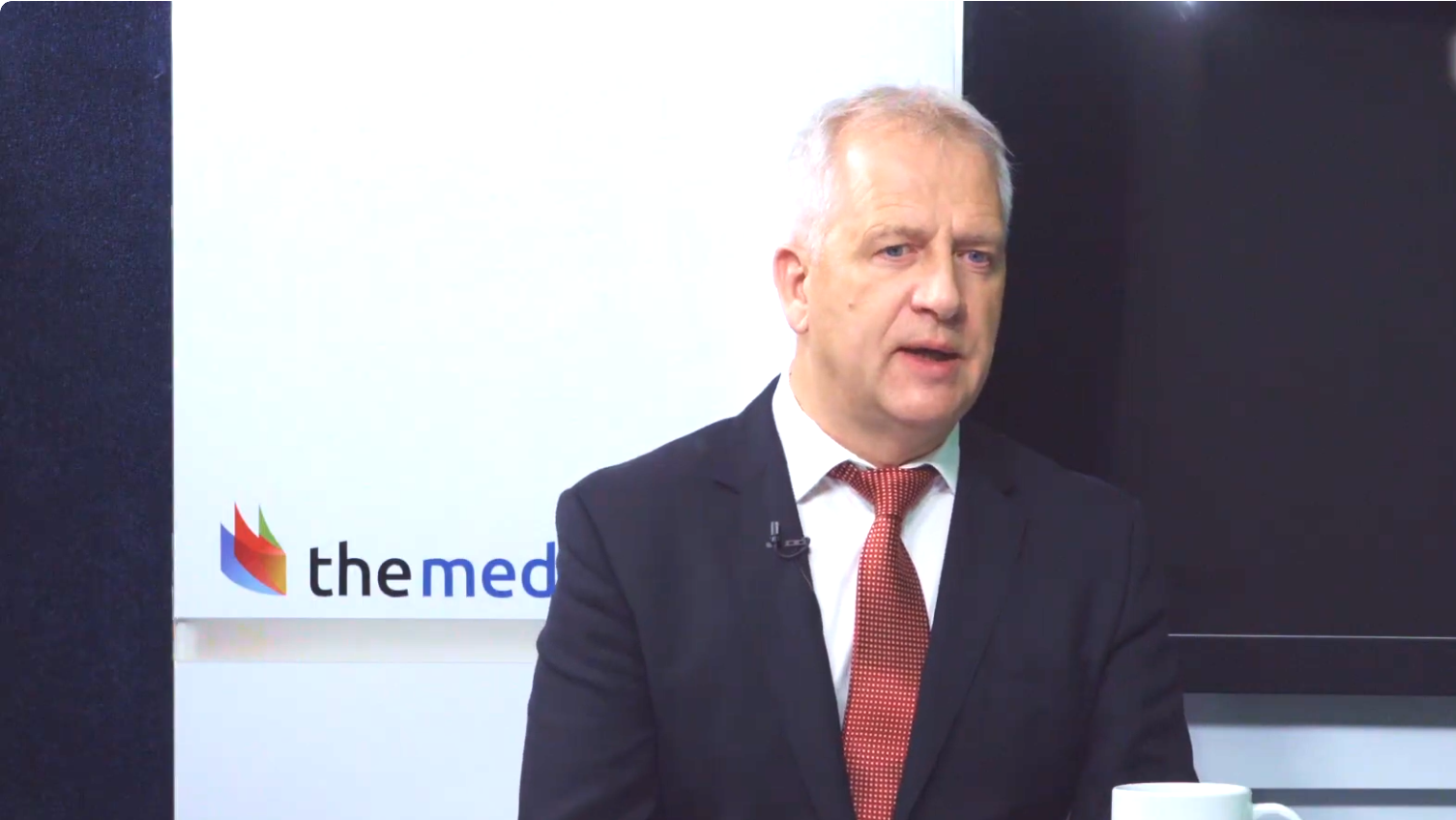
There are few faith-based organizations that engage in both policy and prayer, but one man, Albert Veksler, global director of the Jerusalem Prayer Breakfast, has met the challenge of combining these two powerful elements on a truly international scale. He joined me in the studio to discuss the organization’s astounding accomplishments and what’s in store for 2026 and beyond.
The Jerusalem Prayer Breakfast is heading into its 10th anniversary, with nine annual breakfasts in Israel and 27 outside the country.
At the beginning of 2026, the Jerusalem Prayer Breakfast is planning an event at Mar-a-Lago, President Donald Trump’s private club and residence in Palm Beach, Florida which will include Latvian parliament delegation, Brazilian congressman Eduardo Bolsonaro. In addition, “we will have the crown prince of Iran, Reza Pahlavi,” the son of Iran’s last shah, Veksler said.
Pahlavi’s presence “creates hope that there will be regime change. I’m really praying that this would happen,” Veksler said. “Wouldn’t it be something of a relief, not just for us, but for the Iranian people?”
How many years have they suffered? What a horrible, horrible dictatorial regime. How many people have been murdered and lost their lives and health and future? It’s about time for a change in Iran.
“How many years have they suffered? What a horrible, horrible dictatorial regime. How many people have been murdered and lost their lives and health and future? It’s about time for a change in Iran.”
Speaking of his most recent prayer breakfast, Veksler said, “We just came back from Taiwan,” describing a successful event hosted by Vice President Hsiao Bi-khim.

Jerusalem Prayer Breakfast event in Taiwan. (Screenshot: YouTube)
A Jewish community center founded by Jeffrey Schwartz, along with Ginny and Carl Chien, launched the event, which took place under ongoing threats from China.
As the gathering was happening in Taipei, news broke that Taiwan’s deputy foreign minister, Francois Wu, had visited Israel—”something that enraged” China—alongside revelations about US defense contracts.
“Suddenly all of these things were on the table,” Veksler recalled. “You can say it coincided. But I like this kind of, you know, coincidences,” adding that similar moments have aligned with their visits in Italy, Fiji and Holland.
On the topic of complex geopolitics, the question of radical Islam emerging in once-moderate countries is a serious issue. How does it affect the relationship between Israel, the Middle East and the US during the prayer breakfasts?
“I think you saw that very well played out in Israel recognizing Somaliland, a country that de facto existed for 34 years and was now recognized by Israel. And you saw who supported it. And you saw who criticized Israel for doing so. And I think that kind of shows the lines of where the power struggle is happening,” he replied.
“Happily, the countries that had signed the Abraham Accords with Israel were not the ones condemning Israel for this step.”
Despite hopeful signs from moderate Islamic countries, Veksler expressed concern over the spread of extreme Islam.
“Of course, I think we are very worried to see how this radical Islam is growing. … The influence of it is growing in the Western world.”
He continued, “Of course, Oct. 7 cleared it up very, very much for us. We understood suddenly that, hey, this is actually what they are planning … They have to eliminate, kill every Jew to see their redemption come. I mean, this is their very purpose. And then you realize that this is encroaching us all over the world.”
The problem definitely impacts global Jewish communities, particularly given the election of staunchly anti-Israel Zohran Mamdani as mayor of New York City.
“I’m not even speaking about England or France.”
It never just starts with the Jews. And when it starts with the Jews, then it doesn’t end with the Jews, as we well know from history
Christians worldwide are also affected. Veksler observed, “It never just starts with the Jews. And when it starts with the Jews, then it doesn’t end with the Jews, as we well know from history.”
He added, “I mean, they say, ‘First the Saturday people, then the Sunday people.’ So people have to wake up. That’s very clear.”
Nigeria has been high on Veksler’s list as a potential host country. When asked why it has been so difficult to schedule an event there, Veksler explained that security plays a central role in planning. The complexity “very much depends on the country and, of course, the situation.”
Christians in Nigeria have faced severe persecution, prompting President Trump to send planes in a show of support. Veksler noted that while the organization has held events in Uganda, Ghana and South Africa, “It’s very important for us to go to Nigeria. I mean, we’ve seen so much support coming out of the Nigerian Christians.”
He described aligning Nigerian Christians with Israel as a first step toward the country recognizing Jerusalem as Israel’s capital and moving its embassy there—a move that would benefit both countries and the continent.
In the meantime, the organization is reaching out to churches and Christian communities in Nigeria that may be open to hosting a Jerusalem prayer breakfast.
He was pleasantly surprised that Denmark provided 24-hour hotel security free of charge. Although Norway was similarly cooperative, Veksler said the Swedes were less accommodating, as locals feared threats from radical Islamists.
Give the gift of hope
We practice what we preach:
accurate, fearless journalism. But we can't do it alone.
- On the ground in Gaza, Syria, Israel, Egypt, Pakistan, and more
- Our program trained more than 100 journalists
- Calling out fake news and reporting real facts
- On the ground in Gaza, Syria, Israel, Egypt, Pakistan, and more
- Our program trained more than 100 journalists
- Calling out fake news and reporting real facts
Join us.
Support The Media Line. Save democracy.
Although events in the US generally require more security, “New York was a nightmare,” he confessed—especially in Times Square.
“It’s very visible and then also very expensive.” Security was required for an Israeli government minister, Knesset members and ambassadors. Still, Veksler said the event was well-organized and low-key, with no major interference.
The need for heightened security means more people are hiding their Jewish or Christian identities, even in 2026. While acknowledging that some are bullied into silence, Veksler expressed gratitude to Christian communities in Finland, Estonia, Latvia and Lithuania.
“They are very, very public in their support. Going out … with a demonstration of shofars in Vilnius. I heard it when I was visiting Latvia—big demonstrations with Israeli flags in cold winter in Finland.”
He noted that, by contrast, “it’s Denmark and other Scandinavian countries where you really feel the hostility.”
They are very, very public in their support. Going out … with a demonstration of shofars in Vilnius. I heard it when I was visiting Latvia—big demonstrations with Israeli flags in cold winter in Finland.
However, the supportive countries “have the guts to do that and to stand up with us. So it’s a very, very big thing. … Those Christian communities have love and support so strong that they don’t care. I think it’s a huge thing. And I think we have to see it more happening.”
Often, prayer breakfasts have a direct impact on policy. Veksler described a concrete example in 2019 in Holland, when an event coincided with a controversy over reparations to Holocaust survivors.
During the Holocaust, Nazi-occupied Holland became “a very efficient killing machine,” with about 88% of Dutch Jews murdered. “The irony was that the Jewish people had to pay their tickets to the death camps,” he said.
Although the Dutch government had formally decided to provide reparations, it had stalled on implementation.
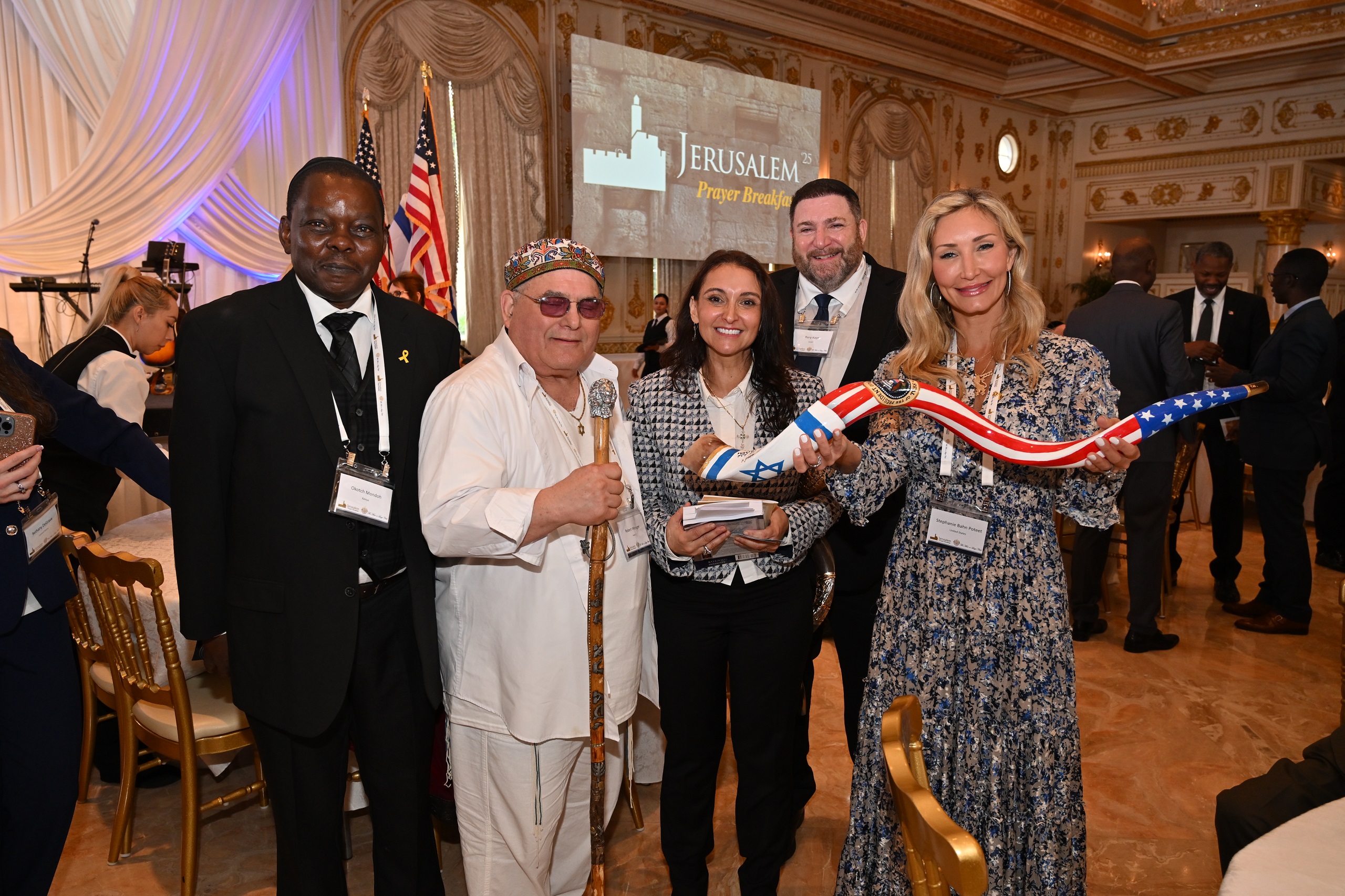
Okotch Mondoh, Robert Weinger, Sarah Boulos, Rory Kaye, and Stephanie Bahn Poteet, with a red, white and blue shofar, at the Jerusalem Prayer Breakfast, Mar-a-Lago, Palm Beach, Florida, Jan. 14, 2025. (Jerusalem Prayer Breakfast)
Against that backdrop, a local member of parliament invited the group to gather in the Ridderzaal—“the very special place where the king only speaks to the nation once a year”—bringing together the Jewish community, pastors, a delegation from Israel and government representatives.
“And that very day,” Veksler said, “you can say it’s a coincidence—and I love these kinds of coincidences—the government decided to release tens of millions of euros” to compensate survivors and their families.
The impact extended beyond the payments. The following year, the king publicly acknowledged national failure, saying he was “ashamed” of the monarchy’s silence during the Holocaust—a moment Veksler said helped spark a broader movement of repentance in the Dutch Reformed Church.
“These kinds of events,” he said, “trigger something, and you don’t know what the ripple effect will bring about.”
Veksler recounted a similar moment in Italy in 2021 during a gathering in the Senate library, when Giorgia Meloni was still head of the opposition. Fifteen lawmakers from multiple parties attended.
Sen. Matteo Salvini set aside prepared remarks, saying, “Somebody wrote a speech for me and I’m not going to read it. I will say what’s on my heart.” He declared that “the Jewish people and Jerusalem are inseparable,” and said Italy should recognize that.
He went further, promising publicly—and later on social media—that “when my time comes to put together the coalition, I will move the embassy from Tel Aviv to Jerusalem.” A year later, he helped form a governing coalition.
“It’s a big promise,” Veksler said, adding that they are still waiting for Salvini, now a minister, to fulfill it.
Prayer also played a role in President Trump’s historic recognition of Jerusalem as Israel’s capital. The first Jerusalem Prayer Breakfast took place in 2017, just after the president had waived the Embassy Act—a piece of legislation delayed since 1996.
During the event, evangelist Billye Brim offered what was described as a simple but striking prayer—that the newly elected president would recognize Jerusalem and move the US embassy on her birthday, Dec. 6.
Veksler called it “really remarkable” to watch that prayer materialize. The president later announced, “I’m declaring the obvious—Jerusalem is the capital of the Jewish people and of Israel,” and moved the embassy despite resistance from the State Department. Veksler credited Ambassador David Friedman for being “so instrumental in making this happen.”
“I really believe that this is the moment when governments should actually show their support for the only democracy in the Middle East—Israel—and declare what the Bible has said for thousands of years: that Jerusalem is Israel’s capital,” he said.
I really believe that this is the moment when governments should actually show their support for the only democracy in the Middle East—Israel—and declare what the Bible has said for thousands of years: that Jerusalem is Israel’s capital
Countries like the Czech Republic and Hungary, which indicated they would move their embassies, should be encouraged to follow through.
“They’ve been kind of waiting,” Veksler said. “I think this is the time.”
He also expressed hope that the US president would recognize Israel’s right to Judea and Samaria.

International spiritual leaders stand on stage at a Jerusalem Prayer Breakfast event at the Knesset auditorium marking 600 days since the start of the war, May 28, 2025. (Gabriel Colodro/The Media Line)
“President Trump has been … amazing—recognizing Jerusalem, the Golan Heights, standing up with Israel in ways that have been remarkable. The hostages were freed. I mean, you cannot even think that this would be possible.”
“I remember it was that day in the Knesset. We were pinching ourselves. Is it really true? Are they really being released? And they were,” he recalled.
“So I think President Trump needs to have a legacy of recognizing Jerusalem, Judea and Samaria.”
During a recent meeting, the American president reportedly pushed back when Netanyahu brought up Judea and Samaria.
Veksler said he wasn’t surprised.
“It’s a very sensitive issue because of the very strong Christian community that is behind President Trump as well. I think that unfortunately, faith and politics sometimes align, and we don’t know. … Of course, in Joel 3, it speaks of judgment coming over the nations—over how they divided not our land, but God’s land. It’s in the hearts of many Christian leaders.”
“So the way the United States treats this situation will either give a lot of hope or make many people despair. “They’ve started to move toward recognition of Jerusalem, the Golan Heights,” Veksler said. “Why not recognize the whole biblical land of Israel?”
When asked why many Christians are more concerned with recognizing Judea and Samaria than some Jews are, Veksler said that when people read the Bible, “they don’t want to see their nations suffer over how their politicians decide on Judea and Samaria. I mean, you have the whole history of empires and nations rise and fall over how the Jewish people were treated.”
They’ve started to move toward recognition of Jerusalem, the Golan Heights. Why not recognize the whole biblical land of Israel?
He described Theodor Herzl’s efforts to persuade Germany to offer a protectorate within the Ottoman Empire. Appeals were made up to Kaiser Wilhelm II, as well as to Ottoman and Russian officials, but efforts were met largely with indifference.
The decisive moment came during the kaiser’s 1898 visit to Jerusalem, when the delegation heard that “Germany has to put Germany first.”
“We know what happened a few years later as the First World War broke out,” Veksler said, adding that Germany, Turkey and Russia ultimately emerged as “the big losers.”
“The Bible is very clear,” Veksler said, citing the principle that those who bless the Jewish people will be blessed, and those who curse them shall be cursed. “I’ve even called it God’s foreign policy doctrine that he laid out to Abraham.”
He urged countries to “stand on the right side of history. … Stand on the side which will support the Jewish people,” adding, “Who would want something evil and bad to happen to your country?”
Next on the agenda is a prayer breakfast in Ottawa, Canada, in March, which will likely be a “huge relief” for Canadian Christians “because they’ve been horrified by how the Canadian government is treating Israel lately.”
April’s event will take place in the Faroe Islands, located between Norway, Iceland and the Hebrides and Shetland Isles of Scotland.
The 10th Annual Prayer Breakfast will take place in Jerusalem May 26–28. Veksler says he also looks forward to scheduling events in Latvia, the United States and Singapore.
When asked how the initiative began, Veksler explained that Robert Ilatov, then appointed by the Knesset speaker as chairman of the Christian Allies Caucus, asked for help building a Knesset-based framework for engagement with Christian supporters of Israel.
After reviewing existing Christian pro-Israel groups, the idea of a prayer breakfast was proposed. Ilatov initially objected, saying, “This is a Jewish state. You don’t expect us to pray to Jesus.” The concept was reframed around shared themes.
“I said, we can pray for the peace of Jerusalem,” Veksler recounted.
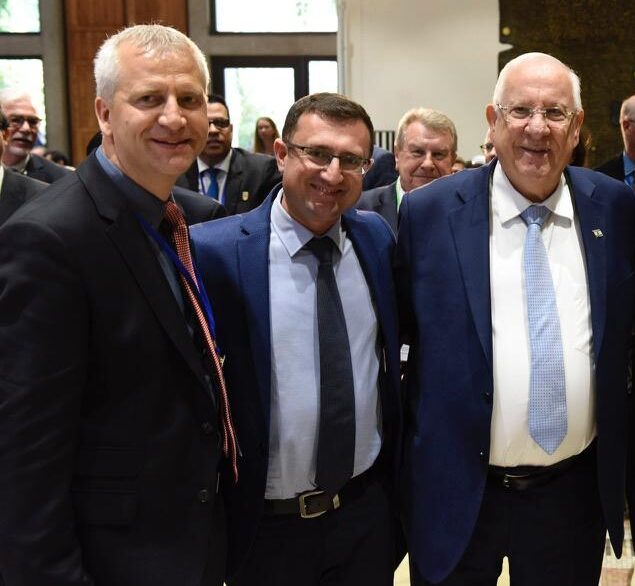
From left: Jerusalem Prayer Breakfast Director Albert Veksler, Knesset member Robert Ilatov, and Israel’s then-President Reuven Rivlin at the first Jerusalem Prayer Breakfast in Jerusalem, 2017. (Jerusalem Prayer Breakfast)
The idea gained traction after Ilatov consulted Reuven Rivlin, then-president of Israel. “Rivlin loved it,” Veksler said, and agreed to support the event.
In 2017, the first Jerusalem Prayer Breakfast was held with 570 participants from 58 countries. Since then, the initiative has drawn international interest, including invitations from the United States, Europe, Africa, Australia and Scandinavia.
Veksler reflected on his family’s decision to make Israel their home. Originally from Estonia, he saw his parents make aliyah first.
“I suddenly experienced a void in my heart, and I felt like I couldn’t stay out. It’s just a beautiful place to stay and live in.”
