
Missile Barrage, Endless Sirens: IDF Official Briefs TML on Warning System
The Israeli military says it is refining alerts to target only those at risk while reducing disruption to daily life, schools, and the economy
When sirens wail across Israel, civilians have mere seconds—15 to 90—to reach shelter, highlighting a sophisticated system balancing safety and normalcy. Behind the chaos lies an IDF-engineered architecture of detection, polygons, and precise alerts that warns only those truly at risk.
That challenge has become more visible as Israelis have faced repeated attacks from different fronts, with varying distances and flight times. In a background briefing with The Media Line, an IDF official familiar with the early warning system described an architecture built around a central objective: keeping civilians safe while maintaining enough precision to allow the country to continue functioning. “The idea is not to send everyone to shelter,” the official said. “It’s to send only the people who are in danger.”
The idea is not to send everyone to the shelter. It’s to send only the people who are in danger
The process begins with detection, handled by the Israeli Air Force, before moving to the Home Front Command’s warning system. Based on that initial identification, alerts are generated and distributed in stages. From there, the system produces “the early warning and the warning and the finish message,” which are then transmitted to civilians, the official said.
Alerts reach civilians via a multi-layered network built for maximum coverage in any scenario. Warnings blast through sirens, cell broadcasts, mobile apps, TV, radio, and the internet.
“Our end devices are the sirens, you have the phone, you have the cell broadcast, you have the television, you have internet, you have radio, and that’s how the message is sent,” the official explained.
At the core of the system is a highly granular geographic model. Israel has been divided into “around 1,700 polygons,” each with its own predefined warning time. These times are embedded in the system and matched against incoming threat data to determine how much time civilians in a given area are likely to have.
In practice, this results in varying alert windows depending on location. “Some people in their city have 15 seconds, 30 seconds, 45, a minute, a minute and a half based on where you are in the country,” she noted.
This localized approach also explains why early warnings are not always possible. The system is designed to issue alerts within the defined timeframe for each location, but the availability of an earlier warning depends largely on the distance from the threat’s launch point. When missiles are fired from farther away, there is more time to generate awareness before the final warning window begins. When threats originate closer to Israel’s borders, that margin can disappear.
The warning system also accounts for risks beyond direct impact. Even when interceptions occur, civilians may still be instructed to take cover. According to the official, alerts are based not only on projected strike zones but also on where interception debris may fall.
“We have the area from the assessments that we get from the air force where the missile is headed … and we have the assessment of where the interception is supposed to be and where the fragments are supposed to fall,” she said. “Those are the two areas where we send early warnings to.”
Our systems are always going through updates. We also see what the civilian needs, what they’re missing.
Give the gift of hope
We practice what we preach:
accurate, fearless journalism. But we can't do it alone.
- On the ground in Gaza, Syria, Israel, Egypt, Pakistan, and more
- Our program trained more than 100 journalists
- Calling out fake news and reporting real facts
- On the ground in Gaza, Syria, Israel, Egypt, Pakistan, and more
- Our program trained more than 100 journalists
- Calling out fake news and reporting real facts
DONATEJoin us.
Support The Media Line. Save democracy.

The system itself is continuously updated, reflecting both operational lessons and civilian needs that emerge over time. “Our systems are always going through updates,” the official said. “We also see what the civilian needs, what they’re missing.”
One example involved adapting alerts for religious communities during Shabbat, the Jewish Sabbath. Because some people do not use phones or television, the system was modified to include radio-based alerts through what the official described as a “silent wave.”
“There’s a certain line on the radio that it stayed quiet for the whole Shabbos [Sabbath], and when there’s an early warning, they would get the early warning into the radio,” she said. A follow-up message is also transmitted when it is safe to leave the shelter.
Another significant shift has been the reduction of the warning footprint itself. Earlier in the conflict, alerts covered broader areas, but over time, analysis allowed the system to narrow those zones.
“When we would send an early warning out to the civilians, it would be much wider,” the official said. “Slowly … we were able to make that polygon smaller and put less people into awareness … less people into shelters.”
That refinement is closely tied to maintaining normal life under sustained threat. “That’s how we were able to continue the day-to-day life because, in the end, that is also one of our missions here—to allow the economy to keep on going,” the official said, adding that the same applies to schools and routine activity.
She pointed to the broader implications of over-warning, arguing that sending large portions of the population into shelters too frequently would carry high national costs. “If every time there was an early warning, I would put half the country into awareness … then the economy would get hit very badly. Schools would get hit. People wouldn’t be able to continue with their day-to-day life.”
To illustrate the risk, the official drew a comparison with the pandemic years. “If you compare that to the two years of corona, when everyone was stuck at home, it hit. It hit the economy. It hit schools,” she said. “So, if we would have the same thing now for two and a half years, we would be in a completely different place.” Precision, in that sense, is not only a technical objective but a societal one.
If you compare that to the two years of corona, when everyone was stuck at home … It hit the economy. It hit schools.
The same logic extends to public trust. Repeated alerts that do not result in visible impact can erode confidence in the system. “We need to keep the trust and build the trust between the government and the civilians,” the official said. Early in the current phase of attacks, warning areas were broader, but were later reduced to maintain credibility. “We needed to keep the awareness and keep them to understand and believe that what we’re saying is true.”
Asked about the risk of alert fatigue, the official said civilian behavior remains mixed. “It’s hard for me to assess that because it’s very different,” she said, noting that some people leave shelters early or continue driving. At the same time, nearby impacts tend to reinforce compliance. “When something happens, and there’s a hit close by, then that gives you the awareness.”
Despite the frequency of alarms in some areas, the official said there is no clear indication that public responsiveness has significantly declined. Residents in heavily targeted regions, she suggested, remain aware of the risks. “They understand that we’re saying it for a reason and we’re not giving them the warnings just to be on the safe side.”
They understand that we’re saying it for a reason and we’re not giving them the warnings just to be on the safe side
On the technical side, the system relies on multiple infrastructures operating in parallel. Cell broadcast is based on cellular antennas, while mobile applications use GPS. Sirens receive messages directly from the early warning system. Importantly, alerts do not depend solely on internet connectivity. “Either from the app or from the cell broadcast, yes,” the official said when asked whether users without internet access could still receive warnings.
Some areas of the early warning framework remain under development. Artificial intelligence, the official noted, is not currently integrated into the system, although it is being considered for the future. “It’s not something that we use right now … but it is in the conversation.”
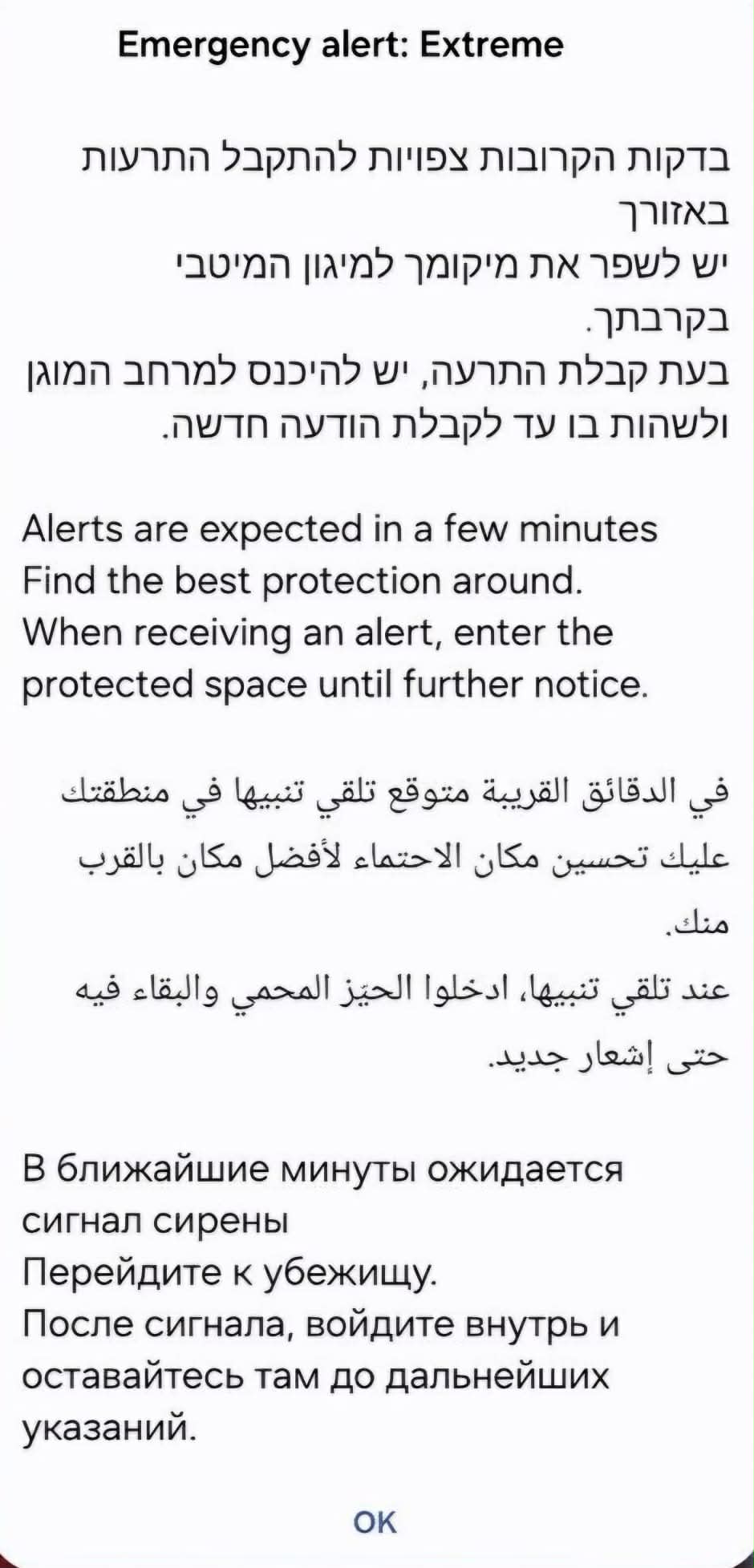
Copy of an alert sent to a phone. (Screenshot:Whatsapp)
International coordination on such systems is limited, she added, emphasizing that “our responsibility … is for the citizens of Israel in Israel.”
She also rejected the suggestion that the volume of attacks has strained the system’s capacity. “Our systems work on also automatic and semi-automatic and manual,” the official said. “There aren’t any problems with capacity on our systems.”
In the end, the official returned to what may be the most important takeaway for civilians. The purpose of early warning, she said, is not simply to extend the time spent in shelters, but to prompt action before the final seconds. “The early warning system is there to give the awareness that something is happening.”
She offered a practical example: “If I’m on the fourth floor and there’s no elevator … I won’t wait for the warning that tells me I have a minute and a half for impact.” Instead, the value lies in starting to move earlier. “The point of the early warning is to give me the awareness that something is coming, and I need to start going towards the shelter.”
In that sense, the system is not only about sirens or seconds. It is about turning limited time into usable time, while allowing a society under sustained attack to continue functioning.
