Iran’s Exiled Opposition Won Seats Across Europe, but in Geneva, It’s Still Not on the Table
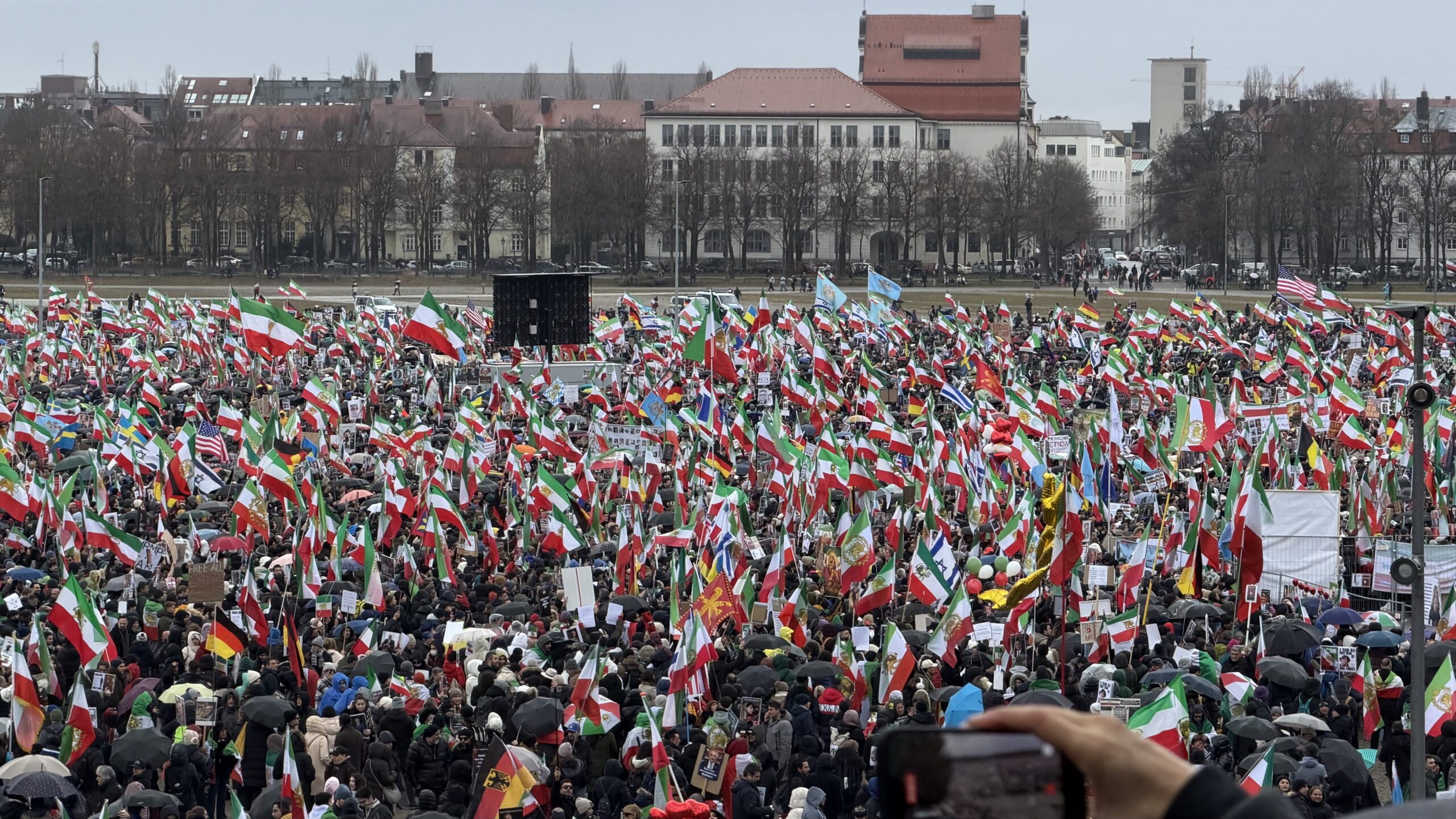
Saturday’s rally, held on the margins of the Munich Security Conference, was the largest Iran-focused demonstration in European history
[ISTANBUL] Seventy-two hours after 250,000 demonstrators filled Munich’s Theresienwiese demanding the fall of Iran’s Islamic Republic, chanting “Change, change, regime change” beneath pre-1979 Lion and Sun flags, Iranian Foreign Minister Abbas Araghchi landed in Geneva. “I am in Geneva with real ideas to achieve a fair and equitable deal,” he posted on X. “What is not on the table: submission before threats.”
As of Tuesday morning, US envoys Steve Witkoff and Jared Kushner are at Oman’s mission in the Geneva suburb of Chambésy for a second round of indirect nuclear talks with Tehran, mediated again by Omani Foreign Minister Badr bin Hamad al-Busaidi. By afternoon, the same American delegation is set to pivot to Russia-Ukraine diplomacy across town. Three days, 300 kilometers, and a strategic gulf between regime change and negotiated containment that no motorcade can bridge.
Saturday’s rally, held on the margins of the Munich Security Conference, was the largest Iran-focused demonstration in European history. US Sen. Lindsey Graham addressed the crowd in a “Make Iran Great Again” cap. Iranian exiled Crown Prince Reza Pahlavi, who had spoken at the conference the day before, warned that the regime’s survival “sends a clear signal to every bully: kill enough people, and you stay in power.”

Crown Prince Reza Pahlavi, center, with senior CDU policymakers at the Munich Security Conference, Feb. 14, 2026. From left: Norbert Röttgen, deputy chairman of the CDU/CSU parliamentary group; Bundestag member Reza Asghari; Pahlavi; David McAllister, chairman of the European Parliament’s foreign affairs committee; and Jürgen Hardt, CDU/CSU foreign policy spokesman. (Courtesy of the office of Prof. Dr. Reza Asghari)
But Munich was not just a protest. It was the public face of something quieter: a diaspora opposition that has been moving—unevenly, sometimes with surprising speed—from the street into European institutions. From Stockholm to Berlin, from Paris to Oslo, Iranian-born lawmakers now sit inside the policymaking structures that once treated them as spectators.
The question is whether Europe knows how to use that access, or whether it is drifting toward regime-change language without a transition strategy. For Israel, which has pressed Washington to keep missile restrictions on the table, and for Gulf states watching the Strait of Hormuz, the answer is not theoretical.
The Man Who Was Already in the Room
Among the 250,000 was one man who didn’t need to rally for access. He already has a vote.
Prof. Dr. Reza Asghari, imprisoned by the Islamic Revolutionary Guard Corps (IRGC), later exiled, and now elected to the Bundestag on the Christian Democratic Union (CDU) ticket, is the only sitting European parliamentarian who has been inside an IRGC prison. He described the EU’s Jan. 29 designation of the IRGC as a terrorist organization as “a big achievement for Europe, for the Iranian people, and for civilized society as a whole.”
If you want to understand what this organization [IRGC] means, compare it with the Gestapo, with the Stasi
“If you want to understand what this organization means,” Asghari told The Media Line, “compare it with the Gestapo, with the Stasi. A large part of the state apparatus is cooperating together. Then you see how mighty this organization is.”
The comparison is not rhetorical. The IRGC functions simultaneously as a military force and a political-economic empire, its business networks, intelligence arms, and militia branches forming the regime’s internal insurance policy. To date, no meaningful fracture has emerged inside the Guards, the Basij, or the regular armed forces. That cohesion remains Tehran’s strongest defense against collapse.
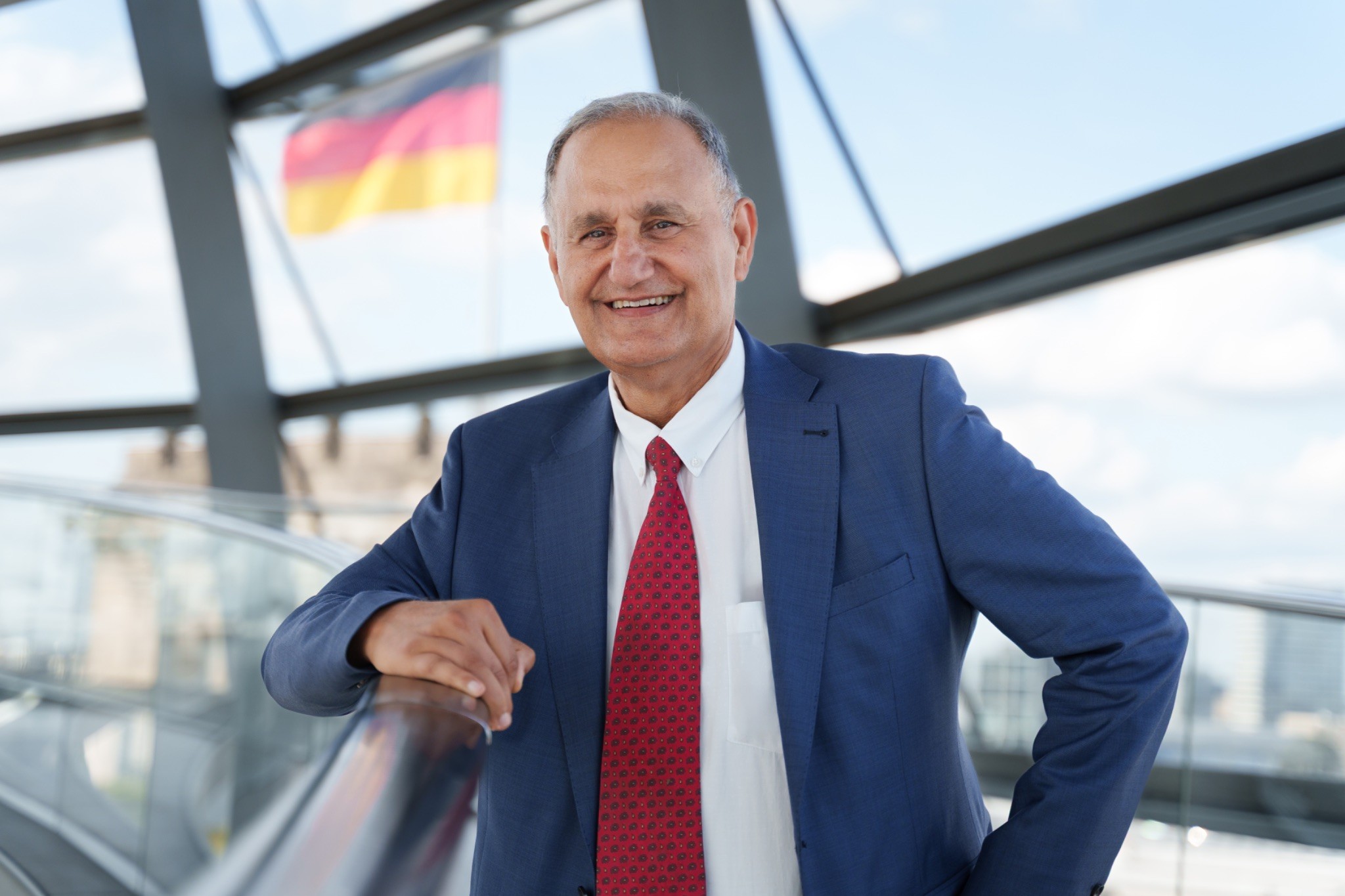
Prof. Dr. Reza Asghari, CDU member of the German Bundestag and the only sitting European parliamentarian to have been imprisoned by Iran’s Islamic Revolutionary Guard Corps. He was elected to the Bundestag in 2025. (Courtesy of the German Bundestag)
Asghari is not alone. Sweden has up to 10 parliamentarians of Iranian descent, the largest such concentration in any European legislature. One of them, Alireza Akhondi, wept on the Riksdag floor in 2022 as he read the names of Iranian teenagers killed by security forces, then helped push the European Parliament toward the IRGC designation.
After it passed, Akhundi, who requires 24-hour security protection after being targeted by the IRGC, told The National he was “very, very happy,” adding: “Compared to the thousands who have been killed in Iran, it’s a small price to pay.”
In Norway, Masud Gharahkhani became speaker of parliament in 2021, the highest-ranking Iranian political expatriate in the world. In Denmark, Foreign Minister Lars Løkke Rasmussen publicly pressed for the IRGC designation. Germany and the Netherlands drove the process at the EU level.
Give the gift of hope
We practice what we preach:
accurate, fearless journalism. But we can't do it alone.
- On the ground in Gaza, Syria, Israel, Egypt, Pakistan, and more
- Our program trained more than 100 journalists
- Calling out fake news and reporting real facts
- On the ground in Gaza, Syria, Israel, Egypt, Pakistan, and more
- Our program trained more than 100 journalists
- Calling out fake news and reporting real facts
Join us.
Support The Media Line. Save democracy.


The designation was a tangible policy outcome. But the same week the Munich Security Conference hosted Pahlavi, the Dutch Foreign Ministry canceled his scheduled appearance in The Hague—a reminder that institutional access does not equal institutional consensus.
Institutional Access Without Institutional Coherence
Despite its parliamentary footholds, the exile movement remains divided along fault lines that European policymakers cannot ignore.
Analysts at the German Institute for Global and Area Studies (GIGA) warn that the diaspora is “deeply fragmented” and increasingly polarized. Unlike the brief Georgetown coalition moment of 2022, sustained unity has not materialized. The movement’s politics, GIGA’s Hamid Talebian wrote as the January protests unfolded, “increasingly register with right-wing, ultra-nationalist ideologues,” a tendency that may attract some segments but “antagonizes many and limits the possibilities for coalition-building greatly.”
Asghari pushed back. “I would not talk about a lack of unity, because Prince Reza Pahlavi has achieved the unification of most of the Iranian people, not only abroad, but also within the country.” He described meeting Pahlavi inside the Munich Security Conference on Friday with several CDU policymakers: “He convinced us that he is able to take on the leadership in the time of transition.”
But the broader landscape tells a more complicated story. In France, the Parliamentary Committee for a Democratic Iran—a standing body inside the National Assembly—hosted Maryam Rajavi of the National Council of Resistance of Iran (NCRI) in December. In Rome last July, former Prime Minister Matteo Renzi endorsed regime change at the NCRI’s Free Iran Summit. Yet the NCRI’s political arm, the Mojahedin-e-Khalq (MEK), remains a group many Iranians, including sworn opponents of the Islamic Republic, cannot forgive for siding with Saddam Hussein during the Iran-Iraq War.
In short, the diaspora has institutional access in at least seven European countries. It does not have a unified message to deliver through those institutions.
Between the Rally and the Table
While Munich’s crowds chanted over the weekend, the IRGC conducted live-fire naval exercises in the Strait of Hormuz under the label “Smart Control.” On Monday, Araghchi met International Atomic Energy Agency (IAEA) chief Rafael Grossi for what Grossi called “in-depth technical discussions.”
Outside the talks, the diaspora followed. Reuters photographs showed demonstrators waving pre-revolutionary Lion and Sun flags near the United Nations office in Geneva as negotiations got underway at the Omani ambassador’s residence in Chambésy.
The core impasse is stark. Washington demands zero uranium enrichment. Tehran calls enrichment nonnegotiable. Iran has floated incentives—dilution of highly enriched uranium, investments in oil, gas, and mining—but Araghchi told the BBC that abandoning missile capabilities is out of the question, which is precisely what Israeli Prime Minister Benjamin Netanyahu flew to Washington last week to keep on the table.
The rhetoric on Tuesday matched the distance between the positions. Just after talks started, Supreme Leader Ayatollah Ali Khamenei warned that Washington could not force out his government: “The strongest army in the world can sometimes be slapped so hard it cannot get up.” President Trump, aboard Air Force One on Monday, framed the choice differently: “I don’t think they want the consequences of not making a deal.”
Europe, meanwhile, finds itself largely excluded from both tracks in Geneva. As French President Emmanuel Macron put it at the Munich Security Conference on Friday: “You can negotiate without the Europeans, if you prefer, but it will not bring peace to the table.”
Wolfgang Pusztai, a Vienna-based security analyst and former Austrian defense attaché who advises European governments on Middle East and North African affairs, assessed that Iran’s military capacity has been “significantly degraded, not so much because of Operation Midnight Hammer, more because of Israel’s Twelve-Day Campaign.”
On the two carrier strike groups now converging on the region, he was direct. Pusztai told The Media Line: “This is coercive diplomacy to shape talks.” But he warned that a short, sharp strike and a protracted missile war are very different propositions: “If a quick, three-to-five-day strike wave is enough to topple the regime, it might work. If this ends in a protracted missile war, this will be a tricky issue.”
If a quick, three-to-five-day strike wave is enough to topple the regime, it might work. If this ends in a protracted missile war, this will be a tricky issue.
Pusztai invoked Libya as a caution. “Iran is larger, more heavily armed, less homogeneous. Without a serious plan for the day after, fragmentation is possible.”
For Germany specifically, Pusztai said, the calculus is economic as well as moral. “The free flow of oil from the Gulf is crucial, keeping the currently difficult economic situation in Germany in mind. Berlin has absolutely no interest in any development that might harm this free flow.” At the same time, he added, “Germany as a value-oriented country would certainly welcome a smooth regime change in Tehran, especially after the recent bloody suppression.”
Asghari dismissed the negotiations outright. “A regime that assassinates more than 30,000 of its own citizens is not reliable,” he said, comparing the Geneva talks to the 1938 Munich Agreement, the treaty Hitler broke within six months.
GIGA analyst Diba Mirzaei offered a different lens: the regime’s reassertion of control represents “a tactical pause rather than restoration of stability,” not a resolution, but a reprieve.
That is the uncomfortable variable for European policymakers. The diaspora can shape rhetoric, push designations, and win parliamentary votes. But the decisive arena may lie inside the IRGC’s command structure, beyond the reach of any rally, any parliament or any negotiating table.
Two hundred fifty thousand marched on Saturday. Ten Iranian-Swedish lawmakers sit in Stockholm. An Iranian-born speaker runs Norway’s parliament. A former IRGC prisoner votes in Berlin. A French parliamentary committee hosts exile leaders by name.
Political transformation in Iran is more likely to depend on elite realignments than on mass mobilization in isolation
But access without unity is lobbying, not leverage.
And as American envoys sit across from Iranian negotiators Tuesday morning in Chambésy, Mirzaei’s assessment lingers: “Political transformation in Iran is more likely to depend on elite realignments than on mass mobilization in isolation.”
