Palestinian Authority Sidelined as Regional War Reshapes Political Landscape
Regional confrontation with Iran is pushing Palestinian governance and security concerns to the margins while tensions in the West Bank continue to escalate
As the regional confrontation between Israel, the United States, and Iran unfolds, the Palestinian question has not disappeared. In the West Bank, security pressure remains intense; Gaza’s political future is uncertain; and the Palestinian Authority appears increasingly sidelined from the decisions shaping both.
Interviews with Hiba Husseini, a practicing attorney and former legal adviser to Palestinian negotiators during the Israeli-Palestinian peace process, and Kobi Michael, a political analyst at the Institute for National Security Studies and the Misgav Institute, offer sharply different readings of what is happening and what may come next. Yet both point to the same broader reality: the Palestinian arena is being pulled along by a regional war whose course is being set elsewhere.
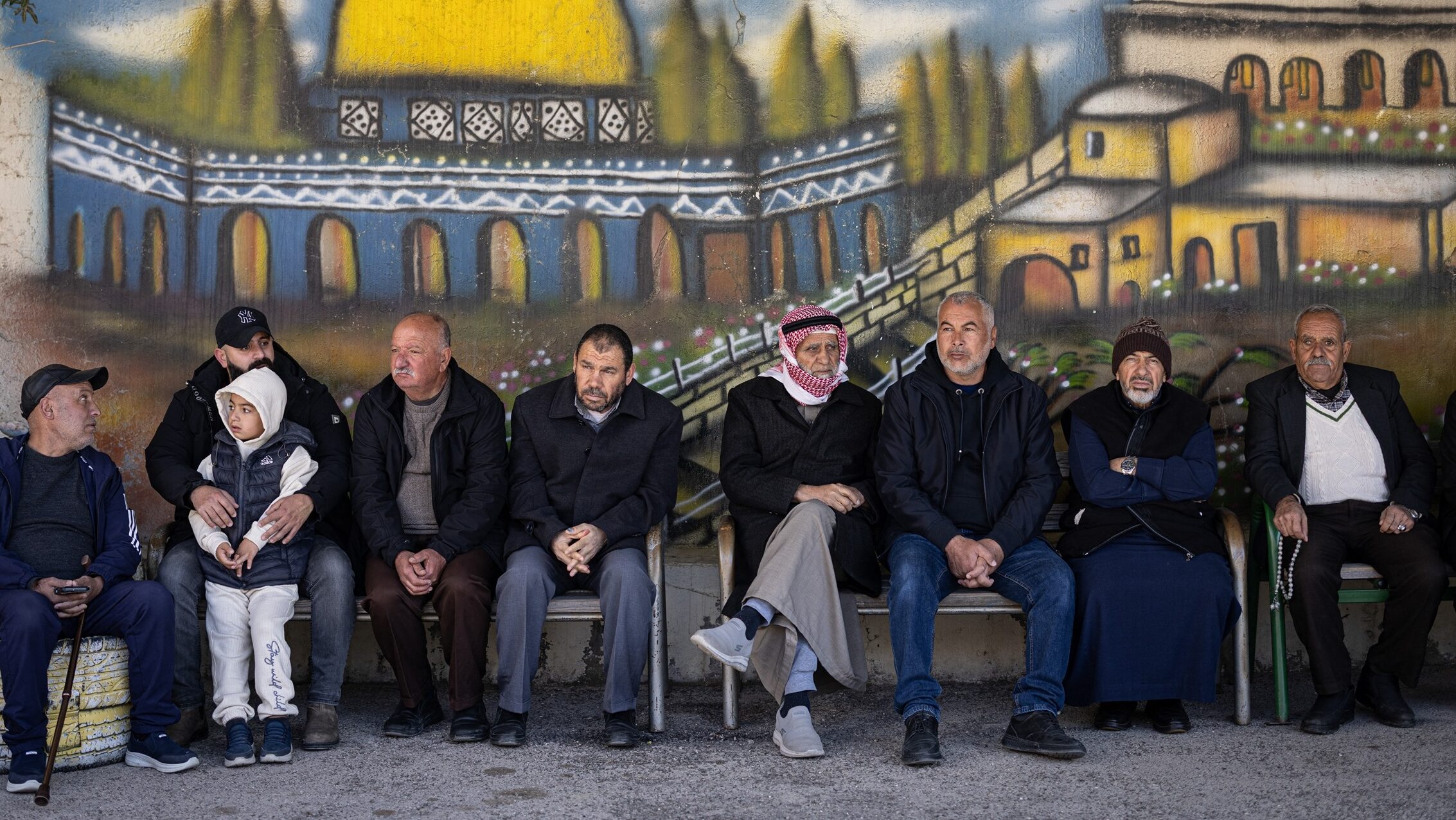
For Husseini, the most immediate impact is the daily insecurity facing Palestinians, especially in the West Bank, where there are few protections for civilians and movement is tightly constrained.
“This is not an Israeli–American retaliation against Iran. It’s an attack on Iran, and the retaliation was made by Iran, which is affecting not only our lives but also those of the entire region,” she told The Media Line.
She said the danger is both physical and psychological. In the West Bank, there are no shelters, and civilians remain exposed not only to falling debris from missile interceptions but also to the constant strain of hearing and seeing the war unfold around them.
“The situation in the West Bank is very difficult because we don’t have shelters in Palestine,” she said. “If you have parts falling on the West Bank and on any part of the West Bank, it will cause damage, of course, and may even cause a death. We are not very safe. Also, the situation is very difficult because we hear everything, we feel everything, and we see everything.”
The Palestinian Authority, she said, has responded mainly with emergency measures such as closing schools and universities, shifting education online, and urging people to stay indoors. But those steps also show the limits of Palestinian governance. Israeli checkpoints still control movement between areas, and military activity in the West Bank has continued despite the war with Iran.
“You still have daily incursions in the West Bank by the Israeli military,” she said. “Even though they’re busy fighting Iran, the troops that usually are present in the West Bank have remained in the West Bank; they’re still going into incursions in the northern West Bank—Nablus, Jenin—regularly.”
For many Palestinians, she argued, the most immediate fear still comes from local realities rather than the wider regional battlefield.
There is … ironically and sadly, more fear from the settlers and from the protection they receive from the army, more so than from missiles or parts of missiles falling … on our heads
“There is fear, more fear, ironically and sadly, more fear from the settlers and from the protection they receive from the army, more so than from missiles or parts of missiles falling on the West Bank on our heads,” she said.
That sense of vulnerability is deepened by the Palestinian Authority’s financial crisis. The authority still manages parts of daily life, but with fewer resources. Because much of its budget depends on tax revenues collected by Israel under the Oslo arrangements, repeated withholding or delay of those funds has left it struggling to pay salaries and maintain services.
Husseini said the broader crisis has only deepened the pressure on Palestinians already living with economic hardship.
Give the gift of hope
We practice what we preach:
accurate, fearless journalism. But we can't do it alone.
- On the ground in Gaza, Syria, Israel, Egypt, Pakistan, and more
- Our program trained more than 100 journalists
- Calling out fake news and reporting real facts
- On the ground in Gaza, Syria, Israel, Egypt, Pakistan, and more
- Our program trained more than 100 journalists
- Calling out fake news and reporting real facts
Join us.
Support The Media Line. Save democracy.

“It has already affected our economics, this situation. We’re not earning, so revenues are not coming in,” she said. “There is no welfare system in Palestine. … There is no unemployment support. So it’s a very difficult situation financially for people to sustain themselves for a long time.”
She also argued that the Palestinian Authority has been pushed to the margins politically, excluded not only from regional diplomacy but from discussions over Gaza’s future.
“They have been sidelined,” she said. “The US and Israel don’t want them to participate in the technocratic committee or anything related to Gaza. … They don’t seek their input. … They don’t even have a role to play in the West Bank at the moment.”
That marginalization is especially visible in Gaza, where the proposed technocratic administration meant to govern after the ceasefire has yet to deploy. Hamas continues to operate as a military force, and local armed groups that have reportedly received Israeli backing have also appeared in parts of the enclave. Without a unified governing structure, questions of reconstruction, public services, and security remain unresolved.
Michael interprets the same moment very differently. In his view, Iran remains the central node in the regional conflict system, and the confrontation with Tehran could reshape the region far beyond the Palestinian arena.
Israel perceives the event as a very historical opportunity to reshape the regional architecture in its entirety
“I think that Israel perceives the event as a very historical opportunity to reshape the regional architecture in its entirety,” Michael told The Media Line.
He said Gulf states remain hesitant to align too openly with Israel and the United States because they fear being left exposed if Washington does not follow through.
“The Gulf countries are very hesitant when it comes to Iran because they don’t rely on the Americans,” he said. “They are afraid that if they join the American-Israeli coalition now … the Americans will not finish the job, and then they will remain there with Iran, which is the wounded lion.”
Michael described the military campaign as tightly coordinated and potentially transformative in its effects on Iran.
“It’s a very well-planned campaign, a very clear division of war between both sides,” he said. “The accumulation of the damages that are caused to Iran is very significant. … Iran after the war … will not be Iran that we used to know.”
Still, he said the central issue is what follows once the military phase gives way to political decisions.
“The big question … is what is going to be on the day after,” he said. “On the day that President Trump reaches the conclusion that he won the war … what will remain here in the region?”
That same uncertainty extends to the Palestinian Authority, whose decline Michael sees less as deliberate exclusion than as a consequence of being overtaken by larger events.
“They became very marginal,” he said. “Nobody now has the patience to deal with the Palestinians because everybody understands that we are facing a tectonic event that will change the entire world.”
Even so, Michael acknowledged that the West Bank is becoming a growing concern inside Israel, including because of violence by Israeli settlers.
“When it comes to the West Bank and to the brutal, violent, and the terrorist behavior of some of the Israeli settlers—we are talking about a marginal group—but unfortunately this marginal group is very vocal, very violent, and very damaging,” he said.
He added that there is growing recognition in Israel that the problem can no longer be ignored.
“I think that there is an understanding among the Israeli leadership that enough is enough in this regard, and measures will be taken,” he noted.
Recent violence in villages such as Abu Falah, where three Palestinians were reportedly killed in settler-related incidents in recent days, is further inflaming tensions in the West Bank even as regional attention shifts to Iran.
For Husseini, that combination of pressures has left Palestinians confronting overlapping crises all at once: institutional weakness, economic hardship, settler violence, movement restrictions, and an uncertain future for Gaza.
It’s a disastrous formula for the Palestinians
“It’s a disastrous formula for the Palestinians,” Husseini said. “A bankrupt and sidelined PA, an uncertain future for Gaza, and restrictions also in East Jerusalem. It’s a grim situation for us.”
The contrast between the two accounts is sharp. Michael sees a regional realignment in motion, one that could alter the balance of power across the Middle East. Husseini sees a Palestinian crisis deepening as attention moves elsewhere. For now, both perspectives converge on one point: the war with Iran has not resolved the Palestinian question. It has pushed it deeper into a wider regional struggle while leaving the underlying crises unresolved.
