Regional War With Iran Ripples Across Arab States as Jordan Intercepts Missiles and Egypt Feels Economic Shock
As missiles, drones, and economic shocks ripple outward from the war involving Iran, Israel, and the United States, Arab states beyond the main battlefield are confronting its consequences in sharply different ways.
In Jordan and Saudi Arabia, the escalation has brought missile interceptions, security alerts, and civilian casualties. In Egypt, the fallout is showing up in pressure on the currency, shipping routes, trade, and tourism.
Their responses show how neighboring governments are trying to absorb the fallout without being pulled more directly into the conflict.
Jordan Tries To Contain Military Spillover
Jordan is among the states most immediately exposed to the conflict’s spillover. Iranian retaliatory operations across the region have repeatedly crossed the kingdom’s airspace, forcing its air defenses into action and prompting emergency coordination with international partners.
Authorities in the kingdom say more than 100 missiles and drones entered or approached Jordanian airspace during the first week of the escalation, with most intercepted by air defense systems. Debris from those interceptions caused injuries and limited material damage in several areas.
Despite the tense security environment, daily life inside the country has remained relatively stable, with authorities working to preserve a sense of continuity even as security institutions remain on alert.
The most immediate impact has been on aviation and tourism due to temporary airspace restrictions and reduced regional flights. Business activity inside Jordan continues largely as normal.
“The most immediate impact has been on aviation and tourism due to temporary airspace restrictions and reduced regional flights. Business activity inside Jordan continues largely as normal,” Mai Anati, the managing editor of The Jordan Times, told The Media Line.
Even so, regional instability is driving economic ripple effects. In a country that imports most of its energy, fluctuations in global markets are quickly felt.
“However, regional tensions tend to push oil prices higher, which can affect fuel costs and energy imports in a country like Jordan that relies heavily on imported energy,” she said.
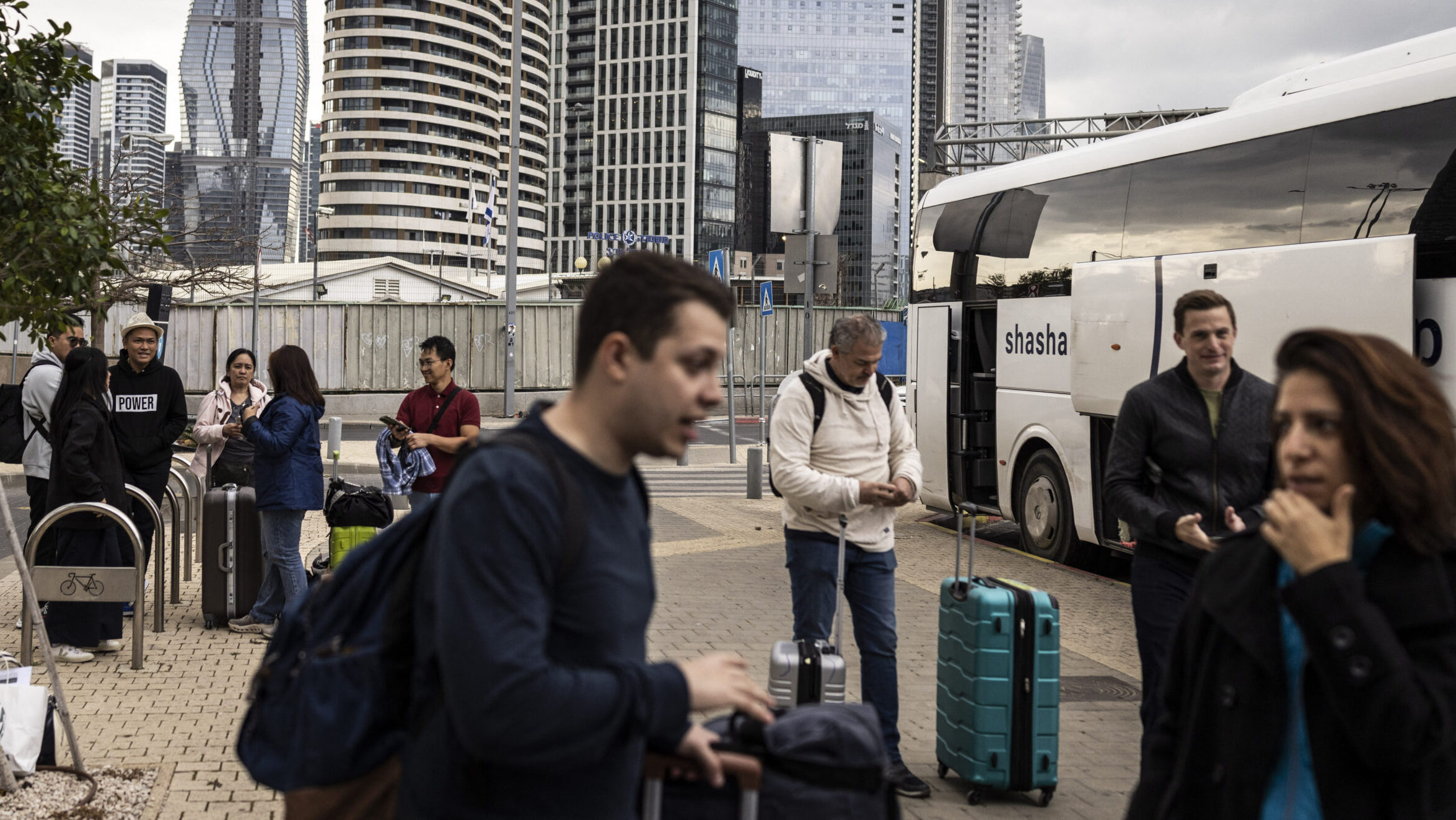
Jordan has also emerged as a logistical transit corridor as the conflict disrupts travel patterns across the region. Foreign nationals seeking to leave Israel and nearby areas have increasingly used Amman as an exit route.
“So far, there are no indications of large-scale population movements into Jordan. Some foreign nationals have used Jordan as a transit point to leave the region through Amman,” Anati said. She added that Jordan’s Foreign Ministry has also been helping Jordanians in the Gulf return overland through coordination with embassies.
“Daily life in major cities such as Amman, Irbid, and Zarqa continues largely as usual, with normal activity in schools, workplaces, and markets,” Anati said, adding that authorities have introduced precautionary coordination and security measures while trying to maintain normal daily life.
Behind the scenes, Jordan’s security apparatus has moved to a heightened state of readiness to manage potential spillover incidents.
“Jordan has activated early warning systems and precautionary civil protection measures,” she explained. “Security institutions and civil defense remain on high alert, and authorities have issued public guidance on safety procedures to ensure rapid response in case of emergencies.”
So far, the direct consequences inside Jordan have remained limited.
“The impact inside Jordan has so far been limited,” Anati said, citing minor injuries from falling debris and minor material damage in a few locations.
Still, the number of intercepted threats reflects the kingdom’s exposure to the regional escalation.
“According to a statement by the Jordanian Armed Forces, since the beginning of the regional conflict, Iran has targeted Jordanian territory with 119 missiles and drones that were heading toward vital sites in the kingdom. Air defense systems intercepted and destroyed 108 of those missiles and drones,” she noted.
Despite those incidents, Jordan’s strategic message has remained consistent: defend national sovereignty while avoiding deeper involvement in the conflict.
“Jordan is primarily focused on defending its sovereignty and protecting its airspace while continuing to call for regional de-escalation and diplomatic solutions,” Anati said.
The kingdom’s position is clear: Jordan will not become a battlefield for any regional conflict
“The kingdom’s position is clear: Jordan will not become a battlefield for any regional conflict,” she concluded.
Give the gift of hope
We practice what we preach:
accurate, fearless journalism. But we can't do it alone.
- On the ground in Gaza, Syria, Israel, Egypt, Pakistan, and more
- Our program trained more than 100 journalists
- Calling out fake news and reporting real facts
- On the ground in Gaza, Syria, Israel, Egypt, Pakistan, and more
- Our program trained more than 100 journalists
- Calling out fake news and reporting real facts
Join us.
Support The Media Line. Save democracy.
Saudi Arabia Balances Deterrence and Restraint
Further south, Saudi Arabia has also had to navigate the consequences of the regional confrontation. Iranian missile and drone attacks targeting strategic infrastructure across the Gulf have heightened the kingdom’s security posture and forced its air defense systems into action.
Several projectiles from Iran were intercepted over Saudi territory, including threats aimed at key sites such as the Ras Tanura energy complex, the US Embassy in Riyadh, Prince Sultan Air Base, and Riyadh airport. Although interceptions prevented major damage in most cases, falling debris in populated areas caused two casualties, highlighting the vulnerability of even heavily defended infrastructure.
Riyadh’s official response has emphasized deterrence while maintaining a clear preference for avoiding a wider regional war.
Saudi Arabia’s official position has consistently emphasized the importance of protecting its sovereignty while avoiding escalation that could further destabilize the region
“Saudi Arabia’s official position has consistently emphasized the importance of protecting its sovereignty while avoiding escalation that could further destabilize the region,” Abdulaziz Alshaabani, a Saudi political analyst, told The Media Line. He said the kingdom has condemned attacks threatening its territory or security as violations of international law that undermine regional stability.
The stakes for Saudi Arabia extend far beyond the immediate military dimension of the conflict. Instability in the Gulf carries economic implications well beyond the region, given Saudi Arabia’s role as one of the world’s largest energy producers and a central node in global trade networks.
“From Riyadh’s perspective, the broader concern is not only the immediate security dimension but also the wider regional risks. Any escalation in the Gulf could disrupt critical supply chains, including food imports and energy production, both of which are essential not only for Gulf countries but also for global markets,” Alshaabani said.
Protecting shipping corridors and energy infrastructure remains a strategic priority as the kingdom tries to preserve market confidence and keep the conflict from widening.
The stability of shipping routes, energy infrastructure, and regional trade flows remains a top priority for the kingdom
“The stability of shipping routes, energy infrastructure, and regional trade flows remains a top priority for the kingdom,” he noted.
Saudi Arabia has responded by reinforcing air defenses while keeping diplomatic channels open.
“As for a direct response, Saudi policy has generally focused on strengthening defensive capabilities, coordinating with regional and international partners, and pursuing diplomatic channels to prevent further escalation,” Alshaabani said.
“The kingdom has repeatedly indicated that its goal is to safeguard its security and economic stability while avoiding steps that could expand the conflict or endanger the broader region,” he concluded.
Egypt Absorbs the Economic Fallout
Unlike Jordan and Saudi Arabia, which have confronted direct security threats, Egypt has experienced the conflict mainly through economic and strategic ripple effects. Cairo has not been directly targeted by missiles or drones, yet regional instability is already straining key parts of its economy.
“Egypt’s economic exposure to this conflict is almost entirely indirect—but no less damaging for that,” Samir Ragheb, a retired Egyptian army brigadier general and president of the Arab Foundation for Development and Strategic Studies, told The Media Line.
“The country is being hit through what might be called the ‘anxiety premium’: investor sentiment, shipping insurance rates, flight rerouting decisions, and tourist cancellation patterns all respond to regional instability as a whole, not just to whether Egyptian soil has been struck,” he noted.
Financial markets were among the first sectors to react.
“The Egyptian pound has come under renewed pressure almost immediately. The currency had only recently stabilized following the IMF-backed reform program and the painful 2024 devaluation. The war reversed that trajectory within days,” Ragheb said. He added that “hot money,” or short-term portfolio inflows, had flowed out just as sharply, with some Egyptian analysts estimating capital flight at more than $2 billion in the opening week alone.
In response, the central bank has spent reserves to defend the pound. At the same time, rising global energy prices are adding pressure to an economy already strained by International Monetary Fund-linked reforms and subsidy cuts.
“The central bank has been spending reserves to defend the pound’s trading band, but that is a finite buffer,” he noted.
For ordinary Egyptians, the consequences are likely to emerge gradually through inflationary pressures.
The downstream effect on ordinary Egyptians is real: higher transport costs, higher logistics costs for goods, and a secondary inflation wave
“The downstream effect on ordinary Egyptians is real: higher transport costs, higher logistics costs for goods, and a secondary inflation wave that hasn’t yet shown up in official CPI figures but will,” he said.
Trade routes and regional logistics networks have also begun to shift as the conflict disrupts established corridors.
“Regional land crossings have also been disrupted. The Rafah crossing between Egypt and Gaza, already politically complicated, has seen further constraints,” Ragheb said. He said the Taba crossing has been used largely for outbound traffic and that trade flows through the Aqaba-Nuweiba ferry route have also slowed.
Yet the most serious economic vulnerability remains the Suez Canal.
The Suez Canal wound is the deepest
“The Suez Canal wound is the deepest,” Ragheb said, noting that revenues had already fallen from more than $10 billion annually to about $4 billion by the end of 2025 because of the Houthi campaign in the Red Sea. Hopes that the Gaza ceasefire would restore normal shipping routes in 2026, he said, have now been indefinitely suspended.
Tourism, one of Egypt’s most important sources of foreign currency, is highly sensitive to regional instability and has already begun to feel the impact.
Ragheb said tourism is not just a revenue line for Egypt but also a political stabilizer. The sector, he said, employs millions, supports key regional economies, and had reached roughly 19 million visitors in 2025.
“The cancellations since the escalation began have been real and measurable. Travel agencies across Europe—Egypt’s main tourism markets are Germany, Russia, Italy, and the UK—reported cancellation spikes within the first 72 hours of the conflict,” he noted.
According to Ragheb, the perception of risk can matter almost as much as actual security conditions.
“Many travelers and travel insurers do not distinguish between Egypt being targeted and Egypt being adjacent to a region that is,” he said.
How lasting those economic shocks become will depend largely on the duration of the conflict.
“The critical threshold is duration,” Ragheb said.
The critical threshold is duration
“A conflict that ends or de-escalates within four to six weeks likely produces a manageable tourism downturn—perhaps a 15 to 20 percent dip for the season, with recovery possible before peak summer arrivals. A conflict that drags into April and May, or escalates further, would devastate the spring-summer booking cycle,” he noted.
At the security level, Egyptian planners are less concerned about direct missile attacks than about indirect destabilizing effects.
“The concern within Egyptian security circles is real but calibrated,” Ragheb said, adding that officials are more worried about secondary effects, including the possibility that Islamic State’s Sinai Province could regain strength.
“That scenario—not Iranian missiles—is what Egyptian security planners lose sleep over,” he said.
Diplomatically, Cairo has tried to position itself as a mediator while avoiding direct entanglement in the conflict.
Ragheb said, “President Abdel Fattah el-Sisi has adopted the most activist diplomatic posture he has taken on any regional crisis in years—and that itself is significant.”
“President el-Sisi personally stated that Egypt had spent months attempting to prevent the war by bridging US and Iranian positions. That is not a routine diplomatic formulation—it is a political claim of effort and legitimacy that positions Egypt as a good-faith broker with channels to both sides,” he concluded.
Across the region, Jordan is defending its airspace, Saudi Arabia is guarding critical infrastructure, and Egypt is bracing for deeper economic strain as neighboring governments try to contain a widening conflict.
