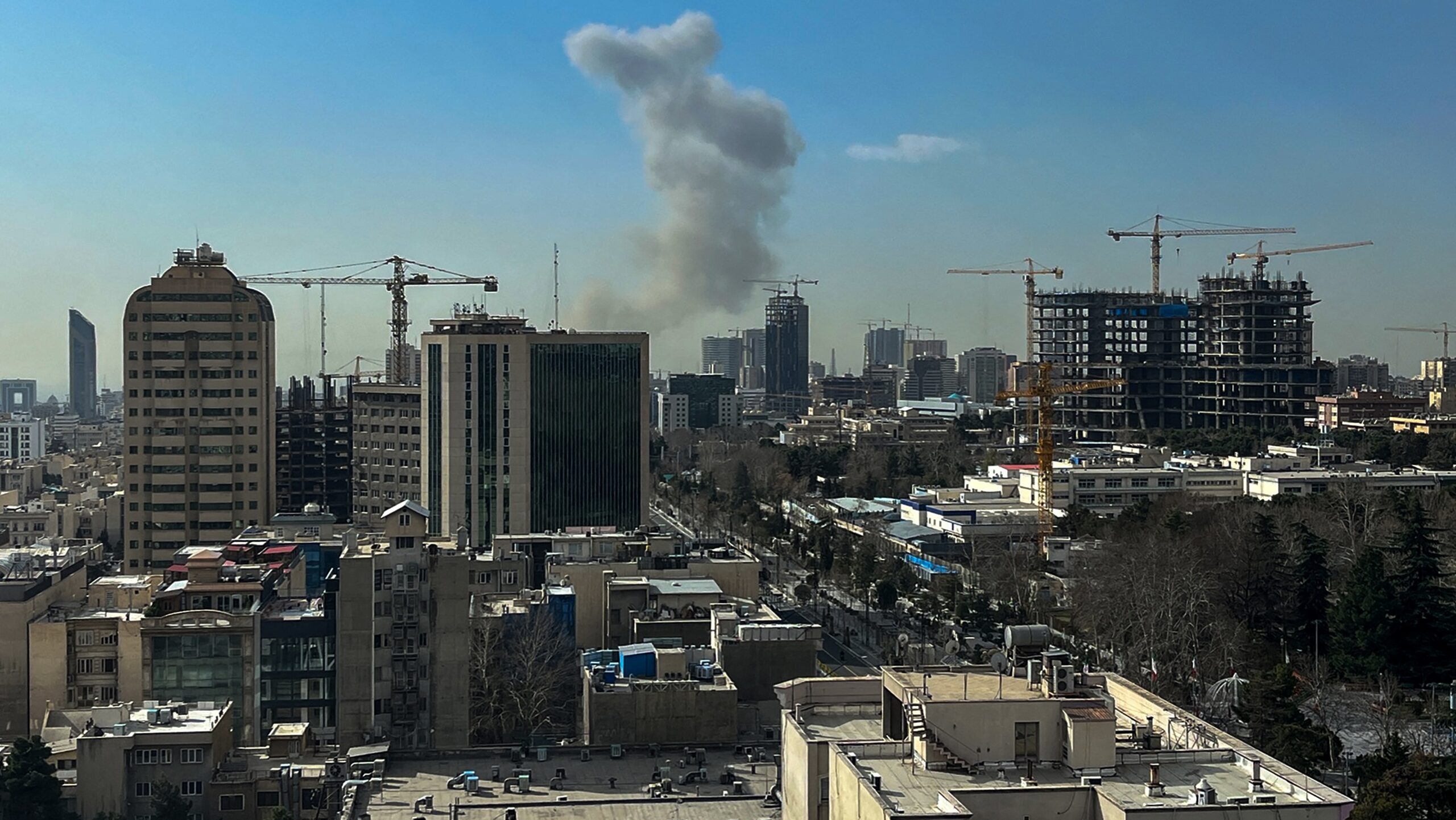
US and Israel Launch Sweeping Strikes on Iran as Tehran Fires Back Across Israel and the Gulf
Missile barrages hit Israel and US-linked facilities across the Gulf as coordinated airstrikes inside Iran continue and regional fronts widen
By late afternoon Saturday, Feb. 28, Israel time, Israel and the United States were pressing ahead with a coordinated air campaign against Iran that both governments said was intended to weaken nuclear- and missile-linked capabilities and senior command infrastructure, while Iran responded with waves of missiles and drones toward Israel and retaliatory strikes against US-linked sites in the Gulf, expanding the crisis into a broader regional confrontation.
Israel described its opening move as a “preemptive” operation and announced what Prime Minister Benjamin Netanyahu called “Operation Lion’s Roar,” presenting the campaign as a decisive effort to roll back what Israel has long described as an existential threat. In a recorded address, Netanyahu said the operation targeted Iran’s nuclear and missile infrastructure and security organs tied to the regime’s power, while signaling the campaign would continue until Israel’s stated objectives were met.
President Donald Trump confirmed a direct US role, saying the United States had begun “major combat operations” in Iran and describing the effort as “a massive and ongoing operation” aimed at removing what he called “imminent threats” from the Iranian regime. President Trump warned Americans that casualties were possible and paired the military message with political language aimed at Tehran, urging elements of the Islamic Revolutionary Guard Corps to surrender and telling Iranians to press for change once the fighting subsided.
In Iran, the picture on the ground remained fragmented for much of the day. Officials and state outlets aired footage and issued claims of strikes in and around Tehran and other locations, while reports of internet disruption and cyberattacks against Iranian platforms complicated efforts to verify damage and casualties independently or in real time. Iranian outlets tied to the IRGC continued to push messaging through Telegram and state channels even as many domestic sites appeared to struggle or go quiet, creating an information environment where dramatic claims spread faster than confirmation.
One of the most sensitive claims involved reports from Iranian domestic media that a girls’ school in Minab, in Hormozgān Province, was hit, with the death toll said to have risen above 40 and dozens more wounded. A local governor also attributed the deaths to an Israeli strike. Given the constraints on independent reporting inside Iran today and the speed at which casualty figures have been changing in state-linked accounts, that episode is best treated as a claim by Iranian authorities and state-linked outlets unless and until it is corroborated by multiple independent sources.
Iran’s retaliation began within hours of the initial strike wave, with missiles and drones launched toward Israel. Sirens sounded across wide swaths of the country, emergency guidance was tightened, and air defenses intercepted multiple threats as residents were told to stay close to shelters. Early reports emphasized limited confirmed injuries during some barrages, with other updates indicating at least one reported injury later in the day, underscoring how uneven and location-specific the impact picture can be during an ongoing aerial exchange.
Even when interceptors do their job, debris can still land in populated areas, and officials have repeatedly warned that “impact sites” can include fragments from both incoming munitions and defensive intercepts. While social media quickly circulated location lists—some of them poorly sourced—several reputable outlets and live briefings pointed to debris and impact sites in multiple parts of Israel.
Beyond Israel, Iran widened retaliation when missiles were launched toward multiple Gulf states that host US forces or facilities, including Bahrain, Kuwait, Qatar, and the United Arab Emirates. The scope of the barrage marked a sharp expansion from Israel-Iran exchanges into strikes on third-country territory tied to US basing and logistics, raising the risk of broader escalation even among states that were not directly involved in the initial Israel-US strike package.
Give the gift of hope
We practice what we preach:
accurate, fearless journalism. But we can't do it alone.
- On the ground in Gaza, Syria, Israel, Egypt, Pakistan, and more
- Our program trained more than 100 journalists
- Calling out fake news and reporting real facts
- On the ground in Gaza, Syria, Israel, Egypt, Pakistan, and more
- Our program trained more than 100 journalists
- Calling out fake news and reporting real facts
Join us.
Support The Media Line. Save democracy.
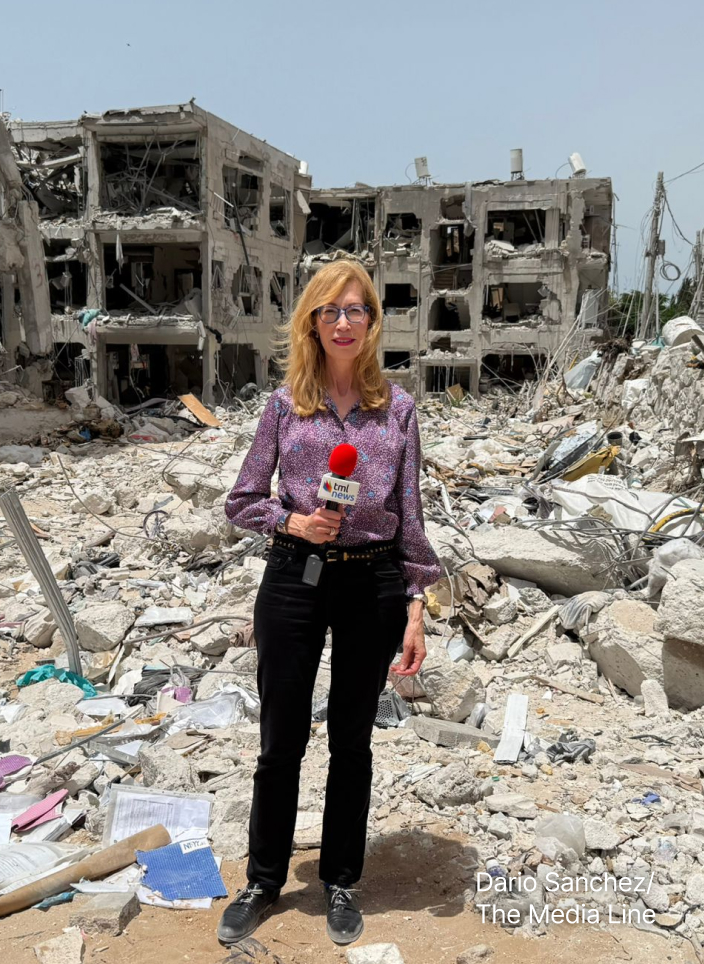
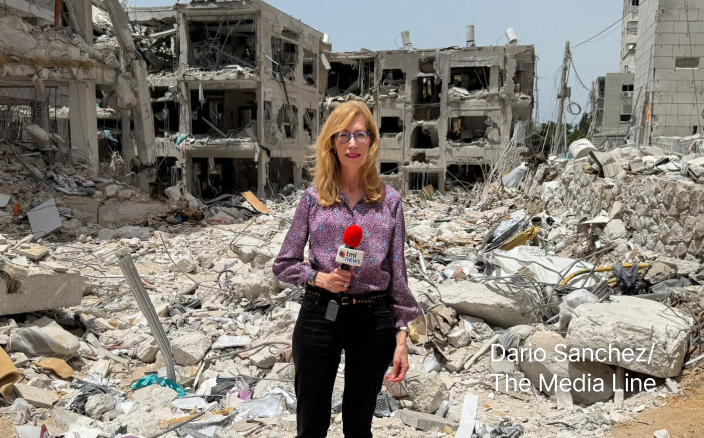
The service centre of the 5th Fleet has come under a missile attack
Bahrain said a US Navy support facility connected to the 5th Fleet was targeted. In an official statement, Bahrain’s National Communication Centre said, “The service centre of the 5th Fleet has come under a missile attack,” and described the incoming strikes as attacks launched from outside Bahrain’s territory in “a blatant violation” of sovereignty. Bahrain’s government condemned what it called “treacherous attacks,” and said it reserved “its full right to respond and take all necessary measures to protect its national security and preserve its sovereignty, in coordination with its allies and partners.”
The United Arab Emirates reported at least one fatality in Abu Dhabi as the retaliatory missile barrage hit targets across the Gulf. Residents described loud explosions and emergency alerts instructing people to shelter indoors, while air defenses were reported to have engaged incoming missiles. Officials in Kuwait and Qatar also reported interceptions, and governments across the Gulf issued civil-defense guidance as the day’s threat picture shifted from distant war to immediate homeland air defense.
Iran’s public messaging framed the Gulf strikes as legitimate retaliation against the US role in the campaign, while warning that more would follow. The IRGC said the operation would continue until it achieved what it described as decisive victory over US and allied forces, and Iranian officials used uncompromising language—at one point vowing “no leniency”—as the strike-and-response cycle intensified.
The attacks triggered immediate secondary effects that often become the real story by day two: airspace closures, mass rerouting of commercial flights, and mounting anxiety in markets and maritime corridors. Airlines rapidly adjusted routes and suspended flights through parts of the Middle East, treating the region’s air corridors as unstable while missile launches and interception activity continued.
At sea, shipping warnings sharpened as the risk envelope expanded beyond land targets. Governments and maritime authorities cautioned vessels to avoid or take heightened precautions in and around the Persian Gulf, the Strait of Hormuz, the Gulf of Oman, and nearby waters, reflecting concern that the conflict could spill into maritime attacks, electronic interference, or harassment of commercial shipping.
The Houthis in Yemen signaled a return to pressure on Red Sea shipping lanes, indicating they could restart attacks that had eased in recent months. Their statements pointed to renewed maritime risk in one of the world’s most important trade corridors and revived the possibility that attacks could target vessels linked—directly or indirectly—to Israel, the US, or partners, even if the immediate military exchange remains concentrated elsewhere.
In Iraq, Iran-aligned armed groups raised the prospect of another front. Kataib Hezbollah threatened to begin attacking US bases, describing such strikes as a response to what it called American aggression, while other factions echoed similar threats. Even if the initial phase of the war remains dominated by state-to-state missiles and airpower, these groups have historically sought to shape the battlefield through asymmetric attacks, especially when they assess that direct Iranian retaliation carries high costs.
For Washington, the day became a test of deterrence under fire: continuing strikes while managing the reality that Iran could threaten US personnel and facilities across multiple countries. President Trump’s message emphasized the scale of the operation and its purpose, stating, “Our objective is to defend the American people by eliminating imminent threats,” while also acknowledging that Americans “may die” as the conflict unfolds—an unusually blunt warning that signaled expectation of further escalation rather than quick containment.
Our objective is to defend the American people by eliminating imminent threats
For Israel, the fight combined strategic aims inside Iran with immediate home-front demands. Netanyahu used sweeping language about the Iranian threat and urged Israeli unity, while emergency services and authorities focused on keeping civilians safe under intermittent alerts. Even when confirmed casualties are limited, the disruption is substantial: schools and workplaces close, airspace restrictions remain tight, and the population is pushed into a shelter routine that can last for hours or days.
Iran’s leadership framed the attacks as a violation of sovereignty and international law, and Tehran’s official bodies urged preparedness and evacuation from certain areas while promising that essential services would continue. This dual message—defiance paired with crisis management—is familiar from earlier rounds of escalation, but today’s scope was broader: direct strikes inside Iran paired with retaliation that crossed borders into multiple Gulf states and sustained missile pressure toward Israel.
The fog of war remained a defining feature inside Iran. Independent verification of specific strike locations, the status of senior officials, and civilian casualty counts has been difficult amid internet disruption, cyber interference reports, and a media environment split between state messaging and opposition channels. In practical editorial terms, the safest approach is still the old-fashioned one: attribute precisely, avoid locking in contested numbers as fact, and distinguish between what is confirmed, what is claimed, and what is inferred from secondary indicators like satellite imagery, verified video, or consistent reporting from multiple independent outlets.
International reactions began to harden as the day wore on. Russia condemned the strikes as “a preplanned and unprovoked act of armed aggression,” warning of wider consequences and calling for urgent diplomatic engagement at the United Nations. Those statements reflect how quickly this confrontation has moved from a regional crisis into a global diplomatic stress test, touching energy markets, maritime security, and great-power positioning.
The operational trajectory by late afternoon remained a strike-and-response cycle rather than a clear glide path to de-escalation. Israel and the United States signaled that operations would continue, Iran promised further retaliation, and the geographic footprint had already widened beyond Israel and Iran. The key near-term uncertainties were straightforward but dangerous: whether the target set inside Iran expands further; whether Iran concentrates the next waves on Israel, on US regional assets, or both; and whether Iran-aligned armed groups such as Kataib Hezbollah and the Houthis convert threats into sustained attacks that open new, durable fronts on land and at sea.
