‘We Did Not Ask for Protection’: Syrian Druze Reject Netanyahu’s Intervention
Druze leaders in Jaramana dismiss Israel’s offer of protection, reaffirming their Syrian identity amid increasing tensions with the government and armed factions
[Damascus] Jaramana, a town near the Syrian capital of Damascus, has become the epicenter of rising tensions, leading to casualties among Syrian security forces and rebel fighters. While Syrian state media claims the rebels are remnants of the fallen Assad regime, many of them belong to the Druze minority, a group that has historically sought to maintain autonomy amid Syria’s conflicts. The recent unrest, triggered by clashes between security forces and armed local factions, has prompted a significant military response from Damascus. Meanwhile, Israeli Prime Minister Benjamin Netanyahu has warned of possible military intervention to “protect the Druze community in Jaramana,” raising further geopolitical stakes.
Security Reinforcements and Curfews
A security source in Syria’s Ministry of Interior told The Media Line that Jaramana has seen significant escalations, prompting authorities to install security checkpoints at all entry and exit points.
“The security tension stems from armed groups spreading across streets and building rooftops following the killing of two internal security officers by gunmen,” the source said, adding that the Syrian government considers these armed fighters “outlaws.”
In response, Syrian security forces issued a five-day ultimatum for the armed groups to surrender their weapons and dismantle their barricades. Additional military reinforcements have been deployed to stabilize the area.
Col. A., a retired Israeli Defense Forces (IDF) officer of Druze descent who requested anonymity, provided insight into the situation.
“First of all, I understand that this was a very small event. It was not as big as what we’ve been hearing recently. These were very minor incidents where just a few people tried to enter the village, and the citizens there refused to let them in. It wasn’t as big as what we’ve been hearing in recent days,” Col. A. told The Media Line.
However, while Col. A. described the incidents as minor, the Syrian government and security forces have treated them as part of a larger challenge involving armed groups in the area.
Local Leaders Call for Calm
Sheikh Laith al-Balous, leader of the “Men of Dignity” movement and a prominent Druze figure, downplayed the severity of the situation, framing the clashes as a personal dispute rather than an organized rebellion against the state.
“The clashes in Jaramana did not start as a confrontation with public security forces; they began as a personal altercation,” al-Balous said, adding that efforts were underway to de-escalate tensions. “We don’t need foreign guardianship. We seek a united Syria.”
The Druze community in Syria are Syrian citizens. … But they will not allow anyone to enter their villages with weapons or anything like that. This is a red line.
Col. A. echoed similar sentiments, stating: “The Druze community in Syria are Syrian citizens. They belong to the Syrian state, to Syrian rules, and they have to be part of the Syrian community. They have to be part of the Syrian state. But they will not allow anyone to enter their villages with weapons or anything like that. This is a red line.”
Give the gift of hope
We practice what we preach:
accurate, fearless journalism. But we can't do it alone.
- On the ground in Gaza, Syria, Israel, Egypt, Pakistan, and more
- Our program trained more than 100 journalists
- Calling out fake news and reporting real facts
- On the ground in Gaza, Syria, Israel, Egypt, Pakistan, and more
- Our program trained more than 100 journalists
- Calling out fake news and reporting real facts
Join us.
Support The Media Line. Save democracy.
Despite local efforts to restore calm, Netanyahu’s remarks escalated tensions. The Israeli prime minister and Defense Minister Israel Katz instructed the Israeli military to “protect the residents of Jaramana” and warned that Israel would strike Syrian government forces if they targeted Druze civilians.
“We will not allow the extremist Islamic regime in Syria to harm the Druze community,” Netanyahu’s office declared, cautioning Damascus that failure to contain the situation could provoke direct military action.
Outrage Over Israeli Statements
Following Netanyahu’s comments, a delegation of Druze elders from Sweida traveled to Jaramana to mediate with Syrian security forces. Negotiations are reportedly ongoing to facilitate the disarmament of local groups and establish permanent security points in the town.
Meanwhile, Druze community leaders in Jaramana issued a scathing rejection of Netanyahu’s statements, emphasizing their Syrian identity and unwavering loyalty to their homeland.
The people of Jaramana are proud Syrian Arabs, deeply connected to their land. We did not ask for protection from anyone.
“The people of Jaramana are proud Syrian Arabs, deeply connected to their land. We did not ask for protection from anyone,” read a statement from a neighborhood committee. “The residents of Jaramana will not allow themselves to be used as pawns for Netanyahu’s political ambitions.”
One of Jaramana’s community elders told The Media Line:
“We are partners in this country. The fall of the Assad regime was a collective Syrian effort, and what we need now is direct and honest dialogue with the new authorities to resolve the security issues in the town.”
Netanyahu’s remarks inflamed tensions, with many in Jaramana and across southern Syria viewing them as an unwarranted interference in Syrian affairs. Some Druze leaders feared that Israeli involvement could undermine their standing in Syria and fuel accusations of external manipulation.
As backlash against Netanyahu’s statements grew, questions also emerged about Israel’s broader role in the region. Some analysts believe Israel’s involvement could be temporary, while others fear it may signal deeper strategic ambitions.
Col. A. weighed in on Israel’s role in the region: “I’m not sure that Israel will stay in this area for a long time. Right now, they want to ensure that no terrorism enters this area. The moment they conclude that the situation is stable—I mean, the Israeli government, the IDF—they will withdraw from the area. For now, we don’t know what will happen in the future. The IDF entered the area to control it, but I’m not sure they will stay there forever.”
Protests erupted across southern Syria in response, with civilians condemning Netanyahu’s remarks as interference in Syrian sovereignty. Demonstrators called for the withdrawal of Israeli forces from the buffer zone along the Syrian border and rejected any foreign military presence in the region.
Israeli Defense Minister Israel Katz reiterated Israel’s commitment to security in the region, stating: “The Israeli military will remain stationed along the buffer zone with Syria for as long as necessary. We will not allow any force that threatens Israel’s security to establish itself from here to the Damascus-Sweida road. The army will act against any potential threat.”
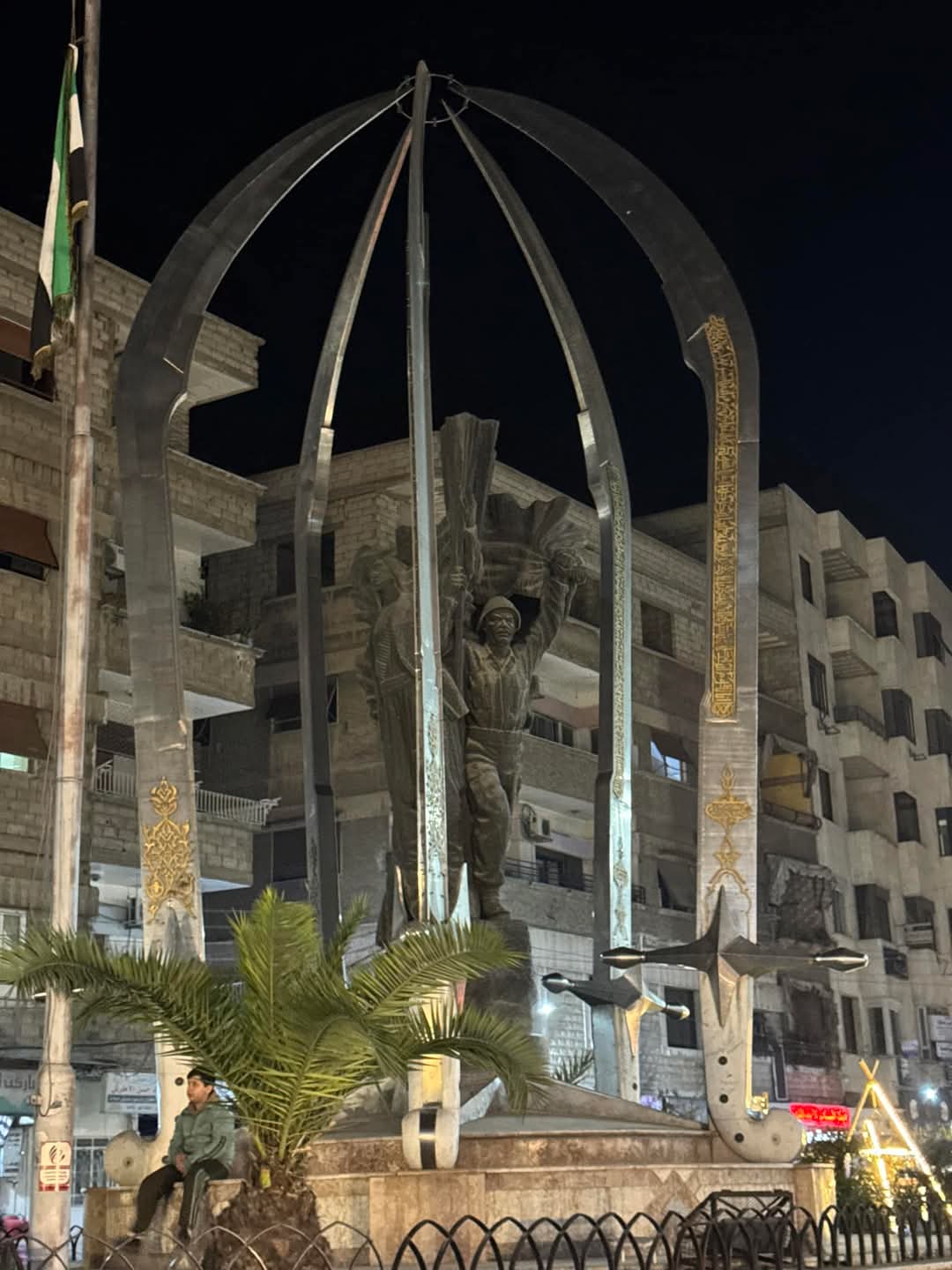
The main square in Jaramana, with the Syrian flag raised. (Omar Al-Bam/The Media Line)
Syria Rejects Israeli Intervention
Regarding Netanyahu’s claim of supporting the Druze in Syria, several residents of Jaramana and Sweida insisted that no one had requested Israel’s help. Instead, they demanded non-interference in Syrian affairs.
Syrian politician Mamoun al-Homsi dismissed Israel’s intervention as a cover for its ambitions in Syria. He argued that Netanyahu was aligning with outlaws in Syria and that Damascus had every right to respond as it saw fit.
Al-Homsi, a Syrian politician residing in Europe, warned that Netanyahu was “playing with fire” and underestimating the resilience of Syrians.
He should learn his lesson before making statements and fear the wrath of the Syrians
“He should learn his lesson before making statements and fear the wrath of the Syrians,” he said.
Jaramana’s Strategic Importance
Jaramana, part of the Damascus countryside, had a population of 114,363 according to Syria’s last official census in 2004. Located just 5 kilometers southeast of Damascus, the town connects to the capital through the Kabas and Duwailah districts.
The town gained symbolic importance in Syria’s recent history, as it was one of the first Damascus suburbs to break away from Bashar Assad’s control, on December 8, 2024.
Now, Jaramana’s future remains uncertain, caught between local peace efforts, Syrian government security operations, and the broader geopolitical struggle between Israel and Damascus. With tensions mounting, the Druze community finds itself at a crossroads—seeking stability while navigating the competing interests of regional powers. Whether Jaramana can maintain its fragile stability will depend on whether the Syrian government can assert control without escalating the conflict—and whether Israel’s involvement remains limited or expands into a broader intervention.
Giorgia Valente contributed to this article.
