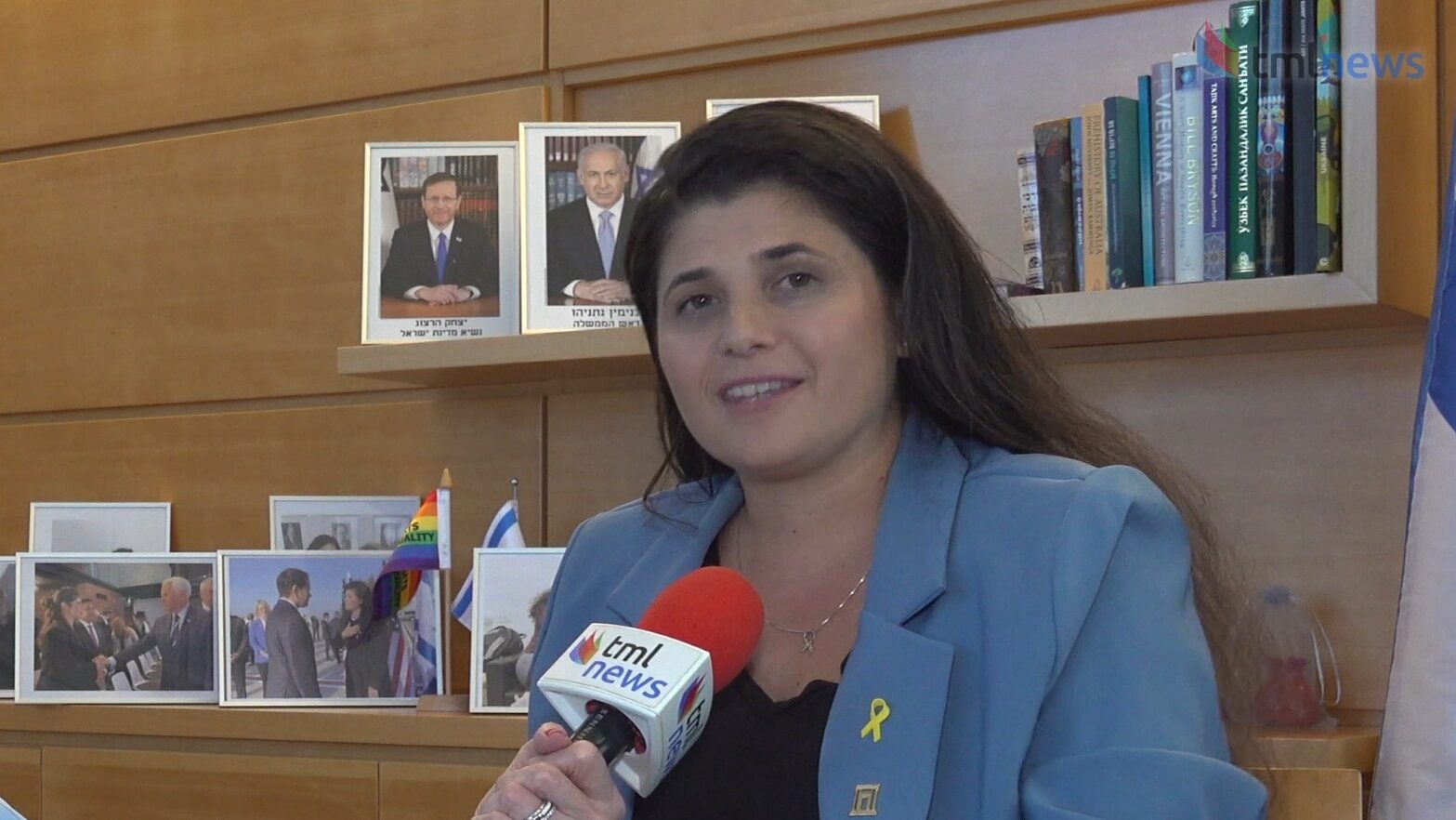
‘Where Do You Begin? At Home’: Deputy Foreign Minister Haskel Discusses October 7 and the Stakes for Israel’s Future
Drawing on family, service, and policy experience, the deputy minister ties domestic resilience to regional strategy, from Jerusalem diplomacy to emerging ties in the Pacific
Israel’s Deputy Foreign Minister Sharren Haskel has become one of the most dynamic and resolute figures in Israeli politics, standing out in a government where female leadership remains rare. A steadfast advocate for the State of Israel, she has made it her life’s work to defend the country against a growing list of accusers and to ensure its voice is heard across the international arena.
In our conversation, I began by acknowledging the moment we are in—one of extraordinary pressure and isolation for Israel. The country is fighting wars on multiple fronts, facing renewed diplomatic pushes for Palestinian statehood, and contending with misinformation and media distortions. From my perspective, antisemitism is surging worldwide, and I wanted to hear how one of Israel’s most determined defenders sees the path forward.
That concern sharpened on Yom Kippur with the Oct. 1, 2025 attack on a synagogue in Manchester, England, where two Jews were murdered. Haskel responded: “How often have we warned British officials that antisemitism is out of control in the UK and it will result in tragedy? More of the same is unacceptable. What is the UK government going to do about the tsunami of Jew-hate and violence in Britain?” She added, “May the memory of the victims be a blessing. I pray that those who were injured make a full recovery. My love to the British Jewish community. I will see you all very soon.”
Where do you begin? At home, with raising my three little babies on the values that I was raised on.
When asked where she draws the strength to confront today’s challenges, Haskel didn’t hesitate. “Where do you begin?” she said. “At home, with raising my three little babies on the values that I was raised on.”
She spoke about the powerful influence of her family history—the bravery passed down from her grandparents and the stories of her ancestors that form the foundation of her identity. “That’s when I begin,” she explained. “You know, growing [up] here in Israel, you’re so sheltered many times from anti-Semitism.”
Her worldview, though, was shaped not only by an Israeli upbringing. Haskel described spending extended periods in France and other countries during her youth, where she first encountered open racism directed at Jews. “Those were my first experiences of racism towards Jews,” she said, adding that these moments deeply impacted her. “I truly believe that that really shaped how I view things, and it shaped my strength as well.”
I noted that she was born in Toronto, a city in a country where antisemitism appears to be on the rise. Canada, I added, has recognized a Palestinian state and is seeing an increase in attacks on schools and synagogues. A woman was even stabbed recently in Ottawa in what many fear is part of this disturbing trend.
Haskel expressed disbelief at how far things have deteriorated. “I never thought in my life that something like that is possible in Canada.”
She described a climate of hatred and racism that appears unchecked—without limits, prosecutions, or consequences. People are paying the price for this violence, and without accountability, there’s nothing to stop others from repeating the same acts against Jews in Canada. “Unfortunately, I don’t see that. I don’t see a strong response. And it’s heartbreaking. It’s devastating.”
Linking part of the problem to immigration from the Middle East, Haskel echoed concerns raised by US President Donald Trump about unchecked migration into Europe—and argued that similar trends are playing out in Canada. “A lot of immigration from the Middle East is coming into Canada,” bringing with it ideologies that demonize Jews and Israel.
In countries like Pakistan, Iraq, and Syria, she said, such views are often taught in schools. When people arrive in liberal democracies and aren’t clearly told that antisemitism is unacceptable, those ideas don’t disappear—they spread. “It will spread like a plague,” she warned. “And that’s what’s happening right now in Canada.”
Haskel emphasized that the Israeli-Palestinian conflict is “not a territorial conflict. It’s a religious cultural conflict.” For that reason, she questioned whether it’s even the kind of conflict that can be “won” in conventional terms.
Reflecting on Israel’s 2005 disengagement from Gaza, Haskel described how the move was made under intense international pressure, with promises of security and international support that ultimately proved meaningless. “They were just empty words,” she said.
She recalled the full extent of the withdrawal, noting that Israel didn’t just evacuate every living Jew from Gaza, but also removed the remains of those who had been buried there. “We dug them out and we buried them in the borders of Israel,” she said. With the land handed over, Palestinians had what many believed they needed—autonomy, the opportunity for self-governance, and the space to pursue self-determination.
Instead, Haskel argued, that opportunity was squandered. “What did they do with it? Created a terror state like ISIS [Islamic State].” Hamas was democratically elected and immediately redirected international aid and resources—intended for infrastructure and education—toward violence. “All of their money, all of their contributions … to create more terror and more hatred.”
Rather than building a functioning state, she said, Hamas constructed a vast underground network, which Haskel described as a subterranean city devoted entirely to terrorizing Israeli civilians.
Those experiences, she added, have reshaped public opinion inside Israel. “I think most of the Israeli public—and we see that in polls as well—has sobered up from that idea that for a religious ideological dispute you will be able to resolve it with territory.” Her conclusion was blunt: “You cannot. It’s far more deeper than that.”
I brought up a past interview Haskel gave to the Israeli Embassy in Nicosia, in which she referred to Syria’s new leadership under President Ahmed al-Sharaa as nothing more than a surface-level shift. “The ISIS terrorists talk nice, have put on suits,” she had said, “but they didn’t change.”
I asked whether she still believes that—or if there’s any evidence that al-Sharaa and his circle are evolving. “Are they the same butchers they always were,” I asked, quoting her words, “or are we seeing a different person emerge?” Beyond personalities, I wanted to know whether Israel can realistically have a détente with Syria.
We will not rely on words, but we will watch their actions
In response, Haskel said the burden of proof lies with the Syrian leadership. “I think that the question needs to be addressed to the new Syrian government and to al-Jolani [the name used by al-Sharaa until recently],” she said, emphasizing that Israel is not interested in rhetoric. “We will not rely on words, but we will watch their actions.”
Israel, she noted, is closely monitoring whether the new regime can protect its own vulnerable populations—particularly religious and ethnic minorities who have long suffered in the conflict. Among them, she said, are Christians who are “being butchered,” Alawites who have been massacred, and Druze communities now facing a “massive humanitarian crisis” following a brutal attack.
She also raised concerns about the Kurdish population, pointing to Turkish military aggression along Syria’s borders. The key test, she insisted, is whether the current leadership in Damascus is truly willing and able to shield these groups. “That’s the real question. Are they capable of defending their minorities? Because otherwise, it doesn’t mean anything.”
Without that ability, she warned, Syria risks falling back into the same cycle of “instability, terrorism, violence, and death.”
Give the gift of hope
We practice what we preach:
accurate, fearless journalism. But we can't do it alone.
- On the ground in Gaza, Syria, Israel, Egypt, Pakistan, and more
- Our program trained more than 100 journalists
- Calling out fake news and reporting real facts
- On the ground in Gaza, Syria, Israel, Egypt, Pakistan, and more
- Our program trained more than 100 journalists
- Calling out fake news and reporting real facts
Join us.
Support The Media Line. Save democracy.
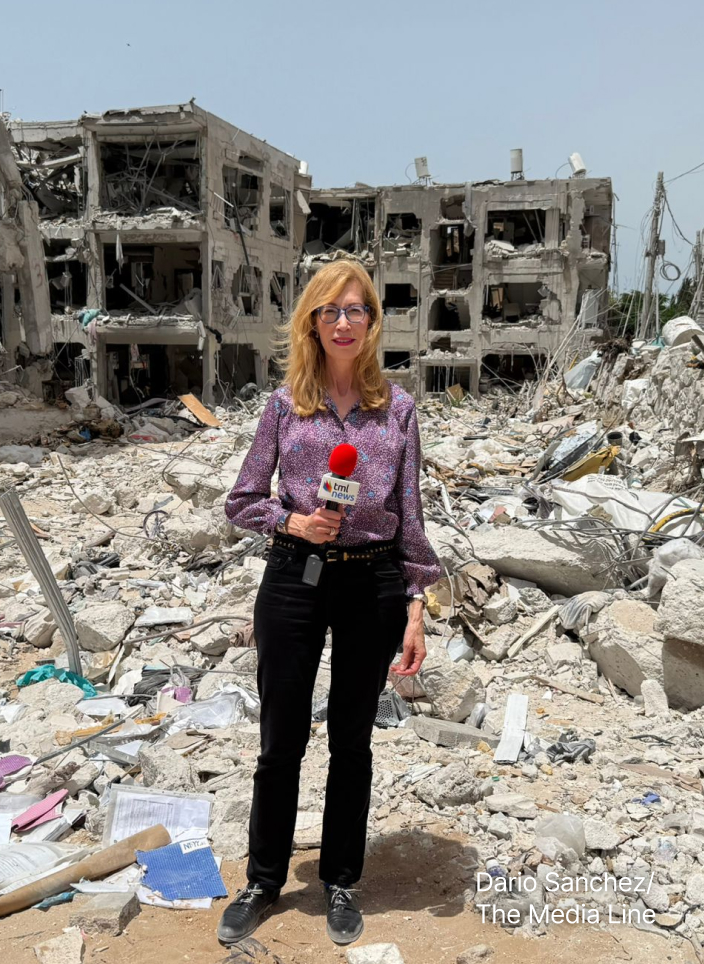
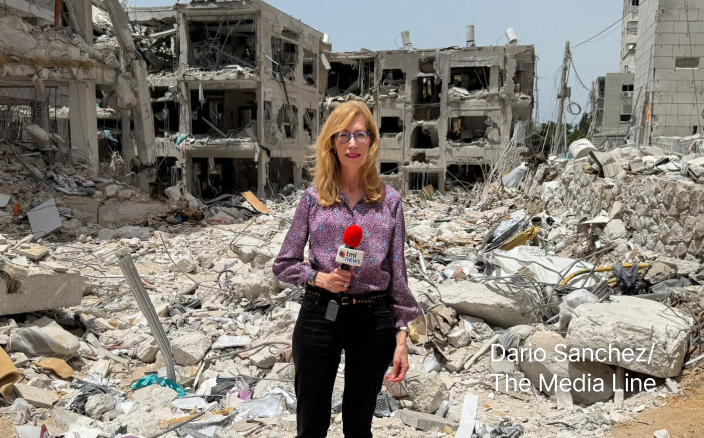
Amid the tension and uncertainty, I noted a rare moment of uplift: the recent opening of the Embassy of Fiji in Jerusalem. Haskel described the opening as deeply emotional and significant—especially during wartime. The decision, she said, was the result of years of close cooperation. “We have talked and worked on that together with our friends in Fiji for many years,” she noted, calling the Pacific island nation “a great ally and a true friend of the State of Israel.”
She emphasized the solidarity shown by Fiji on the international stage, particularly when support is tested. “These are historic times where we are being tested,” she said. “And their moral clarity is absolutely remarkable.”
The move, made in the face of what Haskel described as immense diplomatic pressure, struck a chord. “Their bravery, standing against such huge pressure, is absolutely unbelievable,” she said. “And we truly thank them. We greatly appreciate it.”
Looking ahead, she shared that she will soon head to Fiji as part of a delegation aimed at strengthening ties. The goal, she explained, is to “build more bridges” and explore ways to deepen bilateral cooperation. “There’s a great friendship that’s building up right now. And I really look forward to that.”
Haskel then turned to the symbolism of Jerusalem itself. For her, Fiji’s decision to recognize the city as Israel’s capital was more than diplomatic—it was a powerful affirmation of truth. “Jerusalem has been for thousands of years the undivided capital of the people of Israel, of the Jews,” she said. “It’s been our cultural capital, historic capital, religious capital, spiritual capital, and our political capital as well.”
She voiced frustration with what she called “radical extremists” who attempt to deny the Jewish connection to the land, despite what she described as overwhelming archaeological, historical, and scientific evidence. “You have to ignore all archaeological, historical facts—science, you know, everything—to say something like that,” she said.
In contrast, acts like Fiji’s recognition offered something deeply meaningful. “Reaffirming this simple truth … this is extremely touching,” she said. “And I cannot explain to you how much strength it gives Israelis to see that.”
We next turned to the Abraham Accords, noting that the United Arab Emirates has maintained its commercial flights to Israel—evidence of ongoing engagement despite regional turmoil.
At the same time, I pointed out that the UAE is in a difficult position. With a growing number of Arab nations recognizing Palestinian statehood and calling for a two-state solution, I asked whether these shifting narratives could weaken the foundation of the Accords.
Haskel acknowledged that, from the start, the Abraham Accords were never expected to be tested in calm times. “We always knew the Abraham Accords will be tested—not during quiet times, but during challenging times,” she said.
Tensions and even war were, unfortunately, anticipated as part of the regional reality, especially when dealing with radical Islamist groups. “We knew there’s going to be another round of war,” she added, and with it, a test of whether the Accords could endure.
That they have held firm, she argued, is significant. Economic cooperation not only continued during the war—it expanded. “The fact that they stood strong … is a testament for the strength of those agreements.”
Still, she acknowledged ongoing challenges but said the overall trajectory remains positive. Haskel noted that other countries are quietly expressing interest in joining the Accords, seeing the long-term potential for regional stability.
“I think that once we defeat Hamas and we have returned our hostages back home,” she said, “there’ll be a few more parties that are going to come and join those important Accords that bring stability and peace to our region.”
I then cited Sheikh Abdullah bin Zayed Al Nahyan, the deputy prime minister and foreign minister of the UAE, who has asserted that peace in the Middle East cannot exist without the establishment of a Palestinian state, and asked: if he keeps saying this publicly, how does anything change?
No Palestinian state now
In reply, Haskel made it clear that Israel’s position under Prime Minister Benjamin Netanyahu remains firm: “No Palestinian state now,” she said, echoing his public stance.
She noted that the Accords were signed with full awareness that the parties did not agree on every issue—especially the Palestinian question. “We signed the Abraham Accords knowing we disagree on certain issues, specifically in regards to the Palestinians,” she said. “I think most people know it was signed because of that.”
Despite those disagreements, Haskel emphasized that certain principles are nonnegotiable. “We cannot compromise on the safety and the security of the future of our children—of my three little daughters and the children here in Israel.”
She called on Arab nations, including both allies and critics, to reflect on where they place their allegiance. In her view, countries in the region must decide whether they will continue to tie their futures to what she described as a corrupt and extremist Palestinian leadership.
“If they want to tie that to the leadership—which is Hamas in Gaza, the corrupt Palestinian Authority that’s paying terrorists a salary—the more Jews they kill, the more money they will receive as compensation,” she said, then posed a pointed question: “Is that the future they want for their children as well? That promotion of violence and hatred and racism?”
We turned to Indonesia—the world’s most populous Muslim nation—which, despite lacking formal diplomatic ties with Israel, recently affirmed at the United Nations that Israel has the right to defend itself. I asked Haskel if the move had caught her off guard.
She said she wasn’t entirely surprised by Indonesia’s gesture, noting that discussions about potential ties with Israel have been happening behind the scenes for some time. While there are no formal diplomatic relations, she described the Indonesian people as peace-loving and forward-looking. “People who love peace and stability, who are looking on how to create a better future for their children,” she said.
Haskel believes more countries are beginning to see Israel not as a threat but as an essential partner for the future. “Israel is part of the future with its incredible technology, startups, and businesses,” she explained. With contributions in areas like security, innovation, and development, Israel, she said, “is a gift to the world, not a threat.”
I brought up the killing of Charlie Kirk, describing it as a cold-blooded murder that shook many and led to a massive funeral and memorial. In the aftermath, I noted that some individuals began circulating false and inflammatory claims—rhetoric that Haskel had addressed on social media.
“You yourself said this on a social tweet,” I reminded her, referencing her response to the backlash. “Do you feel that the Jewish people were in any way involved in Charlie Kirk’s murder?”
Haskel responded with a firm denial of any claims suggesting Jewish involvement in Charlie Kirk’s murder. “Absolutely not,” she said. “Charlie Kirk was loved by the Jewish people.”
She described Kirk as a powerful and courageous ally of Israel, someone who stood firm under pressure to defend both the Jewish state and the Jewish people. “That gives us strength and gave us only love to Charlie Kirk,” she said.
Haskel noted that individuals who vocally support Israel, like Kirk, often become targets themselves. “Many people around the world who are supporting Israel, who are defending Israel, are being threatened every single day,” she explained. Those threats, she added, extend to their lives and their families.
She said defenders of Israel commonly face harassment and danger online and offline. “You ask any person around the world who’s a fierce defender of Israel, like Charlie Kirk was, if he received death threats—they’ll show you hundreds of them throughout their feed.”
Haskel reflected on the broader climate of hostility that makes such advocacy risky. “We live through times where people are trying to restrict your freedom of expression, your freedom of speech, and your freedom to think.”
Charlie Kirk, she said, stood apart for his refusal to be silenced. “I think that Charlie Kirk was so unique in that way,” she added, her voice marked with emotion. “And I say it with such a heavy heart—irreplaceable.”
Turning to one of the most painful milestones in recent memory—October 7—I asked Haskel what that day means to her now. For her, the brutality of that day must not fade from public memory. “I want them to remember those sites, and those horrendous images and cries and blood,” she said. It’s not only about honoring the victims—it’s about serving as a warning.
She hopes the shock of that day wakes people up to the dangers of radical ideology before it’s too late. “So that something like that will never happen in their own home.”
What happened, she stressed, was not just terrorism—it was a manifestation of a broader threat. “This is the true meaning of radical Islam. This is the true meaning of jihad.” And the danger, she warned, is no longer confined to Israel. “Unfortunately, it’s spreading all around the world.”
Her final thought was a plea. “I pray, I really pray to God that we will be able to defeat it here in Israel—and that no one else will have to face or challenge it.”
As we wrapped up, I turned to Haskel’s role within the Israeli government. As one of the few women serving at the senior level, her presence stands out, and I asked why there are so few women in such positions.
Haskel acknowledged that gender representation in Israeli politics has varied over time. “In some governments, there’s been more women, and in some governments, less,” she said. But she insisted that Israeli society is steadily moving toward greater inclusion. “Israel is a society that’s striving for the integration and the welcoming of women constantly.”
Challenges remain. Haskel noted that she served as a combat soldier in the army—a tough environment that, in some ways, mirrors the demands of political life. “Politics is a very tough position as well,” she said, adding that many women in Israel hesitate to enter such high-pressure roles, often fearing the personal cost.
“In many cases, it is very difficult for them,” she explained. “They feel they need to sacrifice sometimes, you know, the dream and the life.” For women with young children, the demands can seem nearly impossible.
I pointed out: “You have children under the age of 5, three. Most people would wonder, how do you fit this all in?”
Haskel faced that reality early in her Knesset career. “As a parliament member, I had three under 2,” she said. “And it was very difficult—still very difficult. I won’t lie about it. It’s very tough. It’s very extreme.”
For her, the sacrifice is about more than personal ambition. “I do that for their future,” she said, referring to her children. “Not just to make and shape their future better, but also to show them that women are very important in governmental positions—in making those choices about the future of the country and the people.”
