Why Are Saudi Arabia’s and the UAE’s Competing Policies Dividing Yemen’s Population?
UAE seeks renewed secession with the Southern Transitional Council, while Saudi Arabia aims to maintain Yemeni unity and supports the Yemeni Presidential Council
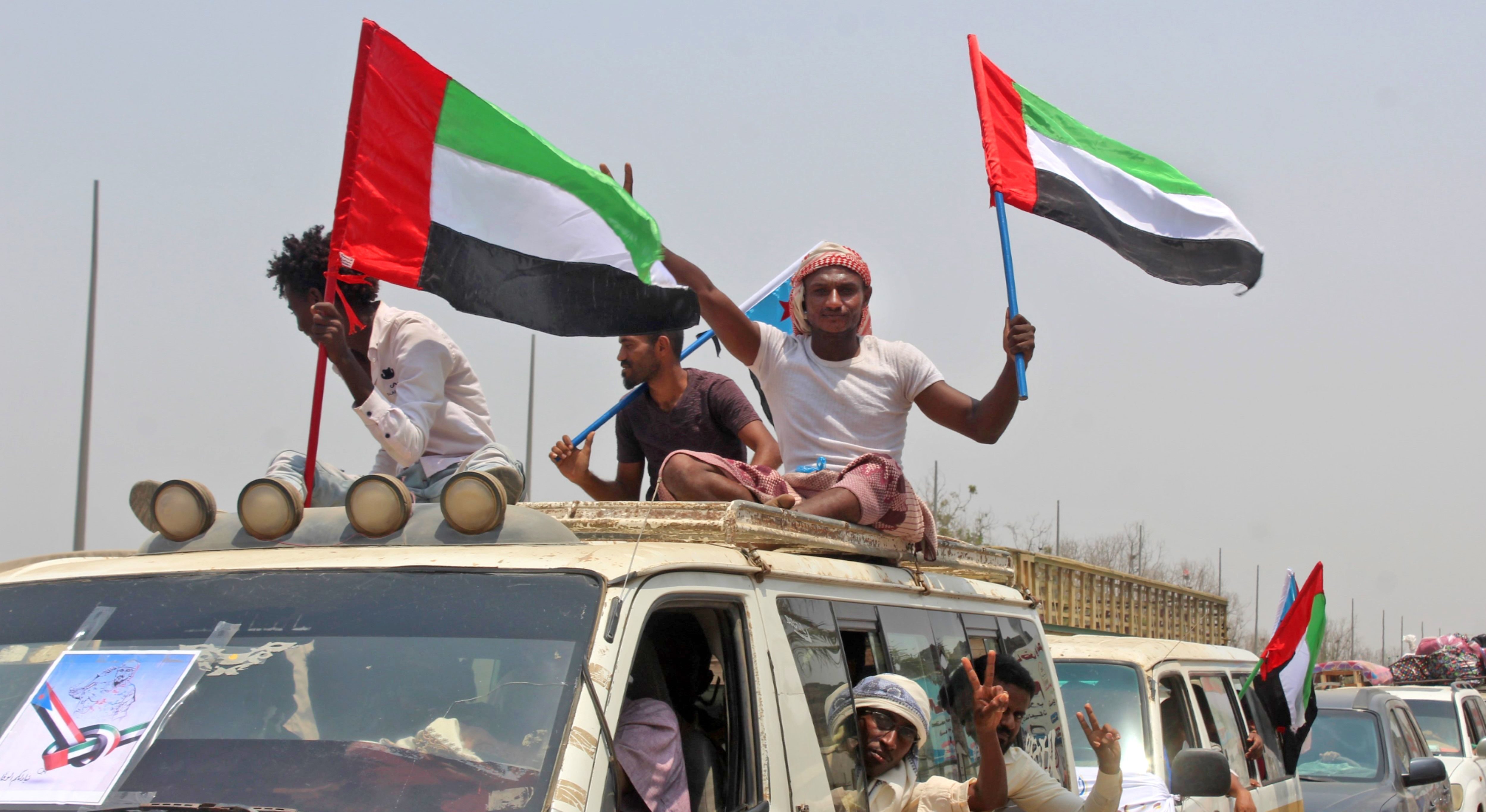
Yemen has witnessed a major turning point in the past two weeks, following the takeover of several key governorates, most notably al-Mahra and Hadhramaut in the east, by forces of the UAE-backed Southern Transitional Council (STC). These forces expelled Yemeni army troops and the Homeland Shield Forces, which were established by Saudi Arabia in 2022.
These recent developments in Yemen reveal a sharp disagreement between Saudi Arabia and the UAE and a significant divergence in their policies toward the country. Saudi Arabia seeks to maintain the legitimacy of the Yemeni government and preserve the unity of North and South Yemen. At the same time, the UAE supports the STC, which aims to partition Yemen and revert to the pre-1990 division between North and South Yemen.
Last week, forces of the STC seized control of Yemen’s border crossings with Oman and the border points between eastern Yemen and Saudi Arabia. They also took over several military camps and government buildings. STC forces expelled members of the Yemeni Leadership Council from their headquarters in Aden, many of whom were already in the Saudi capital, Riyadh, even before the STC’s advance.
Aidarus al-Zoubaidi, head of the STC, stated in a press conference on Wednesday that “the era of side battles is over, and the lifeline that supplied the Houthis from southern Yemen has been severed.”
In remarks carried by Sky News Arabia, a UAE-owned channel, he added, “The next target is Sanaa, whether through peaceful means or war. Southern Yemen will remain committed to the Arab project to cut off Iran’s arms in the region and end the Houthi threat to international navigation and neighboring countries.”
Saudi Arabia attempted to respond to Emirati moves by sending military reinforcements to Yemen. These reinforcements entered through the STC-controlled al-Wadiah border crossing between Saudi Arabia and Yemen without incident.
Saudi Arabia also sent a delegation headed by Maj. Gen. Mohammed al-Qahtani to meet with tribal leaders in Hadhramaut Governorate. During the meeting, al-Qahtani affirmed that “Saudi Arabia’s position is firm in supporting de-escalation and ending the conflict in Hadhramaut.”
During the meeting, which was broadcast live on the Saudi-owned Al Arabiya news channel and several Yemeni channels, al-Qahtani said, “We support the imposition of de-escalation and stability, and the cessation of conflict, far removed from any attempts to obstruct the de-escalation process in Hadhramaut.”
Dr. Rashad al-Alimi, head of the Yemeni Leadership Council, stated that “the Southern Transitional Council’s recent actions in the southern governorates constitute a blatant violation of the transitional phase’s framework, a direct threat to the unity of security and military decision-making, and an undermining of the legitimate government’s authority.”
He added, “The Southern Transitional Council’s actions threaten the future of the entire political process,” expressing his regret that de-escalation efforts are under constant threat due to unilateral military moves.
Hans Grundberg, the UN special envoy to Yemen, in a statement on Tuesday, called for “all parties to de-escalate through dialogue in the eastern Yemeni governorates of Hadhramaut and al-Mahra.”
Following his visit to Riyadh, where he met with Yemeni Foreign Minister Shaea Muhssin al-Zindani, the Saudi and Emirati ambassadors to Yemen, Mohammed bin Issa al-Jaber and Mohammed al-Zaabi, and several diplomats, he stressed “the necessity for all parties to exercise restraint and de-escalate through dialogue.”
Give the gift of hope
We practice what we preach:
accurate, fearless journalism. But we can't do it alone.
- On the ground in Gaza, Syria, Israel, Egypt, Pakistan, and more
- Our program trained more than 100 journalists
- Calling out fake news and reporting real facts
- On the ground in Gaza, Syria, Israel, Egypt, Pakistan, and more
- Our program trained more than 100 journalists
- Calling out fake news and reporting real facts
Join us.
Support The Media Line. Save democracy.
Although the military operation launched by Saudi Arabia in 2015, dubbed Operation Decisive Storm, was supported by the UAE and other Gulf Arab states, the dispute began in 2020 with the UAE’s official withdrawal from military operations and differing visions regarding Yemen.
While there have been no public accusations, the UAE established the STC, which seeks renewed secession. At the same time, Saudi Arabia aims to maintain Yemeni unity and therefore supports the Yemeni Presidential Council.
Disagreements have arisen on several fronts, including the UAE’s attempts to control the Bab el-Mandeb strait, Yemeni ports, and the island of Socotra. Saudi Arabia views these moves as undermining its entire efforts in Yemen.
The UAE officially remained silent, issuing no statement or comment on the events in Yemen, neither positive nor negative. However, its news channel, Sky News Arabia, which broadcasts from Abu Dhabi, promotes the STC and relays only their statements.
Calls for the secession of the South from the North have gained traction. Yemeni citizens from the governorates of Aden, Hadhramaut, and al-Mahra believe that South Yemen could be more stable without the North, which is controlled by the Houthis and is always a source of problems.
Hadhramaut Governorate is the largest in Yemen in terms of area, and it is inhabited by more than two million people. It possesses vast oil fields and numerous natural resources. Many of the merchants operating in the Gulf are from Hadhramaut. Therefore, they believe that instability is costing them business opportunities and weakening the economy.
Thousands of demonstrators took to the streets in Aden Governorate, demanding secession and the declaration of an independent South Arabian state. Their demonstrations have been ongoing since Dec. 5.
Munther Suleiman, a former colonel in the Yemeni army, told The Media Line, “Southerners are different from Northerners in every way. These Northerners don’t want peace. Since Yemeni unification, the southern regions have suffered greatly. We are more numerous and much better off without them.”
Southerners are different from Northerners in every way. These Northerners don’t want peace. Since Yemeni unification, the southern regions have suffered greatly. We are more numerous and much better off without them.
He continued, “We want to achieve these demands. We believe that the separation of the South from the North will bring stability to the region. We have the natural resources, and the Houthi group will certainly be defeated very quickly.”
Mohammed al-Qatman, a tribal leader in Hadhramaut Governorate, believes that “secession and the declaration of an independent South Arabian state are important. There are no shared tribes with the North, and the people have no ties. The people of the North are the ones benefiting from the bounty of the South.”
Yassin al-Salem, a Saudi political analyst, told The Media Line, “Secession does not support Yemen, nor does it benefit the Arab or Gulf states. What the Southern Transitional Council is doing is an attempt to impose a fait accompli and sabotage all the efforts that have been ongoing for 10 years to restore legitimacy in Yemen.”
He continued, “Such moves cannot be accepted. They only benefit the Houthi group, and Saudi Arabia will not allow this. Saudi Arabia will not allow a return to square one in the Yemeni crisis.”
Secession does not support Yemen, nor does it benefit the Arab or Gulf states. What the Southern Transitional Council is doing is an attempt to impose a fait accompli and sabotage all the efforts that have been ongoing for 10 years to restore legitimacy in Yemen
Sabri Salmeen, spokesman for the Hadhramaut Tribal Council, told The Media Line, “The goal of the Southern Transitional Council is to spread chaos and destabilize security and stability, and this is unacceptable to all the southern tribes.”
He added, “The Zubaidi tribe, to which Aidarus al-Zoubaidi, head of the Southern Transitional Council, belongs, does not want what is best for Yemen. It only wants to monopolize power. We are trying to communicate with them and reach peaceful solutions instead of armed conflict, which only exacerbates the problems of the Yemeni people.”
Amin Atef, a Yemeni political analyst, told The Media Line, “The problem lies within the tribes themselves. Each tribal leader controls hundreds of thousands of followers. These tribal leaders live in luxury and play all sides, sometimes siding with the Southern Transitional Council and other times with the Yemeni government forces, depending on who pays more.”
The problem lies within the tribes themselves. Each tribal leader controls hundreds of thousands of followers. These tribal leaders live in luxury and play all sides, sometimes siding with the Southern Transitional Council and other times with the Yemeni government forces, depending on who pays more.
Atef continued, “Most tribal leaders are the root of these problems. If they were to agree and adopt a unified stance, setting aside personal interests, the Yemeni crisis would end.”
Samir al-Mutrib, a Yemeni journalist close to the Houthi movement, told The Media Line, “What’s happening is a major division among Yemen’s enemies and the enemies of the Ansar Allah [Houthi] movement. This proves they don’t want what’s best for Yemen, and their disagreements stem from narrow partisan political interests.”
He continued, “Throughout the past period, they tried to put pressure on the Ansar Allah Houthi group, prevent weapons from reaching them to resist Israel, and cut off supplies to them, but today we see that they are the ones who disagree among themselves. We remain because our concern is religion, Islam, and our Arab brothers in Palestine and everywhere.”
