
Why Is Aid Distribution in Gaza So Complex?
Critics of the US-backed Gaza Humanitarian Foundation accuse it of militarizing aid distribution and placing civilians in danger
As war continues to devastate Gaza, a new US-funded aid initiative called the Gaza Humanitarian Foundation (GHF) has sparked sharp criticism from United Nations officials and human-rights advocates, who say its military coordination with Israeli forces compromises the principles of neutrality and puts civilians at risk. Established in early 2024, GHF now plays a central role in distributing food across a landscape marked by collapsed infrastructure, mass displacement, and rising famine.
Multiple entities remain active in Gaza’s aid efforts, including UN agencies such as the World Food Programme (WFP) and the UN Relief and Works Agency (UNRWA), alongside longstanding international NGOs. GHF, however, operates outside the traditional humanitarian architecture. The foundation is privately run, backed by US funding, and closely coordinated with Israeli authorities.
Marketed as a rapid-response mechanism to fill urgent gaps during heavy fighting, GHF runs four centralized distribution bases in southern and central Gaza. These are staffed primarily by foreign volunteers, including American former servicemen, as well as locally hired workers. Foundation managers say the goal is to “bypass political obstruction and deliver food directly to civilians.”
Critics argue the approach risks creating more problems than it solves. UN officials, including representatives from the Office for the Coordination of Humanitarian Affairs (OCHA) and spokespeople from UNRWA, have publicly voiced concern about the GHF model. In a recent press briefing, a UN humanitarian affairs officer who asked not to be named said the foundation “operates outside the established humanitarian framework” and warned that aid mechanisms functioning under military coordination compromise the principles of neutrality, impartiality, and independence. The UN has refused to cooperate with the GHF, and several member states have withheld funding as a result.
Meanwhile, northern Gaza remains acutely underserved. Most distribution efforts remain concentrated in the south, while residents in Gaza City and surrounding areas face extreme food shortages, limited access routes, and ongoing insecurity. Calls to expand operations northward have grown louder, but both logistics and safety concerns remain unresolved.
Among the GHF’s most vocal critics is Gisha, an Israeli human rights organization that advocates for freedom of movement and access for Palestinians in Gaza. In an interview with The Media Line, Shai Grunberg, spokesperson for the group, said the GHF’s methods run counter to basic humanitarian law.
“The GHF’s distribution sites have become zones of chaos and violence, placing civilians at serious risk,” Grunberg said. “Though framed as a technocratic mechanism, it operates under Israeli control and bypasses established humanitarian actors. It is part of a declared policy of using aid as leverage, rather than a tool to meet urgent humanitarian needs,” she added.
Grunberg argued that the GHF has created centralized hubs where civilians are forced to walk long distances and gather in exposed areas under fire, without safety guarantees or equitable access.
This is not humanitarian relief—it’s a death trap
“This is not humanitarian relief—it’s a death trap,” she stated bluntly. “Hundreds have been killed and thousands injured while trying to reach these hubs,” she added.
She also warned that GHF’s activities undercut the work of experienced humanitarian organizations.
“The GHF undermines experienced organizations like UN agencies and Palestinian NGOs, contributing to a broader policy of displacement and deprivation,” Grunberg said.
In sharp contrast, Col. Richard Kemp, a former British Army commander who recently returned from visiting multiple GHF distribution centers in Gaza, defends the initiative.
Give the gift of hope
We practice what we preach:
accurate, fearless journalism. But we can't do it alone.
- On the ground in Gaza, Syria, Israel, Egypt, Pakistan, and more
- Our program trained more than 100 journalists
- Calling out fake news and reporting real facts
- On the ground in Gaza, Syria, Israel, Egypt, Pakistan, and more
- Our program trained more than 100 journalists
- Calling out fake news and reporting real facts
Join us.
Support The Media Line. Save democracy.
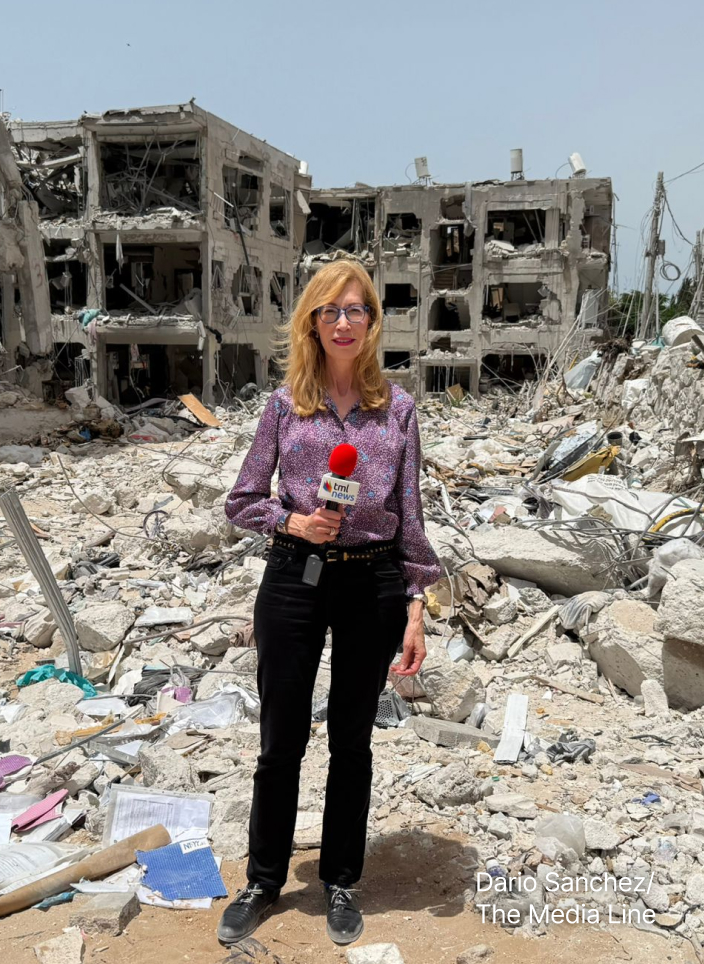
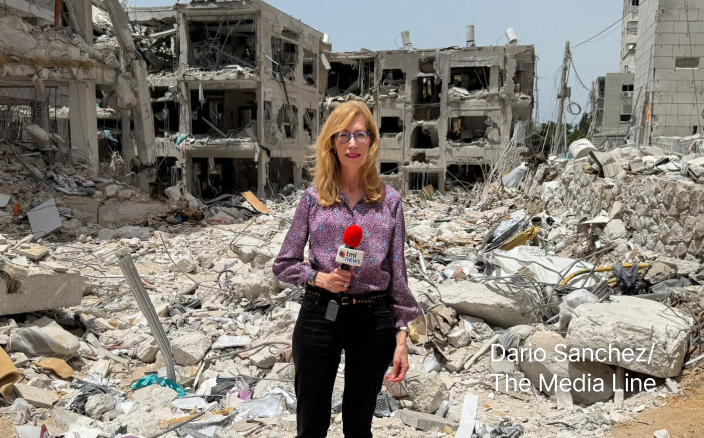
“I’ve been to two of the sites in the last week,” Kemp told The Media Line. “Thousands of Gazans were there collecting food. I spoke to many—dozens at each site—and almost all of them were grateful. They told me it was the first time they had received free aid since the war began nearly two years ago,” he added.
Kemp sharply criticized traditional humanitarian frameworks for failing to adapt to Gaza’s circumstances, citing repeated seizures of aid by Hamas.
The GHF may not be perfect, but it gets the aid directly to the people
“The UN and the main NGOs oppose the GHF. They prefer their outdated procedures, even though they don’t work in this context,” he argued. “The GHF may not be perfect, but it gets the aid directly to the people,” he added.
Col. Richard Kemp speaks about the GHF from the Gaza Strip. (Courtesy)
One of the most contentious issues surrounding the GHF is its security setup, including the presence of armed personnel and coordination with the Israeli military. Critics argue this arrangement increases civilian risk.
“Aid must be protected—not militarized,” Grunberg insisted. “The GHF system embeds humanitarian delivery inside a military framework. It actively undermines protection and neutral humanitarian space,” she added.
A recent exposé by the Israeli newspaper Haaretz claims the IDF has engaged in live fire crowd-control tactics at GHF distribution sites. Soldiers reportedly testified that they received orders to fire on unarmed crowds approaching or lingering near the aid hubs, even when no threat was present. The Israeli government responded sharply, calling the report “false and malicious” and announcing internal reviews of the incidents. In turn, GHF denied that any fatalities occurred at its sites, but said the allegations were “too grave to ignore,” and urged transparent investigations.
Eyewitnesses have also alleged Israeli fire near distribution zones, intensifying fears among civilians. Grunberg maintains that this militarization directly contributes to harm.
“The concentration of aid in militarized zones contributes directly to civilian harm,” she said.
Kemp pushes back on those accusations.
“The IDF provides external security to GHF bases. They’re there to keep Hamas from attacking the sites, not to interfere,” he said. “Why would the IDF fire at a system they’re helping to protect?” he added.
He argues that Hamas, not Israel, bears responsibility, citing claims that fighters killed GHF staff and threatened civilians.
“Hamas has killed Palestinian GHF staff and threatened civilians to stop them from collecting aid. That’s not speculation—I’ve spoken to people who told me that directly,” he noted.
Responding to The Media Line’s inquiry, the Israel Defense Forces said: “The IDF allows the American civilian organization (GHF) to distribute aid to Gaza residents independently, and operates in proximity to the new distribution zones to enable the distribution alongside the continuation of IDF operational activities in the Gaza Strip. … Following incidents in which harm to civilians who arrived at distribution facilities was reported, thorough examinations were conducted in the Southern Command, and instructions were issued to forces in the field following lessons learned. The aforementioned incidents are under review by the competent authorities in the IDF.”
The debate over neutrality continues to shape the controversy. Grunberg argues that any aid system overseen by a warring party cannot be neutral.
Portraying the GHF as ‘neutral’ or ‘effective’ is misleading and dangerous
“Portraying the GHF as ‘neutral’ or ‘effective’ is misleading and dangerous,” she said. “Unlike the UN, the GHF does not operate under principles of impartiality or independence. It is coordinated with the occupying power and undermines the legal obligation to provide unconditional access to aid,” she added.
But Kemp maintains that results matter more than frameworks.
“GHF is a private enterprise. Its objective is to keep aid from Hamas and give it directly to the people. That’s not only legitimate—it’s necessary,” he said.
International agencies remain cautious in their responses. The Media Line reached out to UNRWA, OCHA, and the Norwegian Refugee Council, but none had replied by publication time. Meanwhile, Gaza’s civilians stay caught between competing models of relief—where humanitarian access is increasingly shaped by political alignment, security protocols, and conflicting definitions of what it means to help.
