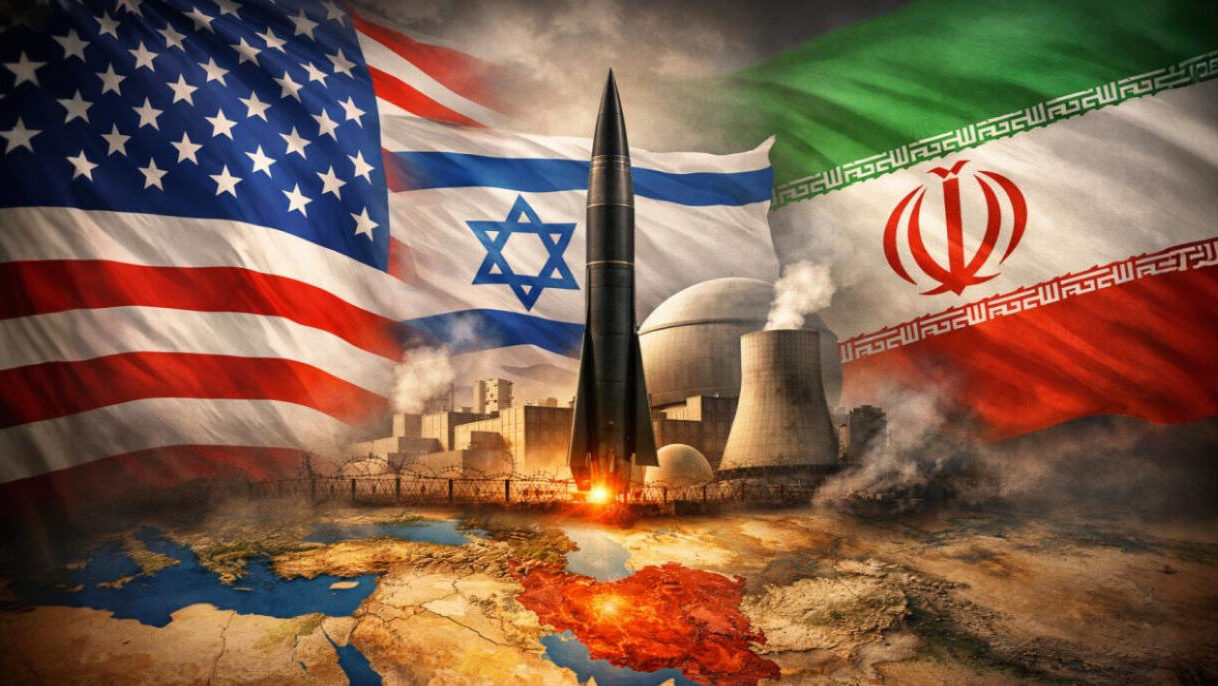
Why Do Israel and the United States See the Iran Threat on Different Strategic Timelines?
Geography, military exposure, and political constraints push Jerusalem and Washington to assess the same intelligence through very different clocks
As Israeli and US officials trade signals about next steps on Iran in late December 2025—including discussion of a possible meeting between Prime Minister Benjamin Netanyahu and President Donald Trump—an old strategic dilemma has returned to the forefront: how to prevent Tehran from edging closer to a nuclear weapon without triggering a wider regional war or locking Washington into an open-ended confrontation.
Israeli security officials have warned their American counterparts that recent Iranian missile activity, described publicly as exercises, could also function as operational preparation. From Jerusalem’s perspective, Iran has repeatedly used drills, proxy movements, and calibrated escalation to normalize dangerous realities before adversaries respond. Geography sharpens the concern. Missiles launched from Iran or through Iranian-backed forces in Lebanon, Syria, or Iraq compress Israel’s decision time to minutes rather than days.
After the Hamas-led October 7, 2023 attack on Israel, strategic thinking in Jerusalem became less tolerant of ambiguity. Many Israelis concluded that long-standing assumptions about deterrence, economic pressure, and diplomatic process failed to prevent surprise and mass-casualty violence. That experience now shapes how Iranian behavior is interpreted, particularly when Tehran tests limits without formally crossing declared red lines.
Washington often views the same intelligence through a broader lens. US officials and analysts broadly agree that Iran’s technical capabilities have advanced, but they differ on intent—whether Tehran has made a political decision to weaponize now or is deliberately maintaining ambiguity while improving leverage. American decision-makers also weigh escalation risks beyond Israel’s borders, including retaliation against US forces, disruption of Gulf energy infrastructure, and shocks to global markets.
On the American right, these questions have produced competing answers. Sen. Lindsey Graham has argued forcefully that deterrence only works if Iran believes Washington will act. He warned this week that if there is credible evidence Iran is resuming enrichment at undisclosed sites, the response must be immediate, saying delay only increases the eventual cost and allows Tehran to rebuild what has been damaged.
The Trump administration has sought to project firmness while narrowing the scope of confrontation. Vice President JD Vance has said the United States is “not at war with Iran” but focused on Iran’s nuclear program, framing recent actions as targeted and limited rather than the opening of a broader conflict. The emphasis on capability rather than regime change has become a defining feature of the administration’s messaging.
Give the gift of hope
We practice what we preach:
accurate, fearless journalism. But we can't do it alone.
- On the ground in Gaza, Syria, Israel, Egypt, Pakistan, and more
- Our program trained more than 100 journalists
- Calling out fake news and reporting real facts
- On the ground in Gaza, Syria, Israel, Egypt, Pakistan, and more
- Our program trained more than 100 journalists
- Calling out fake news and reporting real facts
Join us.
Support The Media Line. Save democracy.
Some Republicans have stressed boundaries. Sen. Jim Risch said during the June escalation that “this war is Israel’s war, not our war,” while emphasizing that there would be no American ground deployment in Iran. That position reflects a growing view within the party: strong backing for Israel’s right to act, combined with explicit limits on US military involvement.
From a different angle, constitutional conservatives have raised objections grounded less in strategy than in authority. Rep. Thomas Massie called the June strikes unconstitutional, arguing that Congress, not the president alone, must authorize acts of war. That critique has gained traction among lawmakers skeptical of expanding executive war powers after decades of Middle East conflicts.
Democrats have voiced their own concerns, often focused on escalation and legality. House Minority Leader Hakeem Jeffries accused President Trump of misleading the country about his intentions and risking deeper US entanglement without congressional approval. Rep. Alexandria Ocasio-Cortez described the strikes as a grave violation of constitutional war powers and said they constituted grounds for impeachment. Sen. Tim Kaine echoed those concerns, saying the American public is overwhelmingly opposed to war with Iran and warning that unilateral action carries long-term consequences.
From Tehran’s perspective, Iranian officials have framed their posture as defensive and nonnegotiable. Foreign Ministry spokesman Esmaeil Baqaei said Iran’s missile program was developed to defend the country and “is not a matter that could be talked about,” rejecting calls to include missiles in any future negotiations. That stance directly collides with how Israel and many US officials define the threat, which includes not only nuclear capability but delivery systems and the regional network they support.
In Israel, the debate has also cut across political lines. Opposition Leader Yair Lapid has agreed with the government’s assessment of the Iranian threat while criticizing Prime Minister Netanyahu’s broader leadership. Earlier this year, Lapid said Netanyahu was “the wrong person to lead the country,” even as he acknowledged that Netanyahu was, in his view, right about the danger posed by Iran. The tension reflects a familiar Israeli pattern: consensus on the threat, disagreement over execution and trust.
Analysts in Washington often sort these arguments into recognizable camps. One emphasizes coercion and sustained pressure, arguing that only dismantlement backed by credible force will change Iranian behavior. Another focuses on diplomacy backed by enforcement, associated with veteran policymakers such as Dennis Ross and Aaron David Miller, who have long argued that agreements matter only if verification and consequences are real. A third stresses escalation management and second-order effects, a perspective frequently associated with analysts like Tamara Cofman Wittes, who warn that Middle East military actions rarely stay contained.
What unites these views is recognition that time itself has become a strategic variable. Israel’s clock is compressed by proximity and vulnerability. America’s clock runs longer, shaped by global commitments and domestic political constraints. Iran’s leadership treats time as leverage, probing thresholds while avoiding a move that would trigger a decisive response.
The central risk is not disagreement but desynchronization: each actor acting rationally within its own timeline, yet producing outcomes no one fully intends. The challenge for Washington and Jerusalem is aligning deterrence tightly enough to deny Iran strategic breakthroughs while avoiding a cycle of escalation that could spiral beyond control.
With 2025 drawing to a close, the argument over Iran is no longer theoretical. It is shaping alliance politics, domestic debates, and regional calculations in real time. The decisions taken now—about pressure, restraint, and coordination—will set the parameters not just for the next crisis, but for how stability and risk are managed in the Middle East heading into 2026.
