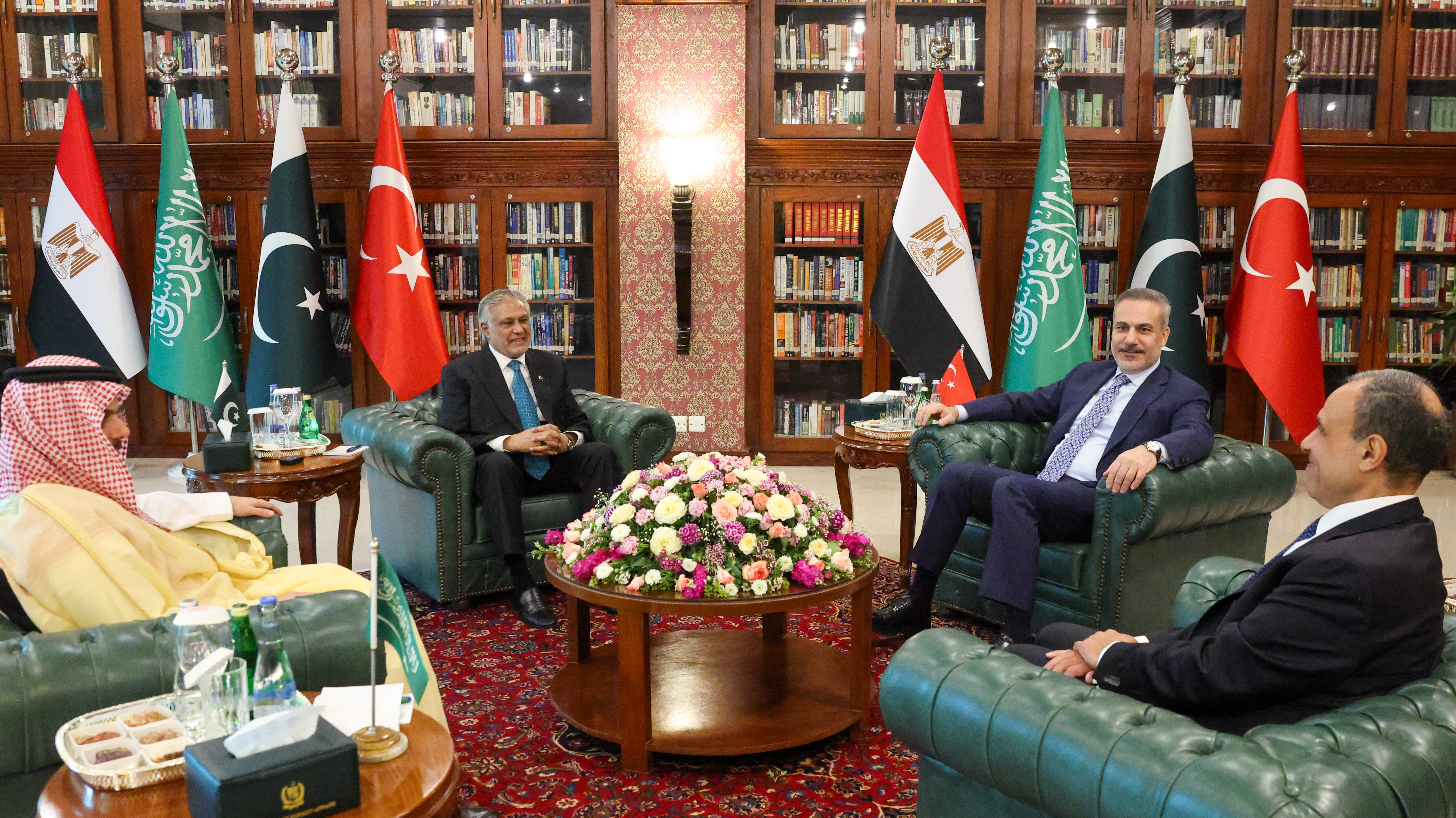
Pakistan Hosts Saudi, Turkey, Egypt FMs for Urgent Talks on US-Iran Conflict
Pakistan is set to host a high-level quadrilateral meeting on March 29-30, bringing together the foreign ministers of Saudi Arabia, Turkey and Egypt, in what officials describe as a coordinated diplomatic push to help de-escalate mounting tensions between the United States and Iran.
Pakistan’s Ministry of Foreign Affairs (MOFA) said in a statement that Deputy Prime Minister and Foreign Minister Mohammad Ishaq Dar has invited Saudi Foreign Minister Prince Faisal bin Farhan Al Saud, Turkey’s Foreign Minister Hakan Fidan, and Egypt’s Foreign Minister Badr Abdelatty to undertake an official visit to Islamabad on the same dates.
Dar, will chair the session, highlighting Islamabad’s increasingly proactive role in regional diplomacy. The engagement reflects Pakistan’s ongoing efforts to foster dialogue and reduce regional tensions through coordinated outreach with key regional partners.
The MOFA said the visiting dignitaries will hold in-depth discussions on a range of issues, with a particular focus on efforts to deescalate tensions in the region.
Give the gift of hope
We practice what we preach:
accurate, fearless journalism. But we can't do it alone.
- On the ground in Gaza, Syria, Israel, Egypt, Pakistan, and more
- Our program trained more than 100 journalists
- Calling out fake news and reporting real facts
- On the ground in Gaza, Syria, Israel, Egypt, Pakistan, and more
- Our program trained more than 100 journalists
- Calling out fake news and reporting real facts
Join us.
Support The Media Line. Save democracy.
The meeting comes amid heightened volatility in the Middle East, with growing fears that any miscalculation between Tehran and Washington could trigger a wider regional crisis. Diplomatic sources indicate the talks will focus on exploring avenues for deescalation through quiet back-channel engagement and coordinated messaging.
Pakistan, leveraging its balanced ties with Iran and key Gulf partners, is positioning itself as a mediator to facilitate dialogue where formal channels remain strained.
The participation of Turkey, Saudi Arabia and Egypt reflects a broader alignment of regional actors seeking to prevent further instability.
While immediate breakthroughs are unlikely, the Islamabad meeting is seen as an incremental effort to revive diplomatic engagement and maintain communication at a critical juncture.
Pakistan’s prime minister, Shehbaz Sharif, held a telephone conversation on Saturday with Iran’s president, Masoud Pezeshkian, and briefed him on ongoing diplomatic engagements.
According to a statement issued by the Prime Minister’s Office, the discussion, which lasted for more than an hour, saw both leaders exchange views on the prevailing regional tensions and ongoing efforts for peace.
The statement said that Sharif informed the Iranian president about the diplomatic outreach undertaken by himself, the deputy prime minister and Field Marshal Asim Munir, aimed at mobilizing the United States, as well as Gulf and Islamic countries, to help create a conducive environment for negotiations.
Meanwhile, Pezeshkian write on his X account: “We have said many times that Iran doesn’t carry out pre-emptive attacks, but we will retaliate strongly if our infrastructure or economic centers are targeted. To the countries of the region: ‘If you want development and security, don’t let our enemies run the war from your lands.’”
