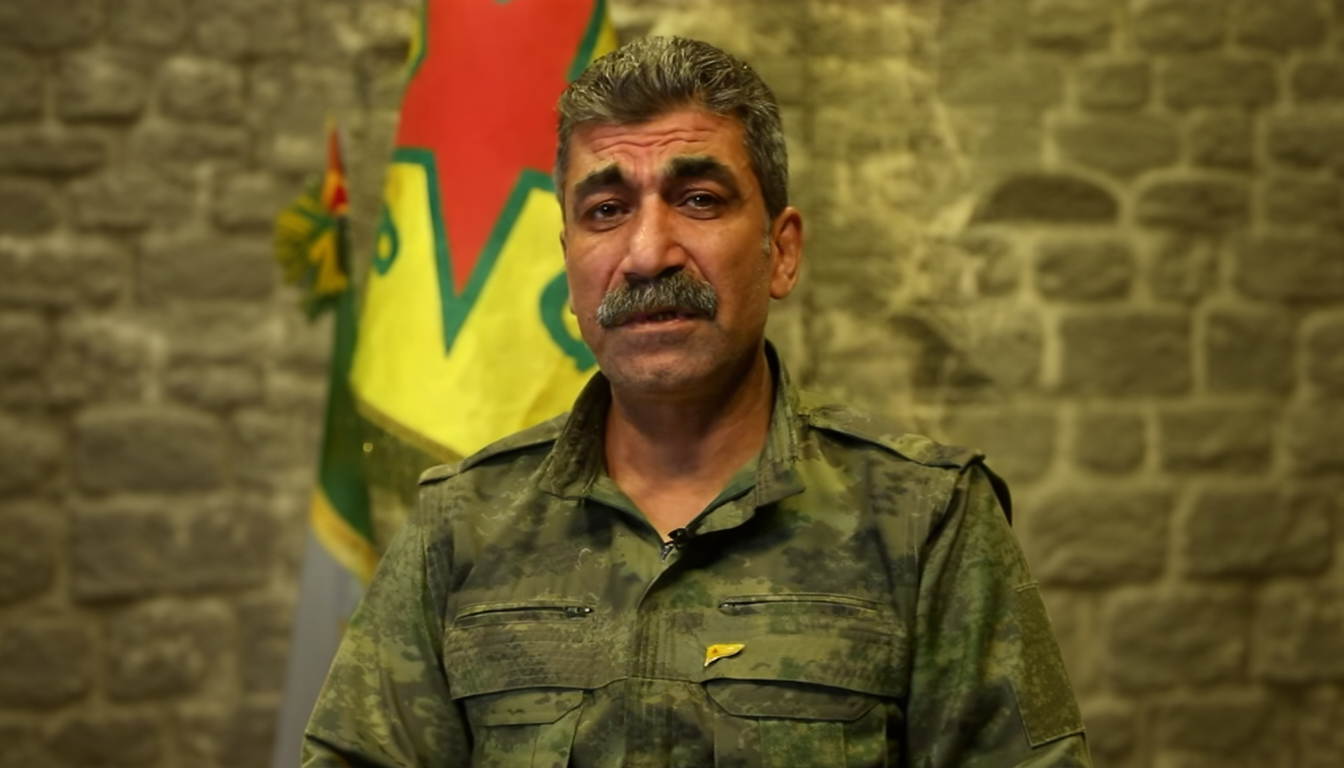
Damascus Appoints Kurdish Commander Deputy Defense Minister, Signaling Shift With Kurdish Forces
[DAMASCUS] The Syrian government has announced the appointment of the prominent Kurdish military commander Sipan Hamo as deputy minister of defense for eastern affairs, in a move that reflects potential shifts in the relationship between Damascus and Kurdish forces that have controlled large parts of northeastern Syria for years.
The decision is widely seen as a political and military signal that the Syrian government is attempting to reintegrate local armed forces into state institutions after more than a decade of conflict, which led to the emergence of multiple security and military structures operating outside the official framework.
According to the Syrian Ministry of Defense, Hamo will oversee military and security affairs in areas east of the Euphrates River—a strategic region that includes large parts of the provinces of Al-Hasakah, Raqqa and Deir ez-Zor. These areas hold significant economic importance because they contain most of the country’s oil and gas fields, in addition to vast agricultural lands.
The appointment comes at a time when Damascus is seeking to strengthen its administrative and military presence in those territories, which have remained for years under the influence of Kurdish forces backed by the US-led international coalition.
Analysts link the decision to ongoing understandings between the Syrian government and the Syrian Democratic Forces, the military alliance that dominates northeastern Syria and is primarily composed of the People’s Protection Units.
Give the gift of hope
We practice what we preach:
accurate, fearless journalism. But we can't do it alone.
- On the ground in Gaza, Syria, Israel, Egypt, Pakistan, and more
- Our program trained more than 100 journalists
- Calling out fake news and reporting real facts
- On the ground in Gaza, Syria, Israel, Egypt, Pakistan, and more
- Our program trained more than 100 journalists
- Calling out fake news and reporting real facts
Join us.
Support The Media Line. Save democracy.


These understandings point to a gradual process aimed at integrating some Kurdish military formations into the official structure of the Syrian armed forces in exchange for granting these regions a degree of local administration while preserving their specific security arrangements.
This development follows years of strained relations between the two sides, fluctuating between limited military coordination and political tension, particularly amid the involvement of multiple regional and international actors in the Syrian conflict.
Sipan Hamo is considered one of the most prominent Kurdish military leaders in Syria. He previously served as the commander in chief of the People’s Protection Units, which played a central role in battles against the Islamic State (ISIS) in recent years.
Hamo hails from the Afrin region in northern Syria and rose to prominence during the early stages of the Syrian war as one of the key figures responsible for building the military structure of Kurdish forces. He also played an important role in developing military coordination between Kurdish forces and the international coalition during operations against ISIS in northern and eastern Syria.
Through this role, Hamo became an influential figure within the Kurdish military establishment and one of the leading commanders who helped consolidate the military and administrative influence of Kurdish forces across large parts of northeastern Syria.
The appointment of a Kurdish commander to a senior position within Syria’s Ministry of Defense carries significant political implications. It may indicate an effort by Damascus to reintegrate local armed forces into the state structure as part of a more pragmatic approach to governing territories that slipped from government control during the years of war.
The decision could also reflect a desire to reduce tensions between the Syrian government and the Kurdish self-administration, potentially opening the door to new political and security arrangements aimed at ensuring relative stability in the region.
At the same time, some observers believe the move may serve as an initial test for a broader process aimed at restructuring the military landscape in northeastern Syria, particularly given the ongoing regional and international complexities surrounding the Syrian situation.
As these developments continue to unfold, the success of this step will largely depend on the ability of both sides to translate political understandings into long-term institutional arrangements that could help redefine the contours of military and administrative authority in this sensitive region of the country.
