From New York to Idlib, al-Sharaa Addresses Syrians: ‘From Here, the New Syria Begins’
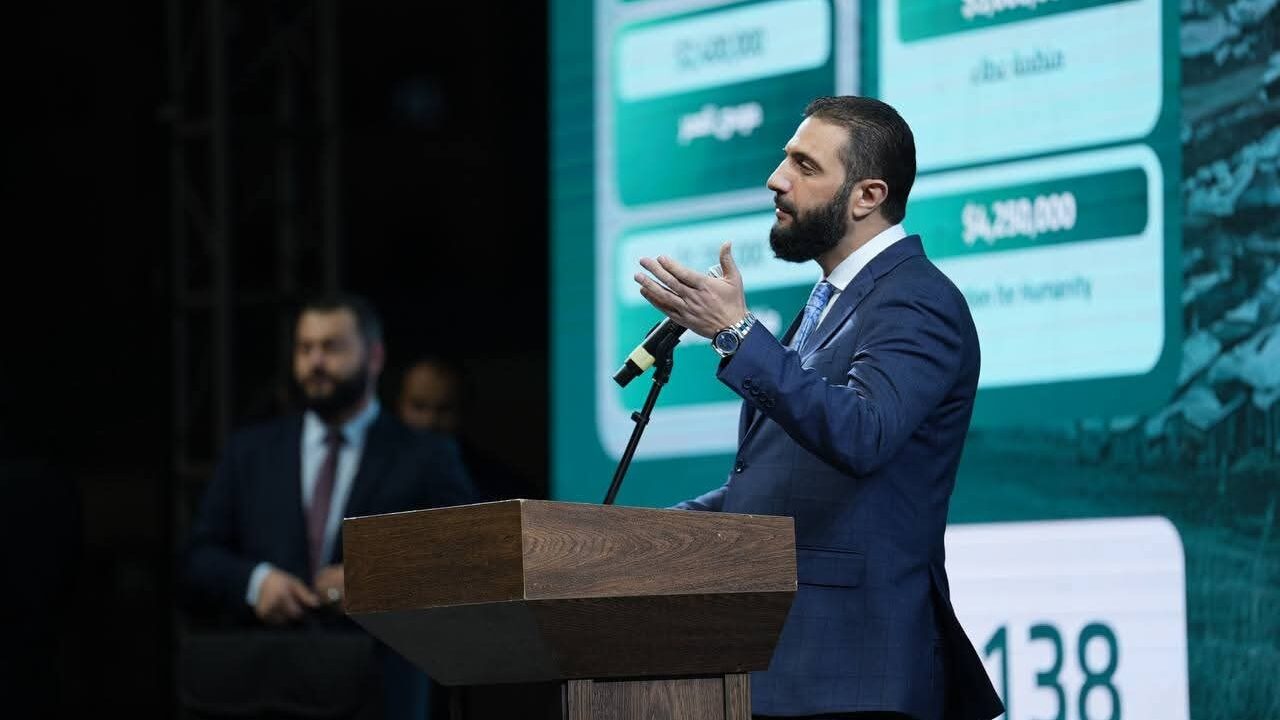
[Idlib] Syrian President Ahmed al-Sharaa delivered his first speech since returning from New York on Friday evening, after participating in the 80th session of the United Nations General Assembly.
Al-Sharaa chose Idlib as the site of his address, which was delivered during the “Loyalty to Idlib” campaign, raising more than $208 million to help rebuild the city after years of devastation from war.
His speech in Idlib came just days after al-Sharaa addressed the United Nations, where he emphasized the Syrian people’s right to shape their own destiny free from external guardianship. He urged the international community to lift economic sanctions on Syria, calling them an added burden on civilians and a barrier to reconstruction efforts.
He also emphasized the unity of Syrian territory and rejected any attempts at partition, affirming that “Syria has emerged from the war more determined to live, and more capable of playing its active role in the region and the world.”
After returning to Damascus, al-Sharaa chose to deliver his first address inside Syria from Idlib rather than the capital — a decision laden with political and symbolic significance.
Give the gift of hope
We practice what we preach:
accurate, fearless journalism. But we can't do it alone.
- On the ground in Gaza, Syria, Israel, Egypt, Pakistan, and more
- Our program trained more than 100 journalists
- Calling out fake news and reporting real facts
- On the ground in Gaza, Syria, Israel, Egypt, Pakistan, and more
- Our program trained more than 100 journalists
- Calling out fake news and reporting real facts
Join us.
Support The Media Line. Save democracy.

In his speech, al-Sharaa said: “I was preparing a speech after our return from the United Nations General Assembly, and I chose that it be from here in Idlib, in loyalty to the place.”
He added: “Yesterday I arrived in Al-Sham, the dearest place on Earth to my heart, but Idlib is love itself.”
These words carry particular weight, as Idlib was not merely a stop along al-Sharaa’s path but the stronghold where he endured the years of war, fought on its soil within the ranks of Hay’at Tahrir al-Sham, and later rose to become both a new political figure and the head of the Syrian state. Choosing Idlib as the platform for his first speech appeared as a return to his roots and an acknowledgment of the city’s resilience as the last opposition stronghold.
In his address, Al-Sharaa told the crowds: “O great people, heroes of the Syrian story, … you are the ones who sacrificed, suffered, were displaced, killed, and tortured. With the blood of your martyrs, the cries of your children, and the grief of your orphans, you raised Syria’s head high among nations,” stressing that the sacrifices of Syrians had made the world stand in “reverence and respect” for their resilience.
Al-Sharaa noted that his meetings in New York reflected an international consensus on Syria’s unity and stability. He stressed that preserving the unity of the Syrian people is an unavoidable duty and the basis for rebuilding a new Syria where all citizens can participate without discrimination.
The Syrian president affirmed that lifting sanctions is not an end in itself, but a means to open the door to investment, stimulate growth, and create job opportunities for Syrian youth.
He added: “Syria is no longer isolated from the world. It has returned to its historic, active place among nations. And just as God granted us victory over the most brutal regime modern history has known, we are capable of rebuilding our country anew.”
Al-Sharaa concluded his speech by stressing the symbolic place of Idlib in Syrian consciousness, saying: “I chose Idlib to address the people of Syria from it, in gratitude to her, for she was the mother to whom her sons returned. She became a miniature Syria when the land grew narrow, so people rallied to her and together they achieved this historic accomplishment.”
Thus, the Idlib speech appeared as the culmination of al-Sharaa’s political and military journey, and as a message that rebuilding Syria can only begin from the cities that bore the burden of war and made the greatest sacrifices.
