Noose Pins Spark Uproar as Knesset Battles Over Death Penalty, Media Reform, Reserve Duty, and the Budget
Clashes over symbolic displays, public broadcasting, and war-time mobilization reveal deep fractures across Israel’s governing coalition
Faction meetings at the Israeli parliament erupted into sharp political exchanges as parties confronted one another over the government’s media reform bill, the structure of reserve duty after two years of war, and mounting pressure inside the coalition over the state budget. The day also brought criticism of far-right lawmakers who arrived wearing yellow noose-shaped pins to promote a bill introducing the death penalty for convicted terrorists—a symbolic choice that several opposition members warned could be confused with the yellow ribbon used in the campaign to free the hostages taken by Hamas.

Far-right lawmakers wore yellow noose-shaped pins to promote a bill introducing the death penalty for convicted terrorists. (Gabriel Colodro/The Media Line)
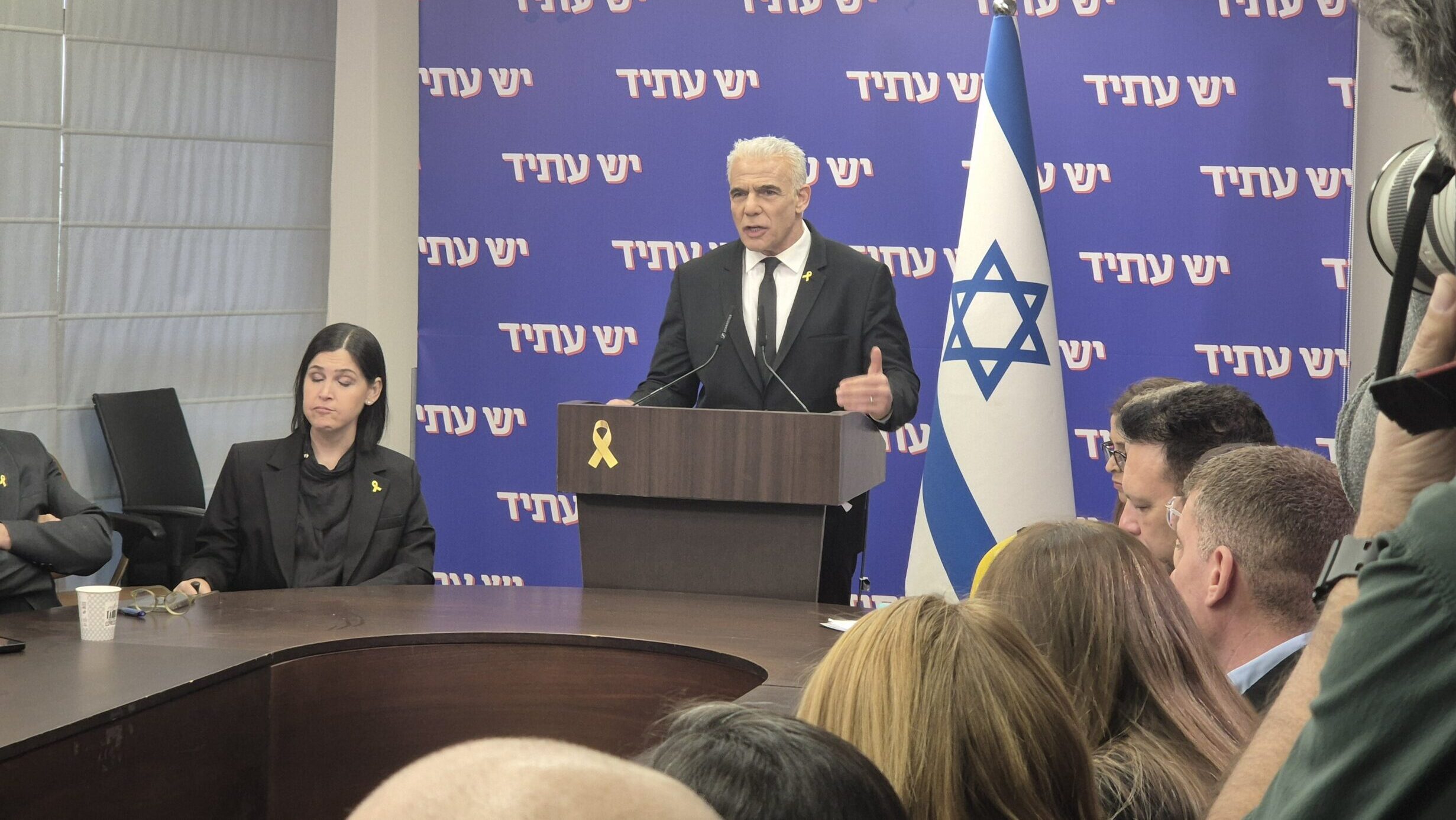
Opposition Leader Yair Lapid opened his Yesh Atid meeting with a direct attack on the government’s proposed restructuring of public broadcasting. He said the new committee overseeing the legislation represents “a gagging commission” designed to intimidate the press rather than reform it. “The media they want is obedient, frightened, controlled,” Lapid said. “The goal is to shut your mouths. There is no democracy without a free press, and the first step in crushing any democracy is when the government forces the media to bend.”
Lapid also addressed the decision by lawmakers from the far-right Otzma Yehudit party to wear yellow noose pins during the parliamentary push for a death penalty bill. He described the gesture as “a cheap provocation” and warned that images of it were already circulating around the world and “causing significant damage to Israel’s image.”
Give the gift of hope
We practice what we preach:
accurate, fearless journalism. But we can't do it alone.
- On the ground in Gaza, Syria, Israel, Egypt, Pakistan, and more
- Our program trained more than 100 journalists
- Calling out fake news and reporting real facts
- On the ground in Gaza, Syria, Israel, Egypt, Pakistan, and more
- Our program trained more than 100 journalists
- Calling out fake news and reporting real facts
Join us.
Support The Media Line. Save democracy.
A parallel confrontation unfolded in the meeting of the National Unity party, where former Defense Minister Benny Gantz presented what he called a realistic model for reserve service after the prolonged mobilization triggered by the Gaza war. Gantz argued that the current expectations placed on reservists, in some cases reaching 100 days a year, were unreasonable and unsustainable. “There is no justification for continuing to call up any reservist for 100 days a year,” he said, insisting that the burden must be widened and that ultra-Orthodox service integration can no longer be delayed. The state, he warned, “cannot keep relying on a small group that storms the front while the country sleeps.”
Coalition tensions escalated further when Aryeh Deri, leader of the ultra-Orthodox Shas party, announced that his faction would not support the state budget unless new food aid eligibility rules were reversed. Deri accused the Finance Ministry of discriminating against ultra-Orthodox families, calling the criteria “a cruel act against the most vulnerable households” and warning, “As long as this is not resolved, Shas will not support the budget.”
At the far-right end of the coalition, National Security Minister Itamar Ben Gvir doubled down on his effort to advance the death penalty bill and dismissed criticism of the pins worn by his party members. He said the legislation was steadily moving toward its next parliamentary readings and claimed that opponents of the bill, particularly Arab lawmakers, had reason to be “concerned.” The proposal, he argued, would “finally deliver justice” and his faction would push it forward “as fast as possible.”

National Security Minister Itamar Ben Gvir speaks at the Otzma Yehudit faction meeting on Dec. 8, 2025 at the Knesset in Jerusalem. (Gabriel Colodro/The Media Line)
Ben Gvir also revisited his longstanding criticism of the previous government’s “Resolution 550” plan, arguing that the program had diverted funds into the hands of criminal networks in Arab communities. He urged coalition partners to abandon what he termed “the Mansour Abbas plan” and redirect resources toward law enforcement.
Economic disputes also surfaced. Finance Minister Bezalel Smotrich, speaking for the Religious Zionism party, defended his consumer-market reforms and accused major dairy producers and retail monopolies of resisting badly needed structural change. He said his ministry was committed to “breaking the concentration of economic power” and lowering household costs, and promised to press ahead despite public criticism of recent pricing policies.
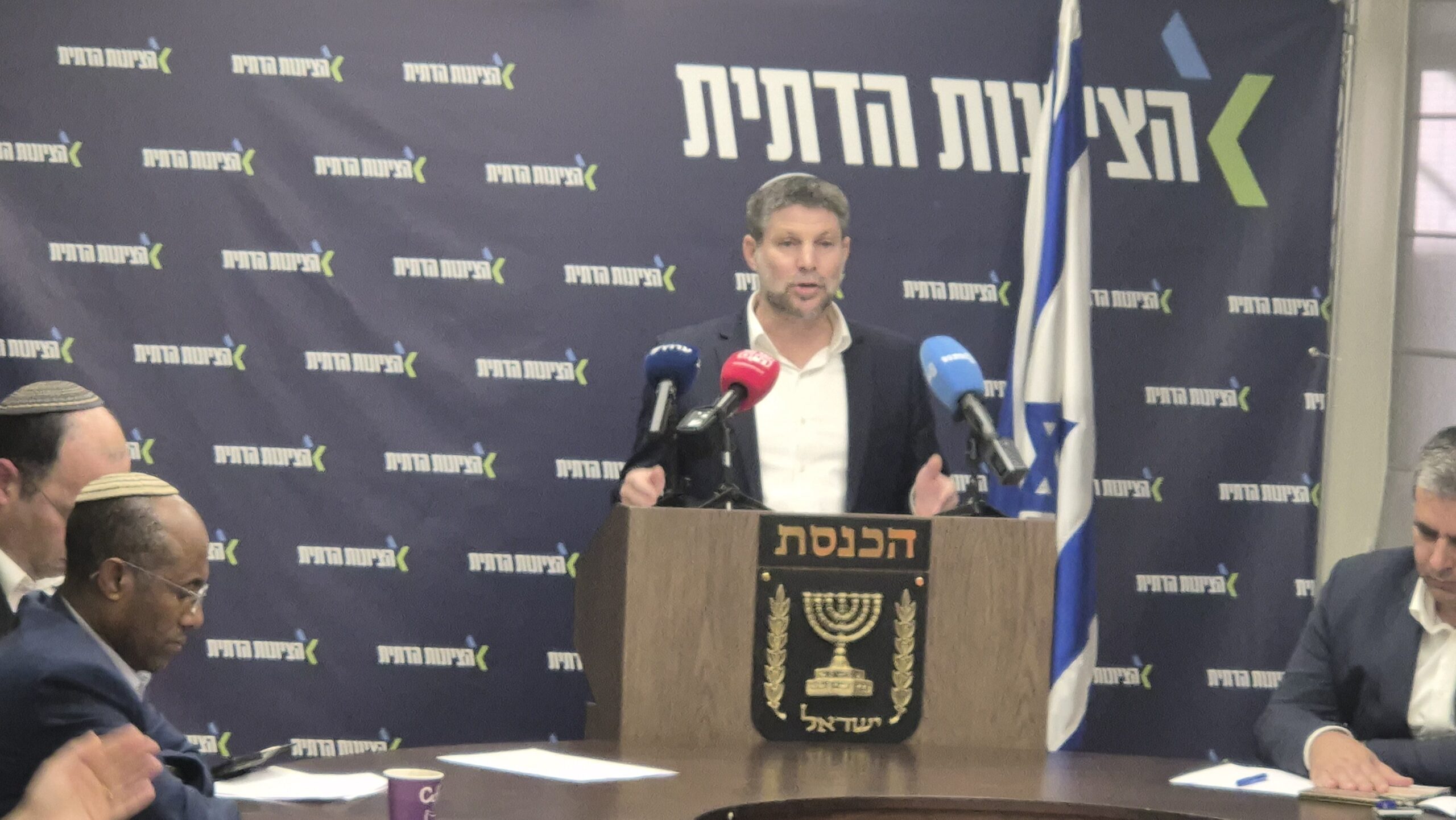
Finance Minister Bezalel Smotrich, speaks at the Religious Zionism faction meeting on Dec. 8, 2025 at the Knesset in Jerusalem. (Gabriel Colodro/The Media Line)
Taken together, the statements emphasized how deeply divided the Israeli parliament remains over the country’s institutional direction following the Gaza war. From media regulation and national service to budget priorities and the boundaries of government authority, parties across the political spectrum signaled that the coming weeks are likely to be shaped by structural battles rather than tactical disputes. Symbolic controversies, such as the noose-shaped pins, are poised to amplify an already volatile political arena.
