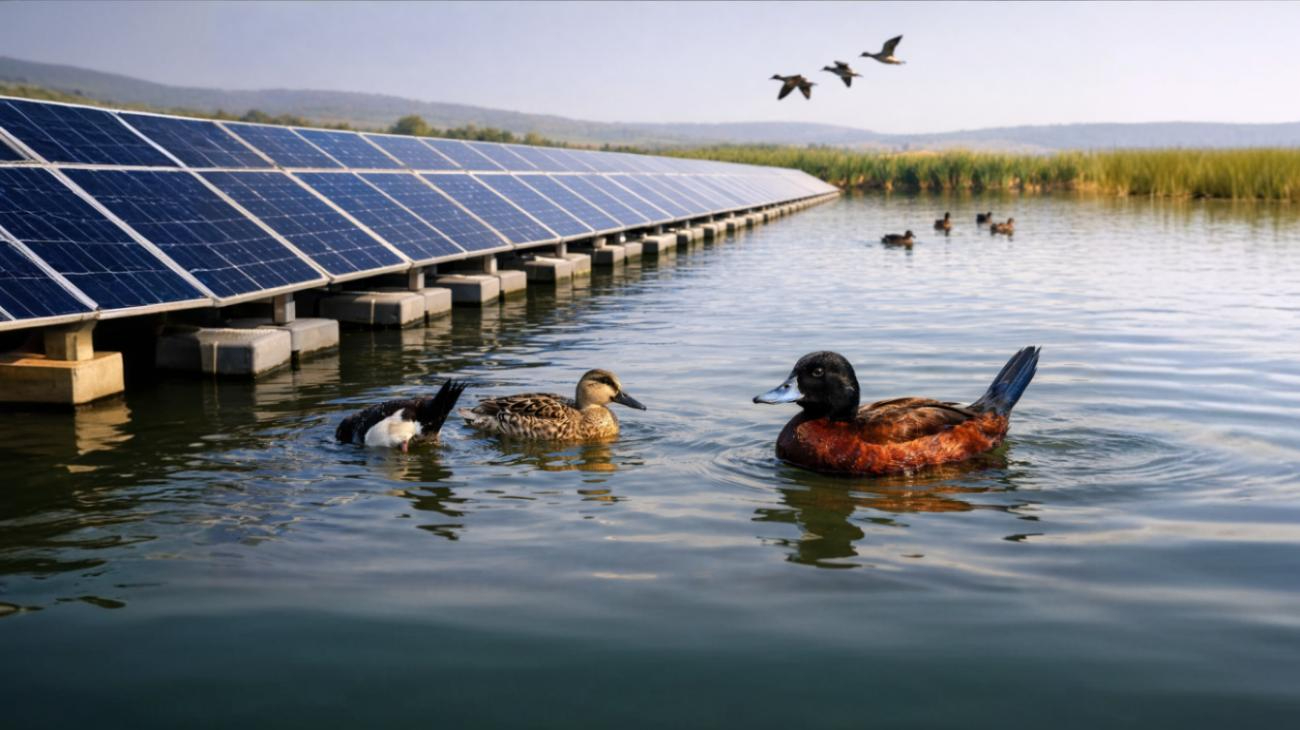
Solar Panels on Reservoirs Tied to Declines in Ducks and Diving Birds
The Israel Nature and Parks Authority said Wednesday that solar panel installations on water reservoirs are linked to substantial declines in some waterfowl, raising fresh questions about how Israel balances rapid renewable-energy expansion with wildlife protection.
In a new study released by the authority, researchers found that reservoirs with solar arrays were associated with a drop of up to 40% in the number of duck and diver species observed. The report notes that floating or reservoir-based solar projects can generate electricity without consuming scarce open land or productive farmland—an advantage in a densely populated country pushing to increase clean energy capacity. Still, the authority cautioned that the ecological tradeoff may be significant at certain sites.
Give the gift of hope
We practice what we preach:
accurate, fearless journalism. But we can't do it alone.
- On the ground in Gaza, Syria, Israel, Egypt, Pakistan, and more
- Our program trained more than 100 journalists
- Calling out fake news and reporting real facts
- On the ground in Gaza, Syria, Israel, Egypt, Pakistan, and more
- Our program trained more than 100 journalists
- Calling out fake news and reporting real facts
Join us.
Support The Media Line. Save democracy.


According to the study, the biggest decreases were recorded among filter-feeding ducks and diving birds, species that rely on access to the water surface and specific feeding conditions. The findings also raised concern for rarer birds that use Israel’s reservoirs as seasonal habitat, including the marbled duck and the stiff-tailed duck. The report said Israel is an important wintering area for the stiff-tailed duck, with about a third of the global population spending the season in the country.
The authority recommended designating key reservoirs as no-build zones for solar panels and limiting the portion of water covered where installations proceed. It also called for continued monitoring and follow-up research so that renewable-energy projects do not unintentionally accelerate declines in vulnerable waterfowl.
