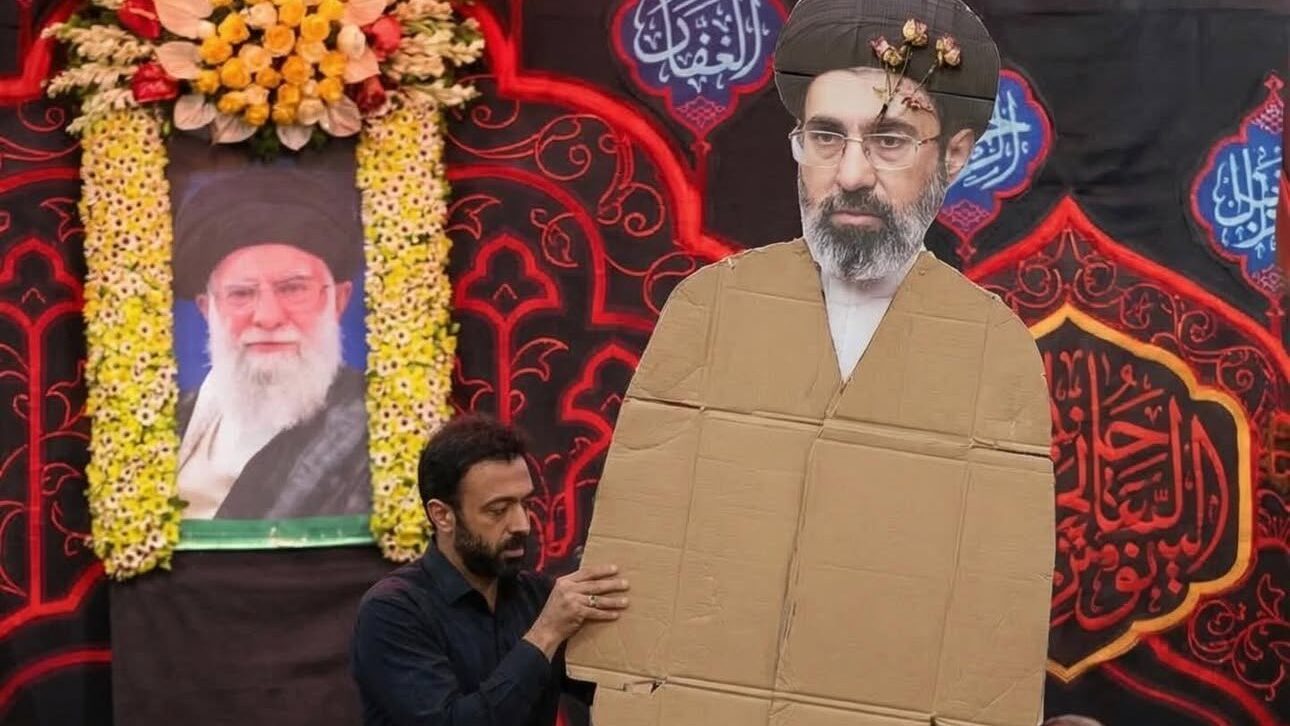
The Cardboard Supreme Leader: How One Viral Image Fueled Rumors About Iran’s Leadership
The story of Iran’s “cardboard supreme leader” traveled the way modern rumors usually do: fast, funny, and almost completely detached from reality.
For a few days, social media looked convinced that the Islamic Republic had reached peak absurdity. Photos circulated online showing what appeared to be a life-size cardboard cutout of Iran’s new supreme leader standing on a stage at a pro-government rally. Memes followed instantly. Commentators joked that the regime had finally revealed its true nature: a brittle system held together by cardboard props. Some users claimed the leader was missing, injured, or even dead. Others suggested the Revolutionary Guard had literally pledged loyalty to a cardboard stand-in.
It was perfect internet material. Authoritarian politics, wartime secrecy, and visual absurdity wrapped into one image.
But the reality was far less dramatic—and far more instructive.
In the days after Iran’s leadership transition, pro-government rallies were held across the country to signal unity and loyalty. At one such gathering, organizers displayed large portraits and at least one life-size cardboard image of the newly appointed supreme leader on stage. The leader himself did not appear in person.
That detail is what fueled the online speculation. In a tense wartime environment, with security concerns great and public appearances tightly controlled, the absence of a new leader quickly became fertile ground for rumor.
Yet the use of symbolic images was not unusual. Iranian rallies have long featured giant posters and cutouts of political and religious figures—from Ayatollah Ruhollah Khomeini to Ali Khamenei. Normally, however, those displays are professionally printed banners or polished life-size posters produced by the state’s well-developed propaganda apparatus. The cardboard cutout seen in the viral photograph appears noticeably cruder, with visible folds and a roughly assembled backing—quite different from the slick imagery usually associated with official Iranian ceremonies.
Whether the viral photograph itself is authentic remains uncertain. The image appears somewhat plausible, and symbolic displays are common at Iranian political events. But the photo’s origins have not been conclusively verified, leaving open the possibility that it could be staged or manipulated.
Give the gift of hope
We practice what we preach:
accurate, fearless journalism. But we can't do it alone.
- On the ground in Gaza, Syria, Israel, Egypt, Pakistan, and more
- Our program trained more than 100 journalists
- Calling out fake news and reporting real facts
- On the ground in Gaza, Syria, Israel, Egypt, Pakistan, and more
- Our program trained more than 100 journalists
- Calling out fake news and reporting real facts
Join us.
Support The Media Line. Save democracy.
But on social media, context rarely survives contact with virality.
The photograph of the cardboard figure traveled faster than any explanation could. Within hours, the image had become evidence—at least in the minds of many online—that something extraordinary had happened behind the scenes. Some users pointed to widely reported accounts that the leader had been wounded in an Israeli strike. Others speculated that he was in hiding. A few insisted the regime was staging loyalty ceremonies for a man who might not even be alive.
While his reported injury has been widely covered, the other claims quickly circulating online remain unverified.
What the episode revealed instead was something about the mechanics of modern information warfare—an ecosystem in which a single image, stripped of context, can become the foundation for an entirely fictional narrative.
It also highlighted the gap between the logic of social media and the discipline of journalism.
Serious reporting moves slowly by comparison. Journalists verify images, check sources, and confirm details before publishing. Social media does the opposite: it rewards the fastest explanation, the most dramatic interpretation, and the funniest punchline. Accuracy comes later—if it comes at all.
The cardboard-leader story was a textbook case. A real photograph may exist. A rally likely did take place. A cardboard image may indeed have been displayed. From there, speculation filled the vacuum.
Once the memes began circulating, the rumor took on a life of its own. People shared it not because they knew it was true, but because it felt plausible in the chaotic atmosphere of wartime Iran. Authoritarian secrecy makes almost any theory believable.
That dynamic is precisely why rumors like this flourish. When governments tightly control information about leadership health, security arrangements, or internal politics, the absence of reliable facts becomes fertile ground for speculation.
Yet the lesson cuts both ways.
The episode is also a reminder that viral content is rarely the same thing as verified reality. A striking image can suggest a story that simply isn’t there. A cardboard cutout at a political rally can become, within hours, a global narrative about a missing dictator.
In the end, the cardboard figure said less about the condition of Iran’s leadership than it did about the modern information environment.
In the age of viral images and instant commentary, the most dramatic explanation almost always spreads first.
The truth usually arrives later—quietly, and with far fewer retweets.
