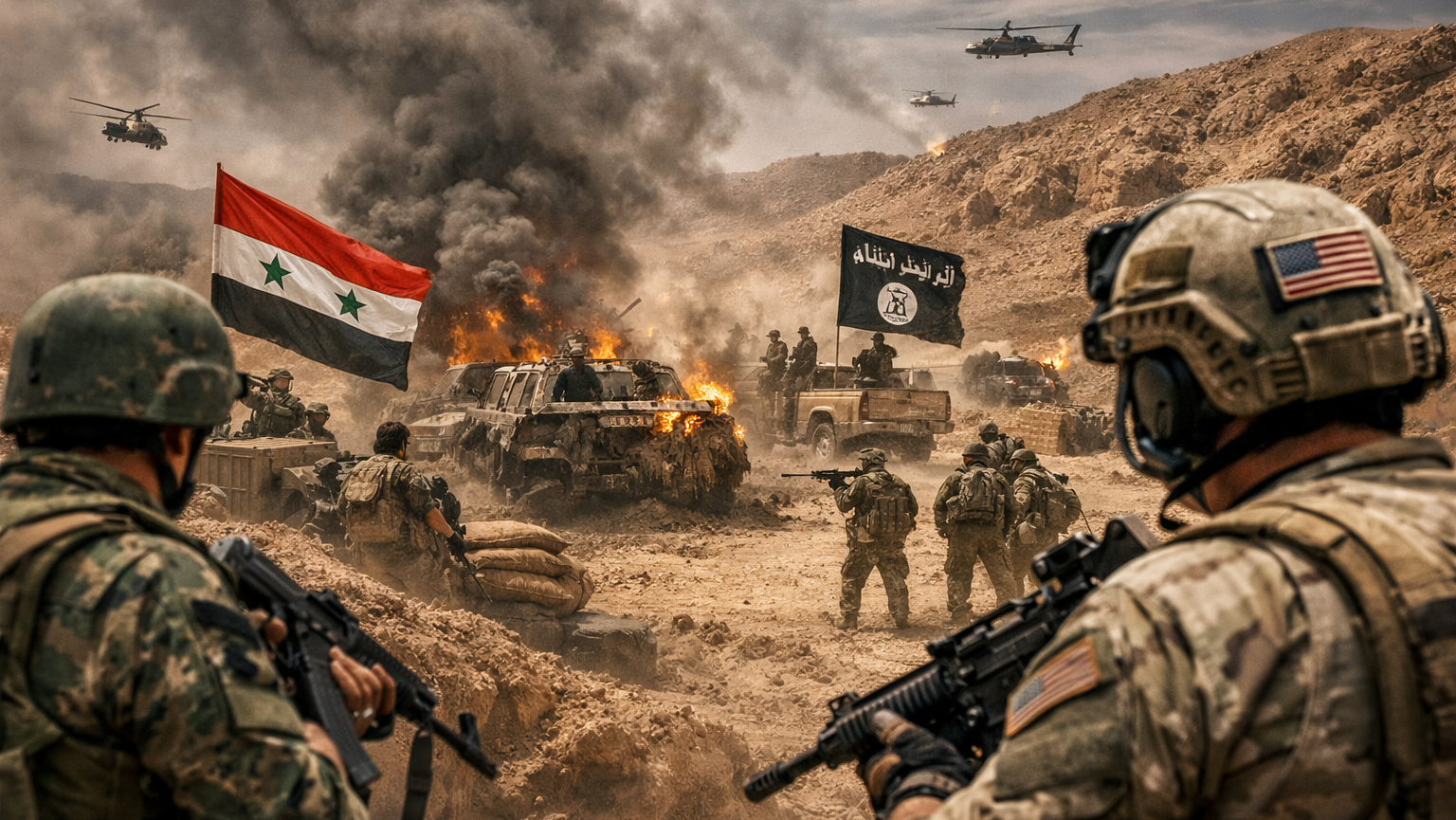
An Open War Between the Syrian State and IS
Okaz, Saudi Arabia, December 18
It is clear that the war between the Syrian state and the Islamic State (IS) terrorist organization has entered a new, more complex, and more dangerous phase, one in which theaters have multiplied, and fronts have become intertwined following the attack launched by the organization against a joint Syrian-American patrol in the city of Palmyra.
This attack cannot be interpreted as an isolated security incident, but rather as an explicit declaration of the nature of the conflict ahead—a conflict that bears little resemblance to conventional wars and is not governed by their familiar rules, instead fitting the pattern of shadow wars, guerrilla warfare, and lightning strikes, where geography itself becomes a trap, security gaps prove more perilous than open battlefields, and terrorism wagers on exhaustion and attrition rather than outright victory.
This war, though its timing may have seemed predictable, carries far deeper implications. The approach of President Ahmed al-Sharaa, founded on restoring the state and its institutions, clearly engaging with the framework of international law, and explicitly breaking with the logic of extremist groups, is inherently unacceptable to terrorist organizations. It inevitably places them in direct confrontation with a state seeking to rebuild itself and with an authority determined to monopolize decision-making, arms, and legitimacy, rendering the clash only a matter of time.
Yet the true challenge lies not in the eruption of the confrontation itself, but in its intricate nature. This is not a war of armies or a battle fought along defined front lines; it is a war of information and intelligence. Such a war demands superior surveillance capabilities, deep penetration, and cross-border cooperation in intelligence and analysis, making international partnerships a vital and indispensable component, particularly given Syria’s renewed role as an active participant in the international coalition against IS, not merely as a battlefield but as an engaged and proactive actor.
Give the gift of hope
We practice what we preach:
accurate, fearless journalism. But we can't do it alone.
- On the ground in Gaza, Syria, Israel, Egypt, Pakistan, and more
- Our program trained more than 100 journalists
- Calling out fake news and reporting real facts
- On the ground in Gaza, Syria, Israel, Egypt, Pakistan, and more
- Our program trained more than 100 journalists
- Calling out fake news and reporting real facts
Join us.
Support The Media Line. Save democracy.


Domestically, the urgency for the Syrian government to accelerate restructuring efforts and to build its security institutions on clear, professional foundations has never been greater. This necessity applies foremost to the intelligence services and the General Security Directorate, with the aim of eliminating the current fragmentation, multiplicity, and overlapping jurisdictions. The fight against terrorism cannot tolerate duplicated decision-making or competing centers of power; it requires a single security apparatus, a unified armed force, and a centralized command that monopolizes the use of force and manages the battle with strategic foresight and patience.
In this context, seeking expertise from allied and friendly nations is not a secondary choice but a strategic imperative, whether from the United States, which possesses extensive experience in counterterrorism, or from Saudi Arabia, which has accumulated deep security and intelligence expertise in this domain in addition to its influential regional role. Washington also bears a dual responsibility at this stage, as many of the complexities of the Syrian landscape—particularly in the north and east—cannot be resolved without direct political and security engagement that leads to the unification of arms, the end of fragmentation, and the alleviation of the burden on the Syrian state so it is not drained by peripheral issues while confronting an existential threat that is expanding across the desert and other fragile areas.
Yes, a war has begun, but it is a harsh and bitter war, one that demands immense patience and profound sacrifices. Syria paid the price from the very first moment with the blood of its soldiers, as did its allies with the blood of American soldiers who fell while confronting an enemy that recognizes no values and assigns no worth to human life. This reality lends the battle a humanitarian and moral dimension that transcends cold political calculations. The truth that must be stated plainly is that this is not Syria’s war alone, nor is it merely a confrontation between a government and an organization; it is a war for the entire region, waged by the international coalition against terrorism. Syria—its state, its people, and its government—stands on the front lines, at the very edge of vacuum and chaos, and at the points of vulnerability through which terrorism infiltrates, strikes, and then vanishes.
Initial reactions, ranging from explicit condemnation and declared support by Arab states and the international community to the advanced American stance, represent a step in the right direction, but they remain insufficient unless accompanied by the development of a comprehensive strategy—security, intelligence, and logistical—built in partnership with Damascus rather than on its behalf, and reinforced by a political umbrella that enables the Syrian government to reclaim its capacity to act and to address the thorny issues obstructing state consolidation.
Supporting the Syrian administration in its war against IS is no longer a debatable political option, but a regional and international security necessity, because the alternative to a strong state is a deadly vacuum, and because terrorism is not defeated by statements, but by the state itself—by institutions, by will, and by a sincere alliance that understands that the fall of a Syrian martyr or an American soldier is a warning to all, not merely a fleeting headline in the evening news.
Rami Al-Khalifa Al-Ali (translated by Asaf Zilberfarb)
