Pope Francis and Peace With Islam
Asharq Al-Awsat, London, April 25
We, Arabs and Muslims, often exaggerate both in our celebration of positives and in our lamentation of negatives. The positive sentiment we are reflecting on today concerns statements made by Arabs and Muslims after the death of Pope Francis, declaring that peace with Islam was his highest priority.
From close observation since 2015, I can say with some certainty that the primary focus of the Argentine cardinal, who ascended to the papacy in 2013 following the resignation of Pope Benedict XVI, was internal reform within the church. Perhaps his second major concern was fostering relations with marginalized communities around the world. His engagement with Islam, while sincere and meaningful, ranked third among his many proliferating activities, and perhaps even lower before his elevation to the papacy.
It is fair to say that during his pontificate, Pope Francis made a concerted effort to improve relations with Muslims, and his very choice of papal name had historical resonance in that regard. Saint Francis of Assisi (1180–1226), founder of the Franciscan Order, is remembered for two major themes in his short life: his compassion for the poor, the sick, and the hungry during the plagues that devastated Central Europe, and his extraordinary efforts to seek peace with Muslims during an era of ferocious conflict between East and West.
Francis of Assisi famously traveled to Cairo and met with Sultan Al-Kamil Ayyubi (1180–1238), ruler of Egypt and nephew of the famed Saladin. While Muslim historians scarcely mention this encounter, Crusader sources claim that Assisi sought to persuade the Sultan to embrace Christianity after sensing his openness to peace. Regardless of historical interpretations, the encounter itself has come to symbolize a rare gesture of reconciliation during the age of the Crusades.
As Ibn Khaldun observed, history is not only about recording events but also about the choices, interpretations, and meanings we attach to them. Over the centuries, the narrative surrounding Assisi’s visit has come to represent a vision of peace, just as Saladin’s own preference for negotiated settlements shaped his legacy.
Give the gift of hope
We practice what we preach:
accurate, fearless journalism. But we can't do it alone.
- On the ground in Gaza, Syria, Israel, Egypt, Pakistan, and more
- Our program trained more than 100 journalists
- Calling out fake news and reporting real facts
- On the ground in Gaza, Syria, Israel, Egypt, Pakistan, and more
- Our program trained more than 100 journalists
- Calling out fake news and reporting real facts
Join us.
Support The Media Line. Save democracy.
I digress here because Pope Francis, too, elevated world peace—and peace with Islam in particular—to a priority of his papacy. He embraced the story of Assisi as a model for his outreach, visiting Muslim-majority countries and championing the cause of interfaith dialogue.
In his first homily after his election, Pope Francis warned of the perils surrounding world peace, emphasizing that it must be preserved at all costs because war brings nothing but misery, destruction, and death. He stressed the need to address the suffering in Muslim lands, asserting that global peace is unattainable without peace with Islam and Muslims.
These themes recurred throughout his papacy, and he visited seven Arab and Islamic countries, each time delivering messages extolling dialogue, cooperation, and the mercy that Christians and Muslims alike believe to be the foundation of God’s relationship with humanity.
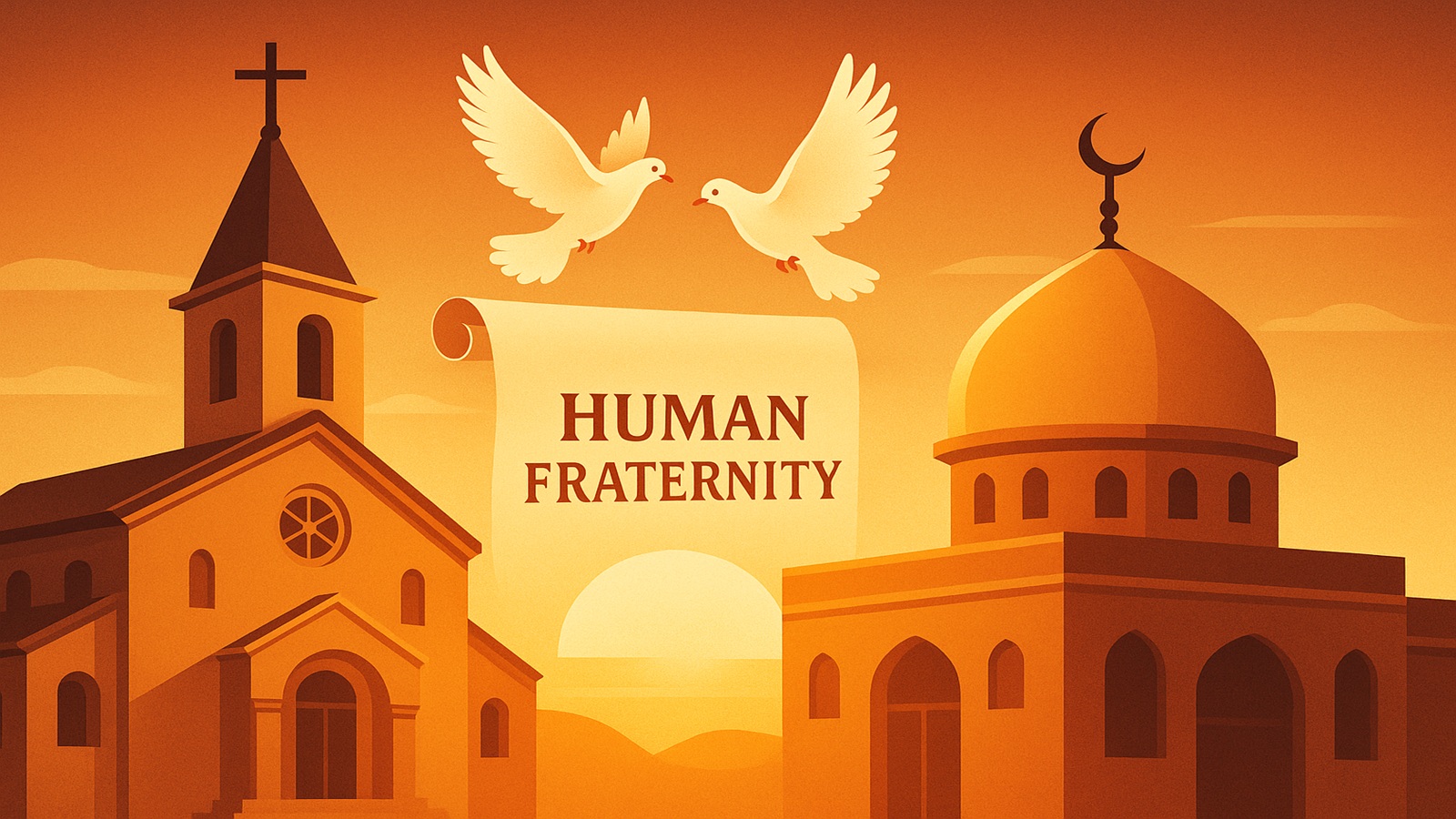
The pinnacle of these efforts came with his historic visit to Abu Dhabi and the signing of the Document on Human Fraternity alongside Grand Imam Ahmed el-Tayeb of al-Azhar on February 4, 2019. The document opens with a profound reflection on faith and divine mercy, affirming that all human beings are encompassed by God’s care, regardless of their beliefs. It then addresses a broad spectrum of global challenges, calling on world leaders and religious figures to approach these problems with unwavering moral and ethical commitment.
It stresses that religious, ethical, and humanitarian dialogue must overcome obstacles and evolve into a path toward greater understanding, cooperation, and peace. Yoannis Lahzi Gaid, the Egyptian-born priest who served as Pope Francis’ secretary during the signing, shared that the document demanded immense courage and sincerity from both leaders.
It is significant that the document’s title and central message revolve around the principle of brotherhood, a value deeply rooted in Islamic tradition. In his subsequent messages and public addresses, Pope Francis frequently cited the document, linking it to the values of neighborliness and hospitality, particularly in the context of welcoming migrants and refugees.
His empathy was evident when he visited Rohingya refugee camps in Bangladesh, describing the denial of human fraternity as a denial of humanity itself.
In the final hours of his life, Pope Francis reportedly called for an end to the wars in Ukraine and Palestine—a plea he may have reiterated during a conversation with the US vice president.
According to statements by the grand imam of al-Azhar and the king of Morocco, Pope Francis was the Christian leader most attuned to Muslim suffering and concerns since the era of the Second Vatican Council. It is hoped that his profound legacy of compassion, dialogue, and solidarity will endure within the venerable institution of the Catholic Church.
Radwan al-Sayed (translated by Asaf Zilberfarb)
