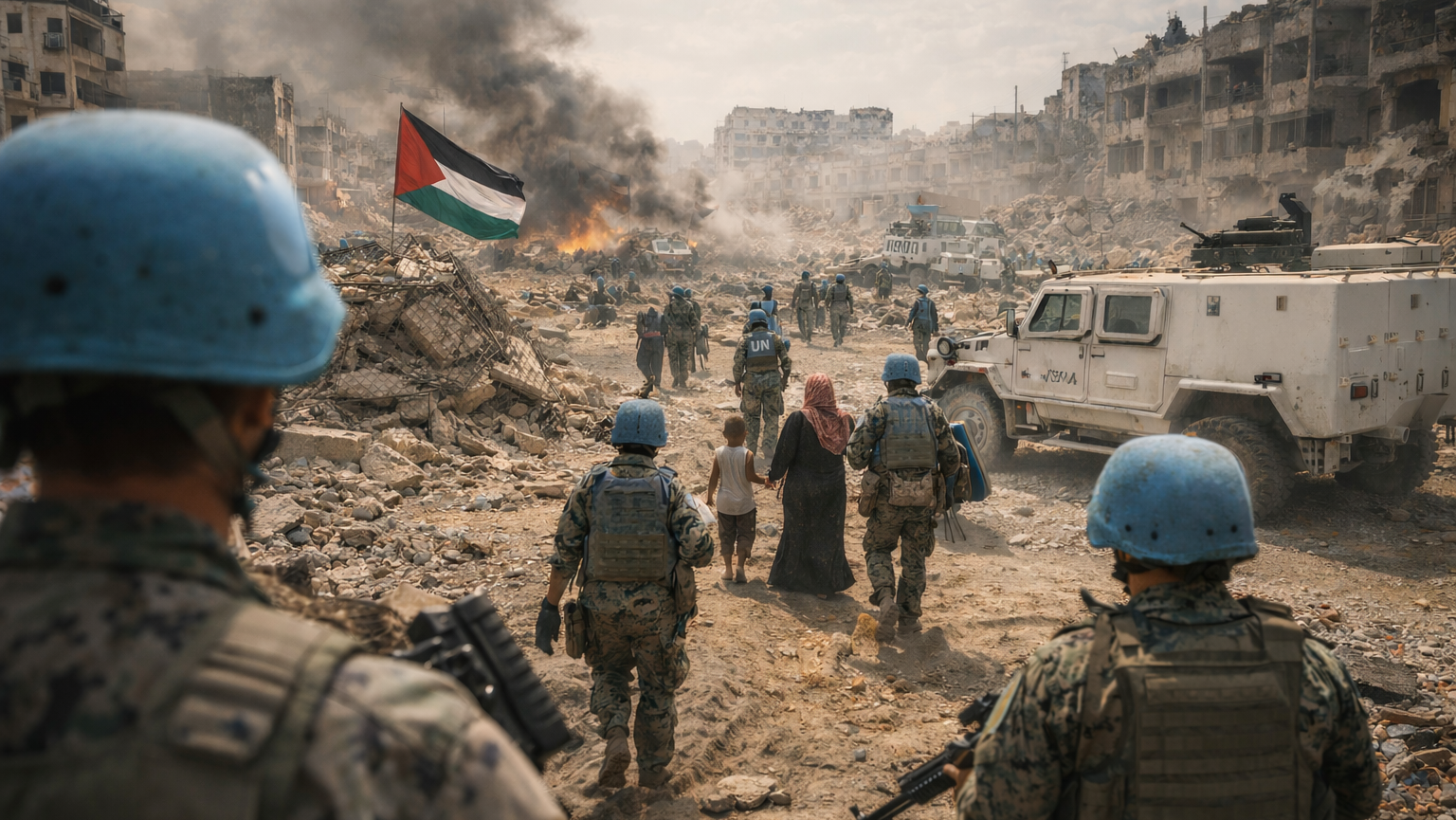
The Calculations of the Peacekeeping Force in Gaza
Akhbar el-Yom, Egypt, December 18
The tragic reality in the Gaza Strip and the deepening humanitarian catastrophe have revived hopes tied to the establishment of an international peacekeeping force to manage the next phase of the ceasefire, break the cycle of violence, and protect civilians, yet these hopes remain entangled in complex political and security calculations involving Netanyahu’s obstacles, Trump’s ambitions, and Hamas’ outright rejection.
The proposal on the table does not envision a conventional force tasked merely with monitoring a ceasefire, but rather a multinational force endowed with broad authorities, including the disarmament and dismantling of military infrastructure in the Gaza Strip, alongside the protection of civilians, the securing of humanitarian aid, support for Palestinian police forces, oversight of any truce agreement, and the implementation of the American plan for managing the transitional phase, contingent on funding from donor states and participating governments.
Benjamin Netanyahu has expressed conditional openness to considering the idea of an international force, while emphasizing that any force entering Gaza must receive Israel’s full approval, a stipulation that reflects Tel Aviv’s insistence on shaping both the form and mandate of such a force and ensuring that it neither threatens Israeli security nor constrains its military freedom of action.
Give the gift of hope
We practice what we preach:
accurate, fearless journalism. But we can't do it alone.
- On the ground in Gaza, Syria, Israel, Egypt, Pakistan, and more
- Our program trained more than 100 journalists
- Calling out fake news and reporting real facts
- On the ground in Gaza, Syria, Israel, Egypt, Pakistan, and more
- Our program trained more than 100 journalists
- Calling out fake news and reporting real facts
Join us.
Support The Media Line. Save democracy.
At the same time, Netanyahu continues to place obstacles in the path of any meaningful political or security role for the Palestinian Authority, raising fears that the international force could ultimately become a security instrument serving the Israeli vision more than safeguarding Palestinian interests. President Donald Trump views the international force as part of a broader framework for what is commonly referred to as “the day after” in Gaza, a framework built on preventing Hamas from regaining power, imposing new security arrangements designed to ensure long-term calm, and establishing an international transitional governance mechanism in coordination with Israel, Egypt, and the Palestinian Authority, in an effort to reshape the postwar reality in the enclave.
Hamas, for its part, rejects these proposals outright, arguing that any international force seeking to disarm it by force constitutes a direct assault on the movement and an attempt to impose political outcomes through military means; it maintains that its weapons are inseparable from the continuation of the occupation and that any discussion of disarmament must be embedded in a comprehensive political settlement that guarantees Palestinian rights, rather than imposed through externally driven security arrangements.
Caught between these competing positions, Palestinians in Gaza confront a stark dilemma: on one hand, there is an urgent need for any mechanism capable of halting the killing, protecting civilians, and opening the door to relief and reconstruction, while on the other, there is widespread concern that a peacekeeping force could evolve into a new form of international trusteeship or serve as a façade for imposing a political and security reality that fails to address the root causes of the conflict.
Ultimately, the idea of a peacekeeping force in Gaza remains suspended between humanitarian necessity and political complexity, carrying promises of protection and stability while colliding with Israeli constraints, American calculations, and Hamas’ rejection, and in the absence of a clear political vision that ends the occupation and confronts the underlying drivers of the conflict, the central question persists: will such a force represent a genuine step toward a lasting truce, or merely another attempt to temporarily manage a crisis destined to endure?
Karam Gabr (translated by Asaf Zilberfarb)
