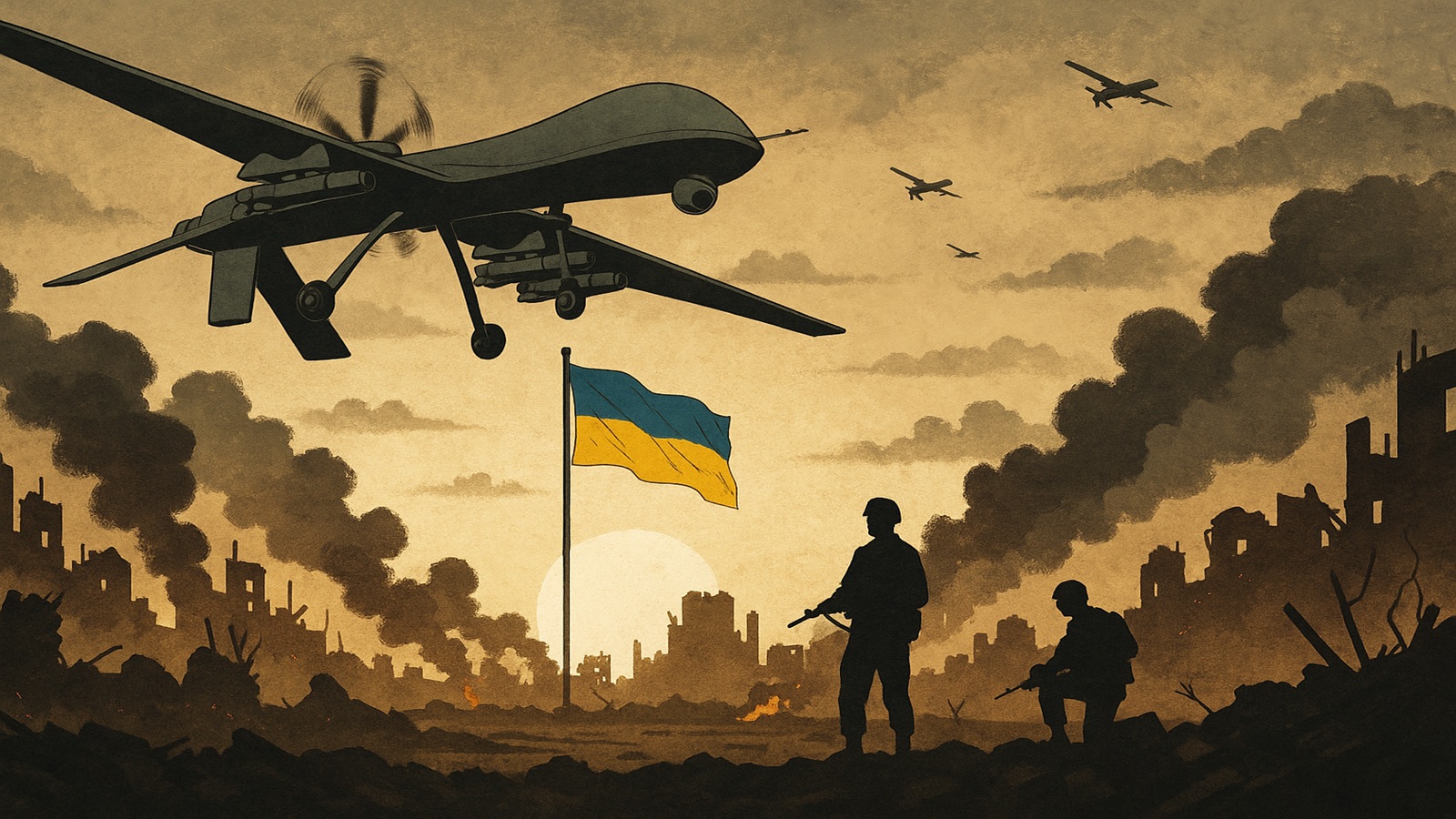
Ukraine: The Next Phase of the War
Asharq Al-Awsat, London, May 9
Students of history understand that starting a war is always easy; the real challenge lies in ending it. The war currently raging in Ukraine is no exception. The fundamental problem is that Russian President Vladimir Putin believed he knew how to end it. More than three years in, it is evident that he, like everyone else, is groping in the dark.
That “everyone else” includes US President Donald Trump, who once claimed he could end the war with a few phone calls to the “Vladimirs”—a reference to both the Russian and Ukrainian presidents, who share the same first name, albeit spelled differently. Meanwhile, global public attention has drifted from the facts on the ground to speculation about what might happen next.
As a result, the latest developments in the war have passed largely unnoticed. The war began in a manner familiar to the pages of history: Russian tanks and armored vehicles rolled into Ukrainian territory in a formation more akin to a parade than an invasion. Many assumed the overwhelming force would swiftly reach Kyiv, secure the surrender of Ukrainian leadership, install a compliant government, and restore a fraternal Slavic union. None of that came to pass. Instead, the war evolved into a classic proxy conflict, pitting NATO countries against Russia, which is tentatively backed by a handful of allies, including Belarus, Iran, and North Korea.
Starting in early 2023, Ukrainian leadership recalibrated its strategy, opting to turn the conflict into a war of attrition. This approach, though painful, has proven effective. Ukrainian forces have slowed the Russian advance, recognizing that the invaders lacked the endurance and resolve of a defending population fighting for its homeland.
Give the gift of hope
We practice what we preach:
accurate, fearless journalism. But we can't do it alone.
- On the ground in Gaza, Syria, Israel, Egypt, Pakistan, and more
- Our program trained more than 100 journalists
- Calling out fake news and reporting real facts
- On the ground in Gaza, Syria, Israel, Egypt, Pakistan, and more
- Our program trained more than 100 journalists
- Calling out fake news and reporting real facts
Join us.
Support The Media Line. Save democracy.
In 2024, Ukraine achieved several major military successes that went largely underreported. With help from the British navy, Ukraine managed to contain the Russian fleet within the Sea of Azov, a minor extension of the Black Sea, by sinking multiple warships.
In a shift toward asymmetric warfare, Ukrainian President Volodymyr Zelenskyy authorized the development of guerrilla tactics merged with advanced military technologies. One such effort, a bold raid on Kursk, fell short of full operational success but sent a chilling message: Russian territory is no longer immune to the reach of the war.
That message was amplified last week, when Ukrainian drones disabled all four of Moscow’s airports for over 14 hours. A similar earlier strike on a major arms manufacturing facility in Bryansk delivered the same warning.
In the face of manpower shortages—shared by both sides—Ukraine has chosen not to rely on foreign mercenaries from Africa or North Korea. Instead, it has invested heavily in building a vast domestic drone production program. Currently producing over 200,000 drones per month, Ukraine is expected to surpass its annual target of 2.5 million units by the end of summer. For comparison, Iran, Russia’s primary drone supplier, produces less than 400,000 drones per year.
Behind this production surge is a transnational effort: hundreds of Western experts from Europe, Canada, and the US are helping Ukraine become a hub of cutting-edge military research. These efforts span from unmanned evacuation vehicles for battlefield medics to AI- and VR-driven tactical simulations. A growing network of startups is also contributing, optimizing combat strategies, resource allocation, and weapon combinations. In a bold move, Ukraine has earmarked a third of its defense budget for technological innovation.
These advances complement traditional guerrilla warfare training. Ukrainians carry historical memory of 1941, when the Nazi war machine swept into their country within two weeks—only to become mired in a drawn-out, losing campaign, undone by relentless partisan resistance. This year could mark a similar chapter, with Ukrainian forces likely to target Russia’s key infrastructure, starting with the $18 billion bridge connecting Crimea to the mainland. As a proving ground for next-generation warfare, Ukraine offers NATO valuable insight and leverage.
With more than half of Russia’s conventional military assets tied down in an unwinnable conflict, there may be a temptation to let the war grind on. But this would ignore the human cost—lives lost daily in what is, by all accounts, an unnecessary, unwanted, and unwinnable war. Reinforcing Ukraine’s self-defense capability should not be seen as a means to perpetuate the conflict, but as the surest path to a fair and lasting peace. President Trump, if he is serious about mediating a ceasefire, must now approach the task with humility and realism, acknowledging that while Putin still holds powerful cards, Zelenskyy is far from empty-handed.
Amir Taheri (translated by Asaf Zilberfarb)
