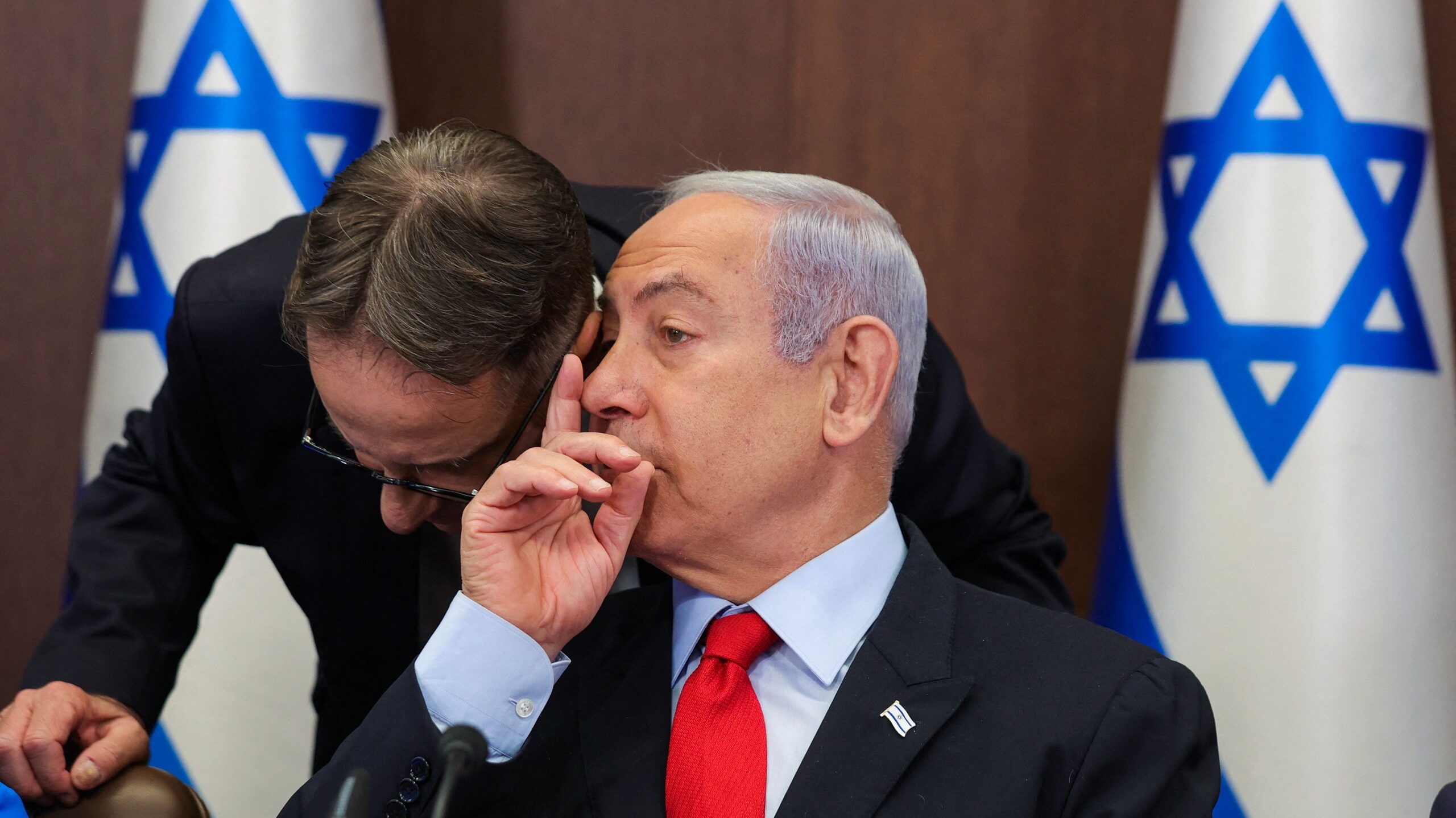
Is Rebellion Brewing Inside Netanyahu’s Likud Party?
The highly contentious judicial reform law passed last week has brought tensions to the surface between the hard-right coalition members determined to steam ahead at all costs and those who believe such laws must have a broad consensus
An internal rebellion may be simmering inside Israeli Prime Minister Benjamin Netanyahu’s Likud party, potentially threatening to bring an end to his seven-month-old far-right governing coalition and raising the specter of a sixth election in less than five years.
At least 10 Likud lawmakers, including several ministers, have publicly or privately expressed objections to further unilateral legislation following last week’s passing of the highly contentious judicial overhaul legislation in the face of mass protests by tens of thousands of Israelis. Defense Minister Yoav Gallant, who called for compromise and concessions on the legislation to appease the opposition and ease the rifts, was even rumored to be considering forming a unity government with the current opposition leaders Yair Lapid and Benny Gantz.
Gallant and Education Minister Yoav Kisch, who also supported making concessions on the legislation, have both said that in the future they will only back legislation that satisfies their demand for consensus.
Likud MK Yuli Edelstein, a former Knesset speaker and current chairman of the Foreign Affairs and Defense Committee, reportedly said in an interview that he would only support bills that have previously been discussed with him and receive his approval. MK Eli Dalal has also stated that he will only support legislation that has wide support.
Agriculture Minister Avi Dichter wrote in a Facebook post that “the sane of both sides” must defeat “the bullies of every side.” MKs David Bitan and Shalom Danino have also reportedly spoken out on the issue.
The divisions have also filtered down to senior public servants, with Education Ministry Director-General Asaf Tzalel, a Kisch appointee, resigning last Friday over the legislation.
“I never belonged to one side or the other and I do not choose a side even today. The education system is stately [i.e., above party politics] and must be kept as such,” he said.
Tens of thousands of Israelis have been protesting in the streets for the past six months over the government’s plans for several new laws, of which the judicial overhaul law is just the first step. That law ends the so-called “reasonableness standard,” the Supreme Court’s authority to review and negate government laws and decisions that it views as unreasonable. The bill was passed last Monday by all 64 coalition members, with the entire 56-member opposition walking out and boycotting it.
Give the gift of hope
We practice what we preach:
accurate, fearless journalism. But we can't do it alone.
- On the ground in Gaza, Syria, Israel, Egypt, Pakistan, and more
- Our program trained more than 100 journalists
- Calling out fake news and reporting real facts
- On the ground in Gaza, Syria, Israel, Egypt, Pakistan, and more
- Our program trained more than 100 journalists
- Calling out fake news and reporting real facts
Join us.
Support The Media Line. Save democracy.


As the turmoil ahead of the Knesset vote grew and protesters massed in Jerusalem, several polls found that Netanyahu’s and the government’s approval ratings were slipping over the issue. One poll gave Netanyahu only a 38% approval rating, while another found that if an election were held now, the number of seats held by the current governing coalition would fall from 64 to 52 or 53, a minority. Even in the pro-Netanyahu newspaper Israel Hayom, a poll found that 64% of the Israeli public felt the government’s handling of the judicial reform issue was “negative.”
That poll also found that only 29% of the public prefers the current right-wing government, while 27% would like to see a center-left government and some 35% would like to see a national unity government, in which the left-wing parties join the government.
However, Lapid said this week that while he was prepared to join a coalition with the Likud party, he would not do so as long as Netanyahu was there. Gantz, too, has been burned by Netanyahu in the past and has said he will not join him in any coalition.
Netanyahu himself said this week that the Knesset’s summer break should be used to “reach consensus,” but made no mention of the overhaul.
Last week, asked whether he would abide by the court’s decision if it overruled the judicial reform law, Netanyahu said that “everyone is subject to the rule of law,” but refused to commit clearly to doing so. Several political watchdog groups have appealed to the Supreme Court to strike down the law.
“Everyone wants to reach agreements and should make every effort to do so,” the Likud party said in a statement.
“However, do not give veto power to the opposition. Contrary to the opinion of many, the prime minister passed an amendment to the reasonableness standard, and he also called for a halt until November in order to reach agreements. Prime Minister Netanyahu will work with all his might to lead the continuation of legislation with broad agreements, as much as possible.”
Some Likud members dismissed the internal disagreements inside their party and in the coalition.
Culture and Sports Minister Miki Zohar pushed back against reports of an alleged “rebellion” in the Likud party.
“I suggest that all the commentators talking about a rebellion in Likud cool their enthusiasm. They have been talking about a rebellion for years, and in the meantime, Likud stays united,” Zohar reportedly said in Sunday’s cabinet meeting.
Transportation Minister Miri Regev, a Likudnik, said she and Finance Minister Bezalel Smotrich, head of the Religious Zionism party, had their disagreements, but that ultimately “our struggles bear fruit for the State of Israel.”
Some protesters said the reports of internal division in the Likud party were nothing but a trick by Netanyahu, a veteran politician.
“The ‘rebellion in the Likud’ spin will not succeed in putting the struggle to sleep,” the Kaplan Force protest movement said in a statement.
“The baseless performances by Likud MKs as if they are rebelling is only a smokescreen, whose entire function is to buy dictator Netanyahu enough quiet to complete his coup.”
As well as the protests within Israel, Netanyahu has also been under tremendous pressure from outside over the legislation, with mounting criticism from the United States, Israel’s historic ally, and warnings from credit rating agencies that could deter investors. The shekel has fallen, as well, as a result of the turmoil, with widespread ramifications for the Israeli economy.
