
Iran, Somaliland, Venezuela, Israel: Don’t
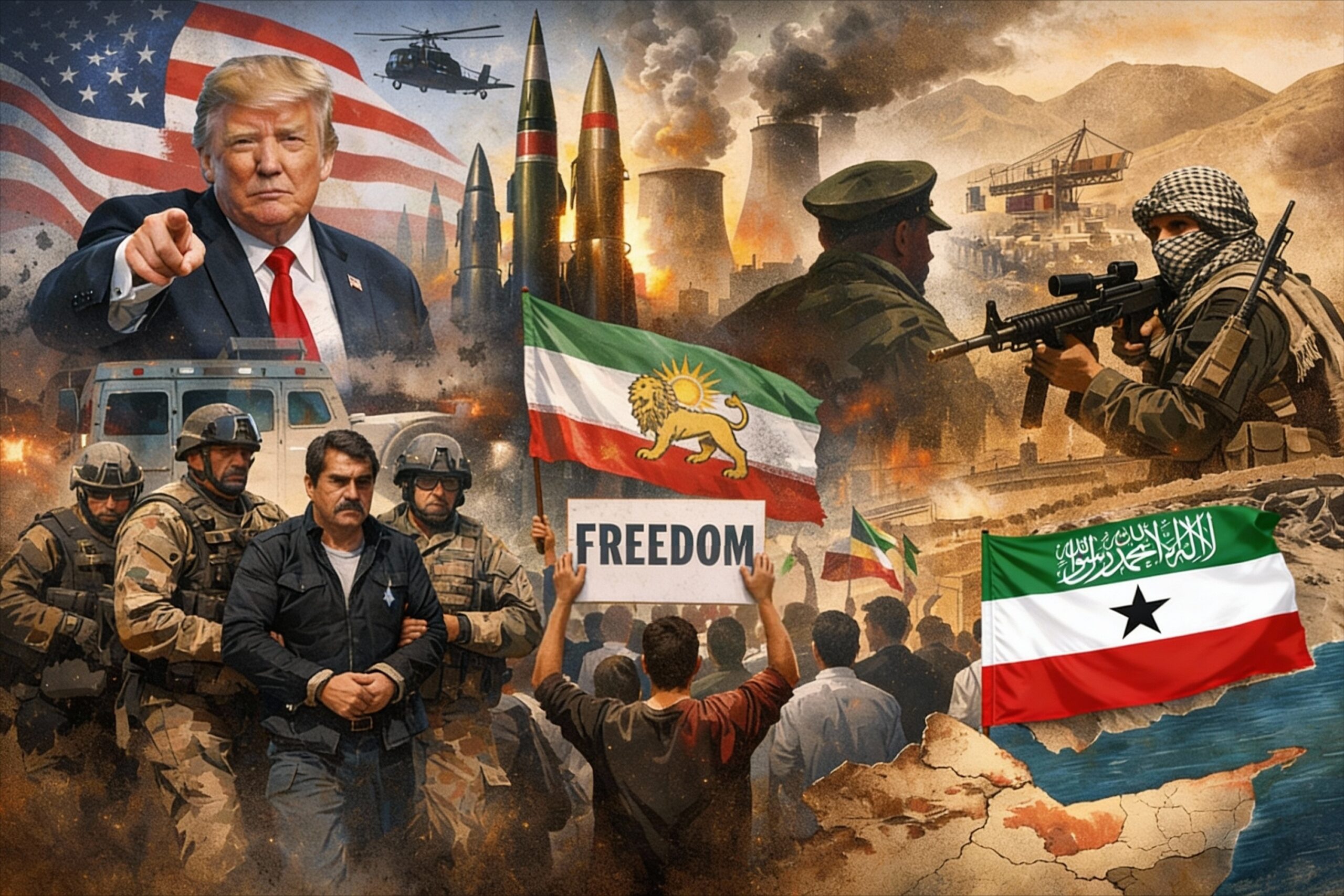
Just when it looked like Israel had Iran in its gunsights after staking out a strategic claim in Somaliland across from Yemen and its troublesome Houthis, along came the US president and reinforced the gung-ho militarists by capturing Venezuela’s errant president.
So what happens now? To some, it’s clear: Either President Donald Trump carries out his threat to attack Iran after regime forces shot and killed demonstrators, or Israel strikes, responding to signs that Iran is rebuilding its ballistic missile force and nuclear program.
At first glance, it looks straightforward: good guys and bad guys. Get the bad guys out of power in Iran and let the good guys in—just like Venezuela. But it’s not that simple.
Drawing on my experience covering Egypt during the Arab Spring from 2011 to 2013, I see some familiar warning signs.
It started out so promising. Huge demonstrations in Cairo’s Tahrir Square brought down the 29-year rule of strongman Hosni Mubarak in just 18 days. The military stepped in to take temporary control while elections were being set up.

Tahrir Square, Cairo, Egypt, 2011. (Courtesy Mark Lavie)
Dozens of protest groups marched in the demonstrations. They communicated over social media, lending their protests the nickname “Facebook revolution.” It seemed trendy and cool.
Then came the election campaign. That’s where it fell apart.
Instead of uniting, the protest groups all ran their separate ways, hopelessly dividing their votes. The fundamentalist Muslim Brotherhood won both parliament and the presidency.
The liberal Egyptian protesters were incapable of compromising with each other to field agreed-upon candidates who could win elections. Add to that the fact that, at the time, fewer than a third of Egypt’s people had access to the internet, so the “Facebook revolution” didn’t reach them at all.
Give the gift of hope
We practice what we preach:
accurate, fearless journalism. But we can't do it alone.
- On the ground in Gaza, Syria, Israel, Egypt, Pakistan, and more
- Our program trained more than 100 journalists
- Calling out fake news and reporting real facts
- On the ground in Gaza, Syria, Israel, Egypt, Pakistan, and more
- Our program trained more than 100 journalists
- Calling out fake news and reporting real facts
Join us.
Support The Media Line. Save democracy.
In the end, the Muslim Brotherhood was unable to govern, and the Egyptian military—always the nation’s strongest element—stepped in and took over. Through the new president, “retired general” Abdel Fattah el-Sisi, it is still in power 15 years later.
Granted, Iran is different. Its people are better educated, and nearly everyone is connected to the internet. But there is no evidence that the many elements of today’s protesters are working together on a “day-after” scenario.
More likely, if the regime of the ayatollahs falls, the military will step in. The cruel, repressive military is the power behind the throne in Iran, as it was in Egypt. There’s talk of the son of the Shah, deposed by Muslim extremists in 1979, coming home and setting up a Western-oriented regime that’s friendly to Israel. But it doesn’t work that way in this region. Any new regime is likely to be just as hostile to Israel and the West. All it would need is an excuse.
That’s why Israel should sit this one out, or—repurposing then-US President Joe Biden’s advice—“Don’t.”
The best way for Israel to ensure the failure of whatever uprising is brewing in Iran is to endorse the protesters and/or bomb the country again. That would taint the protests and unite the country to fight the “Zionist aggressors”—an Iranian version of Israel’s “Together we will win” slogan.
With that in mind, what can Israel do?
- Impose a gag order on its politicians, like extremist minister Itamar Ben Gvir, who posted a message to Iranians in their own language that read, “The dictator must fall.” That gives the ayatollahs—and whoever replaces them—the unifying anti-Israel rallying cry they need.
مردم ایران شایستهٔ زندگی آزاد، رها از دیکتاتور قاتل، خامنهای هستند. ما در کنار شما هستیم!#مرگ_بر_دیکتاتور#اعتراضات_سراسری pic.twitter.com/YbsxkFEBgA
— איתמר בן גביר (@itamarbengvir) January 2, 2026
- Keep its bombers in their hangars and wait to see how this all plays out.
- Move from military action to diplomacy. Recognition of Somaliland is a good start.
Somaliland is usually described as a self-declared state that unilaterally broke away from the mothership, Somalia. One of them is a failed state with terrorist gangs, Islamist murderers, warring militias, drugs, and crime. The other is a functioning democracy with a stable government and a developing economy.
From all the world’s blather about “territorial integrity” and “Muslim unity,” you’d think Somalia has a history like Israel’s stretching back 3,000 years. In fact, the nation was carved out artificially from 19th-century European colonial holdings. After decades of chaos, internal warfare, and genocide against its main Muslim tribe, Somaliland broke away in 1991.
Yes, Somaliland is the stable, democratic one, and Somalia is the failed state. Israel has had quiet relations with Somaliland for some time. Now, it has recognized the country, triggering knee-jerk criticism not only from Arab nations but also, inexplicably, from Europe.
A look at the map underlines the significance and the potential. Somaliland sits on the coast of the Gulf of Aden, just 200 kilometers from Yemen and its Houthis, Iran’s proxies. If the Houthis start firing missiles at Israel again, the potential now exists for quicker and easier retaliation than from Israel itself, 1,200 kilometers away.
If Westerners and Israel’s Arab allies wake up and realize that Iran is the problem, not Israel, they’ll see this could be the first step toward partially surrounding Iran with an alliance of West-friendly nations, including Azerbaijan, Turkmenistan, and someday even Iraq. That would send a much clearer deterrent message to Iran than social media rants by the likes of Ben Gvir.
The hope is that the world’s moaning and groaning over Israel’s courageous and overdue recognition of Somaliland will be quickly forgotten and that nations will take logical and justifiable steps toward Somaliland—with Israel leading the way.
