World Zionist Congress Missed a Historic Opportunity
This week, a deeply meaningful resolution—“Strengthening Relations with Christian Zionist Allies”—was presented to the World Zionist Congress by Israel365, a US-based Zionist advocacy organization whose mission is to mobilize Jewish and Christian-Zionist communities in support of Israel.
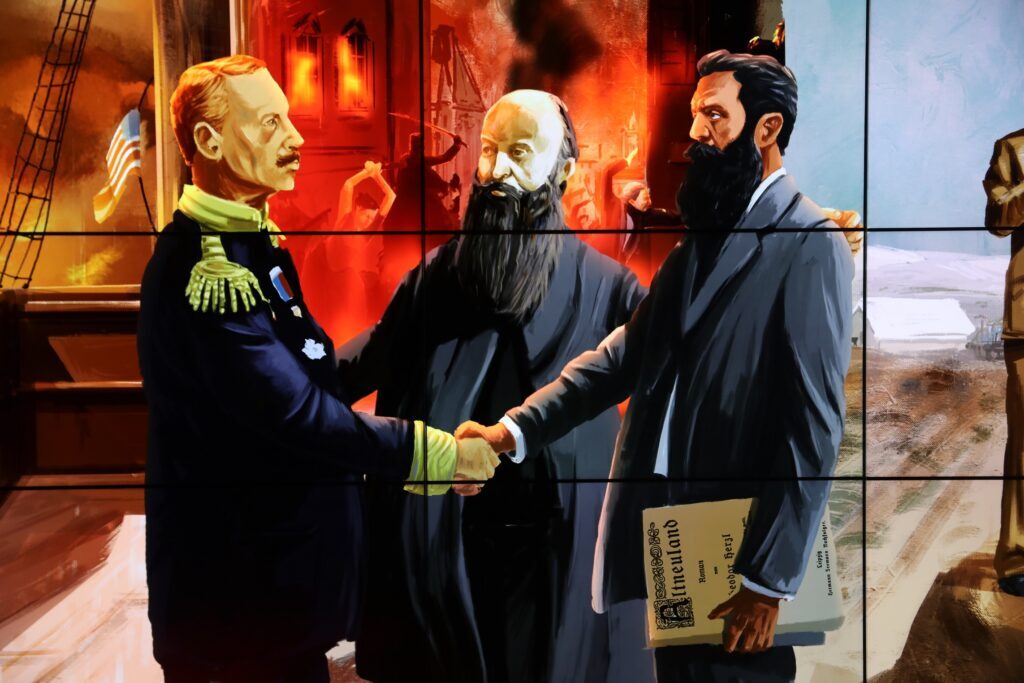
When Theodor Herzl convened the First Zionist Congress in Basel in August 1897, there were 10 Christian attendees, among them Rev. William Hechler, Herzl’s devoted Christian ally, and Henry Dunant, founder of the Red Cross. Their presence was a visible symbol of Herzl’s spirit: Jews and Christians working together toward the restoration of Israel.
After the convening of what Herzl called “the constituent assembly of the Jewish nation,” he wrote in his diary: “At Basel, I founded the Jewish state. If I said this out loud today, I would be greeted by universal laughter. In five years, perhaps, and certainly in 50 years, everyone will perceive it.” Fifty years later, in 1947, the United Nations voted to partition the territory of the British Mandate, paving the way for the rebirth of the modern State of Israel. Herzl’s prophecy had been fulfilled almost to the year.
Working in tandem, Herzl and Rev. Hechler pressed their case to the highest levels of government. Though Kaiser Wilhelm II rejected their proposal, Herzl’s portrayal in the media as the “leader of the Zionists” drew the attention of British Christian statesmen, who ultimately advanced the cause. The result was the 1917 Balfour Declaration—His Majesty’s Government proclaiming its support for a Jewish national home in Palestine—driven in part by faith-based convictions of Christian Zionists who saw the hand of God in Israel’s restoration.
Give the gift of hope
We practice what we preach:
accurate, fearless journalism. But we can't do it alone.
- On the ground in Gaza, Syria, Israel, Egypt, Pakistan, and more
- Our program trained more than 100 journalists
- Calling out fake news and reporting real facts
- On the ground in Gaza, Syria, Israel, Egypt, Pakistan, and more
- Our program trained more than 100 journalists
- Calling out fake news and reporting real facts
Join us.
Support The Media Line. Save democracy.

The friendship between Winston Churchill and Chaim Weizmann helped propel this change. Churchill asked Weizmann to develop a new acetone–butanol–ethanol fermentation process vital to Britain’s munitions industry during World War I. When Arthur Balfour asked Weizmann, “What can we do to repay you for this?” Weizmann answered simply: “Give my people a homeland.”
Half a century later, the warm friendship between President Harry Truman and his Jewish business partner Eddie Jacobson helped persuade the US to recognize the State of Israel, just 11 minutes after David Ben-Gurion declared independence in 1948.
In our own time, the steadfast support of evangelical Christians gave courage and political backing to President Donald Trump when he recognized Jerusalem as Israel’s eternal capital, fulfilling another long-awaited biblical promise.
The Israel365 resolution carried that same spirit, seeking to formally recognize and deepen the historic and spiritual bond between the Jewish people and steadfast Christian Zionist allies around the world. Sadly, the resolution did not pass.
Herzl dreamed of a Zionist movement bold enough to unite the righteous among the nations with the people of Israel in common purpose. The Israel365 resolution aimed to continue that partnership—formally recognizing and strengthening ties between the Jewish people and faithful Christian Zionist allies. Given the immense love and support Christian Zionists continue to show for Israel, particularly in an age of rising antisemitism and anti-Israel sentiment, the rejection of this resolution is both deeply disappointing and strategically short-sighted.
As Israel’s enemies work tirelessly to weaken global support, this was a chance for the Zionist movement to embrace those who bless Israel (Genesis 12:3) and to build a future rooted in shared values and mutual respect. Yet the World Zionist Congress failed to pass it. The outcome departs from Herzl’s spirit: he believed great dreams require great courage, and that the Jewish people’s return to their land would inspire the righteous among the nations to act.
Though the resolution did not pass, its vision remains alive. We should continue to build bridges between Jews and Christians, honoring the shared faith, friendship, and common purpose that have shaped Israel’s story from Herzl to our time: “If you will it, it is no dream.”
