‘You Cannot Build a State From the Outside’: Why Wael Al-Khalidi Came Back to Damascus
Leaving exile to invest in jobs and production reflects a broader wager that Syria’s post-sanctions moment must be shaped from within rather than observed from abroad
[DAMASCUS] Syria has entered a pivotal phase in its economic history following the official announcement that the United States has repealed sanctions imposed under what was known as the Caesar Act. The move is being described as the most significant in years, easing financial isolation and opening the door to renewed foreign investment. More than a legal step, the repeal signals a political and economic shift that has put Syria back on the regional and international radar after years largely cut off from global markets.
Economic expert Samir Tawil told The Media Line that Syria’s needs go beyond injecting capital. He said the country requires long-term investments that do not hinge on quick profits but instead build a sustainable, productive base, alongside the transfer of technical and administrative expertise, modernization of the banking sector, and renewed trust in the legal environment. Estimates indicate the Syrian economy needs to create at least 500,000 new jobs over the next few years to reduce unemployment and absorb new entrants to the labor market.
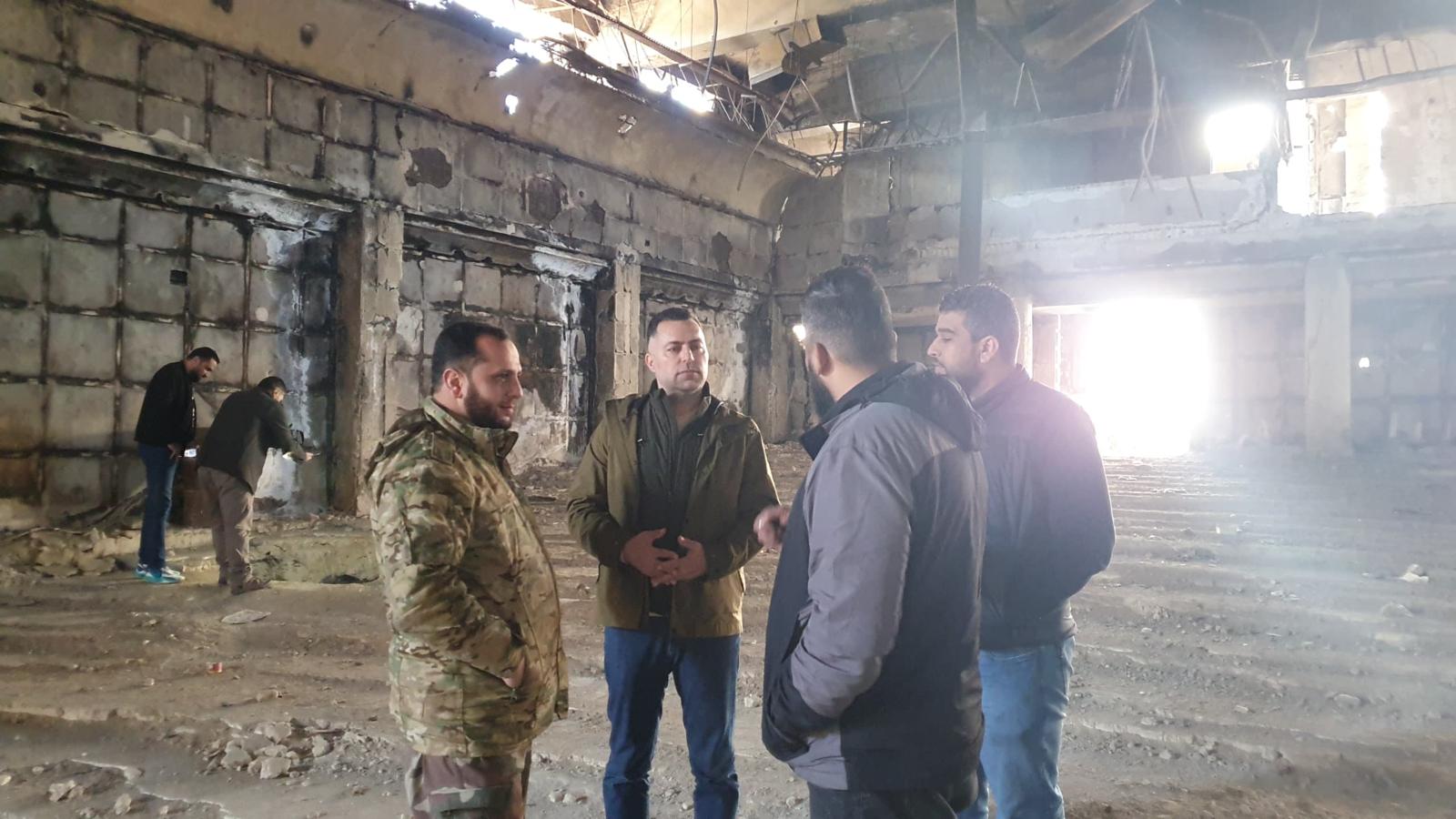
Against that backdrop, the experiences of some Syrian business figures who have returned to work inside the country in the post-sanctions period have drawn attention. One is businessman Wael Abdul Wahab Al-Khalidi, whose return to Damascus reflects the complicated trajectory of a broad segment of Syrians who spent years living outside their homeland.
Born in Damascus to a socially and economically prominent family, Al-Khalidi did not follow a predictable path. During the era of Hafez Assad, and later under Bashar Assad, he faced punitive measures and political and security restrictions that pushed him out of public life and eventually forced him to leave Syria. His departure, he says, was not voluntary but the culmination of bans and persecution that left him among thousands of Syrians stranded abroad without a viable route home.
He moved through several countries before settling in Egypt and later France, where he rebuilt his professional life and worked in trade, investment, and media as early as 2004. Despite years away, his connection to Syria remained strong through close attention to political and economic developments and ties with the Syrian diaspora, which, during the war and sanctions, built parallel economic and media networks outside the country.
Al-Khalidi’s return to Damascus in the early days after the fall of the Assad regime was neither emotional nor symbolic, but a calculated decision grounded in his reading of how the country had changed. It followed a long rupture driven more by politics than geography, as many Syrians sensed a new, fragile chapter had begun.
Give the gift of hope
We practice what we preach:
accurate, fearless journalism. But we can't do it alone.
- On the ground in Gaza, Syria, Israel, Egypt, Pakistan, and more
- Our program trained more than 100 journalists
- Calling out fake news and reporting real facts
- On the ground in Gaza, Syria, Israel, Egypt, Pakistan, and more
- Our program trained more than 100 journalists
- Calling out fake news and reporting real facts
Join us.
Support The Media Line. Save democracy.


Speaking to The Media Line, Al-Khalidi said that mutual exclusion, no matter how long it lasts, does not build a state, and that those who remain outside the equation cannot influence its course. He said his decision to return marked a shift from observer to actor and from political rhetoric to direct economic engagement, with reviving production and creating jobs as what he considers the most realistic route to stability.
He stressed that reconstruction does not only mean rebuilding infrastructure, but also restoring trust between the state and the private sector and shaping an investment environment based on transparency and long-term partnership. He also emphasized that the return of Syrian and Arab capital, alongside the expertise of Syrians abroad, is a key pillar of this phase. He pointed to housing, energy, food industries, and modern agriculture as sectors that can create tens of thousands of jobs and help rebuild a middle class badly damaged over the past years.
Enacted in 2019, the Caesar Act imposed sweeping restrictions on the Syrian economy, targeting productive and financial sectors and imposing penalties on foreign companies or entities that dealt with the Syrian state or participated in projects within the country. Widely cited economic estimates say the sanctions, along with the war, helped shrink Syria’s gross domestic product by more than 60% from pre-2011 levels, drive exports down to less than one-third of their previous value, and push unemployment and poverty to record highs.
The lifting of these sanctions in late 2025 has reopened a cautious window of hope. Preliminary economic analyses suggest that removing US restrictions could support a gradual rise in economic activity of 10% to 15% in the early years, provided it is accompanied by relative stability and internal reforms. The decision is also expected to partially reconnect Syria to the global financial system, a crucial condition for trade, investment, and cross-border transfers.
Specialists argue that Syria offers a fertile investment landscape in one specific sense: not because the market is ready, but because the needs are vast. International estimates put reconstruction costs at $300 billion to $400 billion, including rebuilding destroyed infrastructure, rehabilitating cities, and restoring the energy, water, transportation, and communications sectors. Unofficial data suggest that more than half of the electricity and water networks and about 40% of major roads suffered partial or total damage in recent years.
Even as that optimism grows, questions persist about what Syria can realistically offer investors. Investment advisers say the market has advantages that are hard to dismiss: comparatively low labor costs, a domestic market of more than 18 million consumers, and a strategic location linking Asia, Europe, and the Arab world. If stability holds, they argue, Syria could again serve as a gateway for regional trade.
Syrian businessman Mohammad Asaad told The Media Line that early entry into the Syrian market gives investors a meaningful advantage, given the current lack of extensive foreign competition. He said housing, renewable energy, food industries, pharmaceuticals, and modern agriculture rank among the most attractive sectors because local demand remains unmet and returns could be strong over the medium term.
Beyond profits, investors can shape what Syria becomes next. New projects are expected to create jobs, spur production, and bring technology and expertise into the country. Economic development experts estimate that every $1 billion invested in productive and infrastructure projects could generate 20,000 to 40,000 direct and indirect jobs, with immediate effects on social and economic stability.
Economic expert Hassan Qassem told The Media Line that “investment is a tool of stability as much as it is a tool of growth,” arguing that restarting the economic cycle reduces poverty and migration and helps rebuild a middle class that was severely eroded over the past years. He added that foreign investment, if properly directed, can improve the quality of goods and services, raise production efficiency, and enhance the competitiveness of the Syrian economy.
Still, the obstacles are substantial. Weak infrastructure, complex administrative procedures, and the need for deep legal reforms could slow investment, alongside concerns about profit transfers, judicial independence, and property rights protections. Analysts warn that any slide in security or political stability could undermine market confidence, even if opportunities look compelling on paper.
The repeal of the Caesar Act marks the start of a new path, not the finish line. The investment door has opened, but turning that opening into durable growth will depend on Syria’s ability to offer a stable, transparent business environment—and on whether investors are prepared to commit to long-term partnerships that balance returns with rebuilding an economy shattered by war and isolation. Between cautious optimism and postponed bets, Syria now faces a straightforward test: translating political change into sustainable economic revival.
