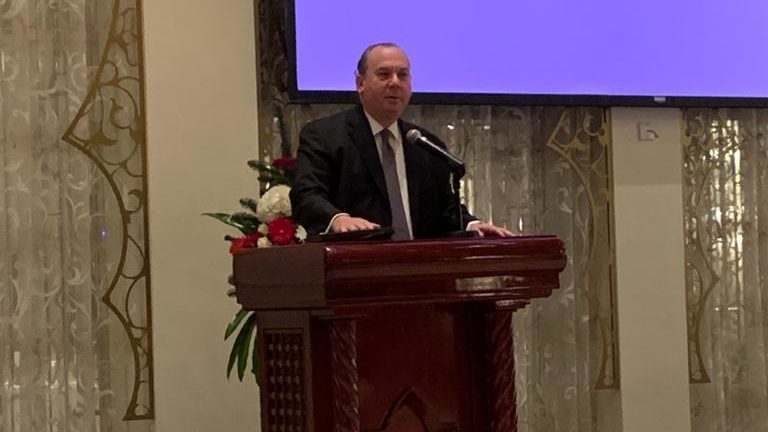
‘Because of the Existence of Israel, There Has Never Been a Better Time To Be a Jew,’ Rabbi Schneier Tells TML
Rabbi Marc Schneier, a longtime figure in Jewish–Muslim relations, warns of rising global antisemitism and shifting New York demographics, yet remains cautiously optimistic about growing normalization efforts with the Arab world
“There has never been a time, a greater time, a better time to be a Jew than today because of the State of Israel,” Rabbi Marc Schneier said in a recent interview, insisting that even with rising antisemitism and anti-Israel rhetoric, the existence and strength of Israel have fundamentally transformed Jewish vulnerability into power and dignity. He framed the present moment as a historic break with centuries of Jewish powerlessness precisely because there is now a sovereign Jewish state.
He argued that Israel has broken with 2,000 years of Jewish history defined by exile, persecution, and powerlessness—from Crusades and inquisitions to pogroms and the Holocaust—and has instead created an era in which Jews have a sovereign state, a formidable military, and unprecedented alliances, including with parts of the Muslim world. Schneier described antisemitism as a constant “cancer” that has not disappeared, but said that Israel’s military successes, global partnerships, and economic and technological achievements mean Jews are no longer at the mercy of hostile forces in the way they once were.
Schneier is an American Orthodox rabbi, founding rabbi of The Hampton Synagogue in Westhampton Beach, New York, and president of the Foundation for Ethnic Understanding, an organization he created in 1989 to strengthen relations between Jews and other ethnic and faith communities, particularly Black–Jewish and Muslim–Jewish relations.
Over the past three decades, he has become a prominent figure in interfaith diplomacy, advising Gulf and other Muslim-majority governments, keynoting international conferences on coexistence, and helping to advance Jewish–Muslim dialogue from the United States to the Middle East, Europe, and Central Asia. He sat down with The Media Line to discuss antisemitism, Israel’s changing place in the world, and the political shifts reshaping Jewish life in New York and beyond.
In a wide-ranging conversation, Schneier began by sharply criticizing New York’s mayor-elect, Zohran Mamdani, whom he described as “clearly anti-Israel in terms of his ideology, his rhetoric, his diatribe,” and he recounted a tense recent exchange about antisemitism and Israel’s legitimacy.
According to Schneier, Mamdani called him to condemn a pro-Palestinian protest that had turned adversarial outside Park East Synagogue, the Upper East Side congregation headed for the past 63 years by his father, Rabbi Arthur Schneier. The rabbi said he appreciated the outreach but found the mayor-elect’s statement deeply insufficient, telling him, “Well, I think your condemnation was somewhat half-baked,” because it came with a caveat accusing the synagogue of misusing its sacred space by hosting the Nefesh [B’Nefesh] aliyah organization.
He said he pushed back forcefully, accusing the mayor-elect of being disconnected both from New York Jews and from the broader Muslim world and arguing that many Arab and Muslim-majority countries back some form of a two-state solution that includes Israel. What troubled him most, he said, was that “‘And here you, Mr. Mamdani, you refuse to acknowledge Israel’s right to exist as a Jewish state.’”
Schneier noted that he didn’t think anyone had ever challenged Mamdani from an Islamic perspective before, “which I could probably uniquely do because of who I am in that part of the world. But you need to understand that this train has left the station without him.”
The rabbi said he cited Saudi Arabia, Indonesia, Azerbaijan, the United Arab Emirates (UAE), Bahrain, Morocco, Kazakhstan, and others as Muslim-majority states that have embraced a two-state framework. He also warned the mayor-elect that demonizing Israel with terms such as “apartheid,” “genocide,” and “occupation” has real-world consequences for Jews in New York, adding, ‘‘It’s somewhat ironic that to temper a newly elected mayor of the second largest Jewish population in the world, that I have to cite other Arab and Muslim leaders as an example for him to follow.”
It’s somewhat ironic that to temper a newly elected mayor of the second largest Jewish population in the world, that I have to cite other Arab and Muslim leaders as an example for him to follow.
Pressed on how Mamdani responded to being challenged from an Islamic perspective, Schneier said he extended an invitation for the mayor-elect to travel with him to Azerbaijan or, failing that, to meet ambassadors of Arab and Muslim states in New York. Mamdani did not commit, Schneier recalled, instead telling him, “Rabbi, you have my cell number, let’s continue the conversation.” Schneier described that response as “very, very troublesome, and it’s very, very upsetting.”
Schneier tied the mayor’s election to larger demographic and political shifts that, he argued, have reduced Jewish electoral influence in New York City. “But as I told Andrew Cuomo, who’s a very, very, very dear friend of mine, the morning of the election result, you know, that he lost, … Moses could have run for mayor, and he would have lost. The bottom line is that you can’t overcome the changing demographics of New York City. The New York Jewish community is not what it used to be in terms of population, in terms of having that voting leverage that we used to have.”
The rabbi noted that New York City has changed and said that the Jewish community would need to be very creative in reaching out to other ethnicities and other faith communities to find and identify either elected officials or candidates who really understand the sensitivities of the Jewish community.
Turning to the subject of antisemitism, Schneier acknowledged growing fear among Jews who are hiding visible symbols of their identity and pointed to vandalism of mezuzot in both New York and Canada. Yet he strongly rejected analogies to the 1930s and the eve of the Holocaust. “Well, let me make something perfectly clear. This is not the 1930s. 2025 is not 1938.
It’s not the eve of Kristallnacht for one reason, and one reason only, because of the State of Israel. It’s the State of Israel that has restored the honor and the dignity of the Jewish people. That’s why you cannot compare this time to any other time in the last 2,000 years.
“It’s not the eve of Kristallnacht for one reason, and one reason only, because of the State of Israel. It’s the State of Israel that has restored the honor and the dignity of the Jewish people. That’s why you cannot compare this time to any other time in the last 2,000 years.
“I mean, the last 2,000 years has been the story of the exile, Crusades, inquisitions, pogroms, the Holocaust, but at the same time, there’s never been a greater time to be alive as a Jew more than today. Yes, we hear of instances of people removing their kippot or covering up a mezuzah, but it is not really endemic as to where the Jewish community of New York or America is today. I think it’s very dangerous for others to suggest that we are seeing the 1930s again, because it’s not,” he said.
At the same time, Schneier stressed what he sees as a vital conceptual line: that opposition to Zionism cannot be separated from antisemitism. “At the same time, I feel a great responsibility as an American Jewish leader never to allow the bifurcation of Israel and Judaism, breaking out anti-Zionism from antisemitism. To me, it’s clear. Anti-Zionism is antisemitism.
“I have delivered that message throughout the Arab and the Muslim world. Never thought I’d have to deliver that message to the mayor of the city of New York, but if I have to, so be it,” he continued.
Looking ahead, Schneier predicted that the city’s new political reality will prompt some number of Jews to relocate, even if not in a mass exodus, and said he has already begun planning for that possibility. “You need to acknowledge a reality that we [will] have a mayor who is a product of his father’s anti-Israel ideology. We’re going to have to deal with it. I can’t project.
To me, it’s clear. Anti-Zionism is antisemitism
“I’m not a prophet. I do believe there will be Jews that will leave New York. I don’t believe there will be a mass exodus.
Give the gift of hope
We practice what we preach:
accurate, fearless journalism. But we can't do it alone.
- On the ground in Gaza, Syria, Israel, Egypt, Pakistan, and more
- Our program trained more than 100 journalists
- Calling out fake news and reporting real facts
- On the ground in Gaza, Syria, Israel, Egypt, Pakistan, and more
- Our program trained more than 100 journalists
- Calling out fake news and reporting real facts
Join us.
Support The Media Line. Save democracy.
“The morning of the election, it was in The New York Times, I announced I’m building a day school in the Hamptons in anticipation of the hundreds and thousands of Jewish families that I believe will be moving out to the Hamptons and to Suffolk County. At the same time, our new controller is Jewish. It looks like the head of the city council, Julie Menon, who has the votes, is the granddaughter of a Holocaust survivor.
“Let’s see what happens. We have to be vigilant. I come from a very unique perspective.
“I know Mamdani heard me. He had never been challenged on the Israel issue from an Islamic perspective, which I thought was a very productive conversation in terms of scoring points,” he said.
Schneier cast antisemitism—whether from the “woke” left, the Christian right, or Islamist actors—as a constant “cancer” in Jewish history, but one he believes is rooted in jealousy of Jewish and Israeli success. “I feel very strongly that antisemitism is rooted in jealousy. I think our success as a people is so out of proportion in terms of where we should be.
“I think the extraordinary success of the State of Israel is so out of proportion. You look at every major survey, top 10 economics, military, happiness, science, medicine. Israel is competing with the major superpowers.
“People are jealous. But you know what? I’d rather people be jealous, which means that I’m successful, that I matter,” he added.
He emphasized that he could not compare this to any other period because there was no other period in which the State of Israel existed. “We’ve had, in the diasporas, very prosperous, out of proportion, successful Jewish communities without a State of Israel. And the end result was not very pretty,” he said.
“It’s a different time. I mean, what Israel achieved in winning a war on seven fronts in the last two years is just so extraordinary. It’s just simply remarkable.”
“No wonder the world is jealous. That’s human nature. Whether it’s as a nation, whether in your profession, your personal life, very few people are well-wishers.
“People are jealous. But that’s usually the flip side to being successful and to being in a position where you matter. I’d rather be successful.
“I’d rather matter. I love people to be jealous,” he concluded.
Schneier, who had just returned from Azerbaijan, described the Shiite-majority country as Israel’s “greatest ally” in the Muslim world and a beacon of coexistence. “Well, Azerbaijan is unique, I believe, of the 57 Muslim nations in the world. It’s Israel’s greatest ally, friend, and supporter. Azerbaijan checks off all the boxes, number one, in terms of support of Israel.
“Number two, its reverence for its indigenous Jewish community, which is close to 30,000 members today. And Azerbaijan, under President Aliyev’s leadership, has become the great beacon of inter-religious, intercultural dialogue, cooperation and coexistence in the greater Muslim world.”
He argued that talk of Azerbaijan “joining” the Abraham Accords misunderstands the depth and longevity of its relationship with Israel. “For Azerbaijan, and I’ve spoken with President Aliyev about this, for Azerbaijan to join the Abraham Accords is somewhat insulting, but even somewhat comical.
“Azerbaijan, if it were to join, there should be an asterisk because it’s enjoyed full diplomatic relations with Israel for over 30 years. It’s one of Israel’s great trade partners. 30% of Israel’s oil comes from Azerbaijan.
“It’s different than the UAE or Bahrain or Morocco. And now Kazakhstan joined the Abraham Accords. I know that the president very much wanted Kazakhstan and needed to demonstrate some expansion of the Abraham Accords, which you could easily do with countries like Azerbaijan and Uzbekistan,” he observed.
Schneier called Saudi Arabia and Indonesia the “two grand prizes” for future normalization with Israel—politically, economically, and above all, theologically. “I mean, the two grand prizes here are Saudi Arabia and Indonesia. Indonesia is the world’s largest Muslim-majority country, 225 million Muslims. … The president of Indonesia most recently agreed to offer up 20,000 troops to join that international force to monitor Gaza. Indonesia has spoken of the need to recognize Israel’s right to exist as a Jewish state … in Palestinian law.”
According to Schneier, Saudi Arabia is not only the great political prize but also a significant spiritual prize, as the spiritual center of Islam. “It is the custodian of the two great mosques of Mecca and Medina. So, if the spiritual center of Islam was to normalize relations with the spiritual center of Judaism, how that would resonate and reverberate throughout the greater Muslim world, so that the Saudi Arabia normalization goes way beyond politics. It would send such a powerful, profound political and theological message to Muslims around the world,” he explained.
But, he warned, neither Riyadh nor Jakarta will normalize ties without at least a formal recognition of Palestinian statehood aspirations from Israel’s leadership. “But again, they’re not going to normalize until the issue of the Palestinian state is addressed, or minimally, that the [Israeli] prime minister acknowledges the aspirations of the Palestinian people for a state. And that’s true of Saudi Arabia, that’s true of Indonesia, that’s true of Qatar, and other countries. There will be a need for the prime minister to publicly make that acknowledgement.”
Turning to Gaza and the stalled political process, Schneier said President Trump has been “consistent” about the precondition for any broader peace: the disarmament and dismantling of Hamas, and was certain that he would maintain his insistence on this matter.
Schneier voiced strong support for President Trump’s and Jared Kushner’s “peace through prosperity” approach unveiled in 2018, emphasizing the need for economic hope for Palestinians. “I hope to support that way of thinking that it is imperative that the Palestinian people have a taste of economic opportunity, advancement, hope. Without it, I don’t see how one could ever achieve a genuine, authentic peace in this region,” he said.
Noting that he participated in the Peace to Prosperity Conference in Bahrain in 2018, he said that he was, uniquely, a member of the Bahraini delegation, not the American one.
Asked about the complexity of the situation, Schneier responded with a broader life philosophy. “Life is complex, but again, we can either choose to exaggerate our troubles or we can magnify our blessings,” he said.
While some critics have compared current normalization efforts to the “cold peace” with Egypt and Jordan—limited elites reaping economic benefits while popular attitudes remain hostile—Schneier said that view misses significant progress.
He argued that instead of fixating on problems, people should focus on positive developments, pointing to the recent war as a historic moment in which Israel, for the first time in its 77-year history, cooperated militarily with countries such as Saudi Arabia and Jordan, alongside Western allies, to intercept Iranian missiles.
Let me remind you, it took the Israelites 40 years to get to the promised land. I am not suggesting that we have arrived at the promised land of Muslim-Jewish relations. But the good news is the journey has begun.
He noted that several Muslim-majority states, including Azerbaijan, Kazakhstan, Uzbekistan, Morocco, and others, also took unusually public and supportive positions toward Israel during the conflict, and stressed that this reflects a gradual, ongoing process of change. “Let me remind you, it took the Israelites 40 years to get to the promised land. I am not suggesting that we have arrived at the promised land of Muslim-Jewish relations. But the good news is the journey has begun,” he said.
Schneier mentioned that he feels strongly optimistic because of what he personally witnesses in the Muslim world: a Shiite, overwhelmingly Muslim country like Azerbaijan openly embracing its ties with Israel, and a growing number of other Muslim and Arab states beginning to follow a similar path.
He conceded, however, that normalization has not yet produced large-scale people-to-people contact—such as planeloads of tourists from Muslim countries landing in Israel—but argued that starting with leaders is still a “major achievement.” “I think the fact that the first step in this process is that the leadership is in a very positive place. That, in and of itself, is a major achievement. It’s a major accomplishment,” he said.
Schneier acknowledged that hostile media and rising antisemitic, anti-Israel rhetoric exist both in the Muslim world and in the United States, but insisted this is only the beginning of a longer process. Despite these trends, he repeated his core message: that thanks to the existence of the State of Israel, there has never been a better time in history to be a Jew. “And you are correct that it has not trickled down. It has not necessarily disseminated among the masses. But 10 years ago, we didn’t even have these kinds of support groups among the leaders either.
“It is a process. It is a slow and steady process. But slow and steady every time wins the race, and I am very optimistic that we’re going to win that race in terms of securing the welfare and continued growth of the State of Israel,” he added.
Schneier also addressed a striking phenomenon in the recent mayoral election in New York City: the number of young Jews who voted for the mayor-elect despite his anti-Israel stance. He linked that to what he called a growing gap between Jews and their own tradition. “One of the greatest challenges facing the American Jewish community is the growing distance between the people of the book and the books of our people. Ignorance leads to indifference. Indifference leads to a loss of identity.
“At the same time, the war in the past few years, in a very ironic way, helped strengthen Jewish identity.”
One of the greatest challenges facing the American Jewish community is the growing distance between the people of the book and the books of our people. Ignorance leads to indifference. Indifference leads to a loss of identity.
“The freedom to live Judaism, as we have in America, also implies the freedom to leave Judaism. That’s a challenge we have. But thank God the world, and with its continued growth in antisemitism, the antisemites of the world, will not allow us to forget that we are Jews,” he observed.
“So, in a somewhat twisted way, listen, there is this cool thought that what has kept the Jewish people alive has been antisemitism. See, of all these forces coming together, but again, never been a better time to be alive as a Jew than today.”
As the interview concluded, Schneier’s tone remained both candid and optimistic, rooted in his conviction that the State of Israel has fundamentally changed the arc of Jewish history—even amid fear, polarization, and rising antisemitism.
